
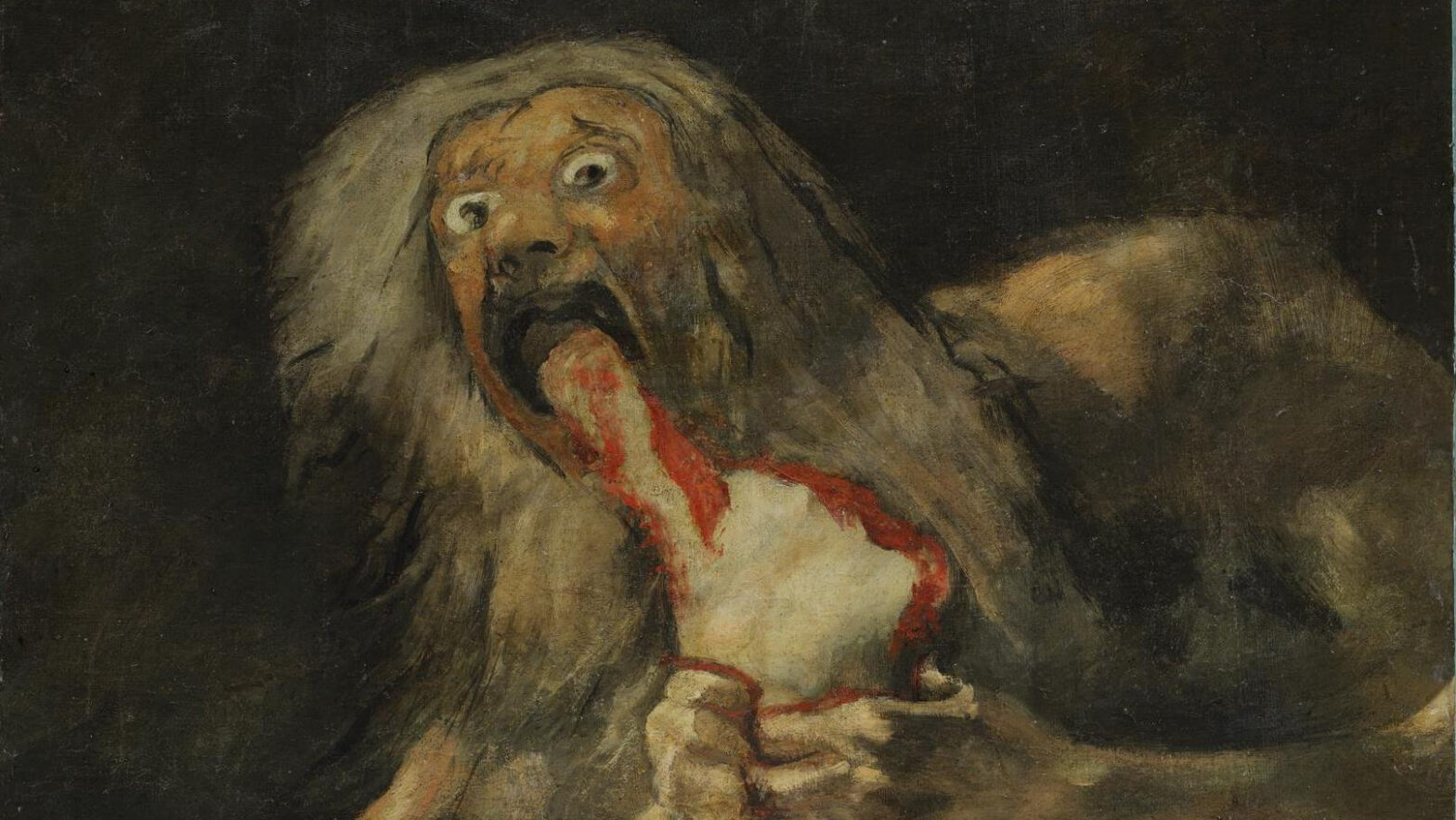
This essay by Alnoor Ladha and Martin Kirk was originally published in the magazine Cosmosjournal (spring-summer 2016) under the title "Seeing Wetiko: On Capitalism, Mind Viruses, and Antidotes for a World in Transition". A shorter, modified version of this text was published by the authors on the website Culture Hacks Labs (April 11, 2022) under the title "Seeing Wetiko". Alnoor Ladha is a writer, activist, and co-founder of The Rules, a global collective of writers, thinkers, programmers, farmers, artists, and activists of all kinds, focused on addressing the root causes of inequality and poverty. He is also the Chair of the Board of Directors Culture Hack LabsMartin Kirk is the director of The Rules and co-author of the book Finding Frames: New Ways to Engage the UK Public in Global Poverty. Translation of the essay: Jiří Zemánek.
Co kdybychom vám řekli, že je lidstvo na pokraji vyhynutí kvůli nemoci? Že veškerá chudoba, klimatická katastrofa, neustálé války a konzumní fetišismus, které všude kolem sebe vidíme, mají kořeny v masové psychologické infekci? Co kdybychom pokračovali a řekli, že tato infekce je nejen vysoce nakažlivá, ale že se také podle zákonů kulturní evoluce sama replikuje a že zůstává v naší psychice tak skrytá, že většina hostitelů v důsledku svého infikovaného stavu vehementně popírá, že jsou nakaženi? Co kdybychom vám pak řekli, že tento „virus mysli“ lze popsat jako formu kanibalismu? Ano, kanibalismu. Ne nutně v doslovném smyslu pojídání masa, ale spíše ve smyslu konzumace lidských i nelidských druhých jako prostředku k zajištění osobního bohatství a osobní nadvlády.
You may dismiss this line of thinking as New Age gibberish or, worse, as a left-wing conspiracy theory. However, this approach, which sees thought transmission as a key determinant of emerging reality, is increasingly being validated by a variety of scientific disciplines, including evolutionary theory, quantum physics, cognitive linguistics, and epigenetics.
The history of this infection is long, strange, and dark. But it leads to hope.
Viruses of the mind
The new world did not fall by the sword, but by the meme.
–Daniel Quinn2
One of the most recognized scientific theories that helps explain the power of ideas to spread is memetics.
Memes are to culture what genes are to biology: the basic unit of evolution. The term was first used by evolutionary biologist Richard Dawkins in his 1976 book The Selfish Gene. Dawkins writes in it: “I think a new kind of replicator has recently emerged. It is still clumsily moving in its primeval soup, but it is already making evolutionary changes at a rate that leaves the old genes far behind.” He continues: “Examples of memes are melodies, ideas, slogans, fashions of clothing, ways of making pots or building arches. Just as genes spread in the gene pool by jumping from body to body via sperm or eggs, so memes spread in the memory pool by jumping from brain to brain via a process that can be broadly called imitation.”3
One of the high priests of rationalism, the scientific method, and atheism is therefore also the father of the concept of “memes.” However, like all memes or ideas, these memes cannot have an owner in the traditional sense of the word, only the interconnection that, as quantum physics reminds us, characterizes our interactions with each other.4
Of course, similar ideas about how ideas move and spread among us have existed in the Western tradition for centuries. It was Plato who first fully articulated them in his Theory of Forms, which claims that immaterial forms—i.e., ideas—represent the ultimate reality from which material reality is derived.
Modern expressions of the theory of forms can be found in Pierre Teilhard de Chardin's idea of the noosphere (the sphere of human thought) and in Carl Jung's collective unconscious, where unconscious structures are shared among beings of the same species. For Jung, the image of the marauding cannibal was first an archetype that manifests itself in the material world through the actions of those who concentrate or embody it.
For those who prefer an empirical approach to science, the growing field of epigenetics offers some intellectual support. Epigenetics studies changes in organisms that are caused by modifications in gene expression. 1/, not by a physical change in the gene itself. In other words, how traits differ from generation to generation is not simply a matter of material biology, but is partly determined by environmental and contextual factors that influenced our ancestors and which are then activated in our own genetic sequence through events in our lives.5
Virus Wetiko
We did not consider the great open plains, the beautiful rolling hills, and the winding streams with their thick vegetation as "wild." Only to the white man was nature "wild," and only to him was the land overrun with "wild" animals and "wild" people. To us the land was gentle. It was bountiful, and we were surrounded by the blessings of the Great Mystery. It was not until the hairy men came from the east and with brutal fury inflicted injustice on us and our beloved families that it was "wild" to us. – Luther Standing Bear, Land of the Spotted Eagle6
Many spiritual traditions, including Buddhism, Sufism (a mystical branch of Islam), Taoism, Gnosticism, as well as many indigenous cultures, have long understood the mind as the basis of creation. At their core, these worldviews recognize the power of thought forms to determine the course of physical events.
Various traditions of North American indigenous peoples have specific and long-established legends regarding cannibalism and the term wetiko for the thought form that causes it. I believe that understanding this idea offers an effective way to understand the deepest roots of the current global polycrisis.
Wetiko is an Algonquin word for a cannibalistic spirit that is driven by greed, excess, and selfish consumption (in the Ojibwe language it is called windigo, in the Powhatan language it is called wintiko). It deceives its hosts by convincing them that cannibalism, i.e. sucking the life force of others (others in the broader sense, including animals and other forms of life on Earth), is a logical and morally correct way to live.
Wetiko it short-circuits the individual's ability to see himself as an interconnected and interdependent part of a balanced environment and elevates the selfish ego to the highest value. It is this false separation of self from nature that makes it cannibalism rather than simple murder. It allows—indeed, commands—the infected entity to consume far more than it needs in a blind, murderous ecstasy of self-centeredness. The writer Paul Levy, in an attempt to find language that Western audiences can understand, describes this phenomenon as "malignant egophrenia"—an ego freed from reason and restraint, acting according to the malignant logic of the cancer cell. We will use the term wetiko, because it is an indigenous term that reminds us of the wisdom of indigenous cultures for those who have ears to hear.
Wetiko can describe both an infection and an infected body; a person can be infected wetiko or, in the case of a very advanced infection, he may personify the disease himself, i.e. be "wetiko". This also applies to cultures and systems; all can be described as wetikoif they regularly exhibit these characteristics.
In his now classic book Columbus and Other Cannibals (Columbus and Other Cannibals) describes how American Indian researcher and historian Jack D. Forbes described how there was a widespread belief among many Native communities that European colonialists were so chronically and uniformly infected with wetikothat it must have been a characteristic of the culture from which they came. In examining the history of these cultures, Forbes laments: “It is tragic that the history of the world for the past 2,000 years is largely a story of the epidemiology of disease.” wetiko".7
We can probably all agree that the behavior of the European colonizers of North America could be described as cannibalistic. Their desire to conquer and accumulate material goods was a violent act of consumerism. The engine of the invasive culture sucked the lives and resources of millions of people and other animals, converting them into wealth and power for itself. The numbers are still disputed, but the number of people killed in the “founding of the New World” can safely be estimated in the tens of millions. It was undoubtedly one of the most brutal genocides in history. And the impact on non-human life was equally extensive. These heinous acts were committed with a moral certainty that rationalized destruction in the name of “progress” and “civilization.”
This conceptualization obscures the extent of the wetiko's infection in the invader culture. They were so blinded by self-centered ambition that they failed to see other lives as as important as their own. Unable to overcome ideological prejudices, they failed to see the intrinsic value of life or the interconnectedness of all things, even though this was the dominant perspective of the indigenous people they encountered. It seems that their ability to see and know things differently from how they saw them had been taken away from them.
This is not some anti-European tirade. This is a description of a disease whose vector was determined by deep historical patterns, including those that empowered Europeans in their quest for “global exploration” when certain appropriate technologies emerged.
Meme wetiko It has almost certainly existed in individuals since the beginning of humanity. It is, after all, a disease that is born and lives from the human psyche. Origin wetiko cultures however, it is more easily identifiable.
Memes can spread at the speed of thought, but it takes generations to change the fundamental characteristics of a culture. We can say that traces of beliefs like wetiko can be traced back at least to the Neolithic Revolution, when people in the Fertile Crescent first learned to control their environment through what writer Daniel Quinn has called “totalitarian agriculture.” That is, through established agricultural practices that produce more food than is strictly necessary for the population and that consider the destruction of any living thing that hinders this overproduction—whether other people, “pests,” or the natural environment—legitimate and moral.
With the advent of Christianity, this early form of logic gained wetiko an amplifying force of indescribable magnitude. “Let man have dominion over the fish of the sea and over the birds of the air and over the cattle and over all the wild animals and over every creeping thing that creeps on the earth,” said none other than God in Genesis 1:26. After 8,000 years of totalitarian agriculture that had slowly spread throughout the region, it is not surprising that this logic also appears in the sacred texts that were created there. Within two hundred years after the death of Christ, this logic had spread throughout Europe under the threat of the Roman sword. It is no coincidence that in order for Christianity to become the dominant religion, the existing pagan belief system, which understood man’s place within nature rather than above it, had to be almost completely destroyed.8
Epidemiology wetiko has left clear traces of its origins. While this phenomenon cannot be pathologized according to geographical or racial criteria, the cultural tensions we know today undoubtedly have many of their deepest roots in Europe. After all, it was European projects – from the Enlightenment to the Industrial Revolution to colonialism, imperialism and slavery – that developed the technology that opened up the channels that facilitated the spread of culture. wetiko all over the world. In this way we are all heirs and followers wetiko.
We are all bearers today wetiko.
Wetiko Capitalism: Uncovering the Context
I don't know who discovered water, but I know it wasn't a fish.
– attributed to Marshall McCluhan
When Western anthropologists first began wetiko study, they believed that it was merely an individual disease and a literal form of cannibalism.9 In both cases, as already mentioned, their understanding was, if not entirely wrong, then certainly limited. Nevertheless, they accurately isolated two features that are relevant to thinking about culture: (1) the initial act, even if motivated by necessity, evokes an unnatural residual desire for next cannibalism; and (2) the host carrier, whom they called the victim, ended up with an “ice heart” – that is, his capacity for empathy and compassion was taken away.
The reader can probably sense from these two features wetiko the nature of modern capitalism. Its insatiable desire for limited resources; its indifference to the pain and suffering of the groups and cultures it absorbs; its belief in consumption as a savior; its overriding obsession with its own material growth; and its viral spread across the face of the planet. It is entirely accurate to describe neoliberal capitalism as the primary cannibalizing force of life on this planet. This is not entirely true—capitalism has also facilitated the explosion of human life and human ingenuity—but when viewed as a whole, capitalism is certainly consuming the life force of this planet in the service of its own growth.
Capitalism is, of course, a human creation, and therefore we can also say that we are phenomenal hosts of a mind virus called wetikoTo understand what makes us who we are, it is useful to consider several features that influence the development of human cultures.
We have decades of evidence from the social sciences that describes how highly contextual beings we are. Almost every aspect of our behavior, including our moral judgments and boundaries, is significantly shaped in response to the cultural cues that surround us. Studies on the Good Samaritan, for example, show that even though people are pre-wired to be altruistic, if they are in a hurry or when the context changes, they will pass by people in need without noticing.10 And Stanley Milgram's infamous experiments show how the vast majority of people are capable of shocking another person to the point of causing death, simply because an authority figure in a white coat orders them to do so.11 We are truly a product of our environment, and therefore it is inevitable that those who live in a culture wetiko, will to one degree or another manifest wetiko conviction and wetiko behavior.
In a broader context, we must also consider the self-driving nature of complex systems. Any living network that reaches sufficient complexity will begin to organize itself and from that point on will exhibit a survival instinct. In practice, this means that it will allocate its resources to support the behavior that best mimics its own logic and ensures its survival.12
In other words, any system that is sufficiently infected with logic wetiko, will reward cannibalistic behavior. Or, as Jack Forbes aptly put it: “Those who [in the system] wetiko] they climb up, they are or they become wetiko and only maintain a system of corruption or oppression. So the communist leaders in the Soviet Union under Stalin were at least as cruel, cunning, and exploitative as their Tsarist predecessors. They gained "power" without changing their culture wetiko.13
This ensures that the basic logic of cultures is transmitted across and between generations. And it explains why power elites themselves organize resources to maintain a high degree of continuity in the distribution of power, as long as this distribution effectively serves their survival and growth. When this continuity is interrupted or disrupted, revolutions occur and the system is threatened.
But as the quote above suggests, the disruption must occur at the right level. Simply replacing one wetika to another on top otherwise unchanged wetiko infrastructure is essentially unnecessary. At best, it can lead to softening the harshest edges of the machine wetiko...at worst, it will do nothing but distract us from seeing the real infection.
The question that arises for anyone interested in eliminating infection from culture is wetiko, is: where in the host's body is this infection located? In one respect, it is wetiko non-local because it is a psychological phenomenon that exists in all of us potentially there is. But while it is important to understand this, it is not the whole truth. It is also true that there is a conceptual place where the most powerful logic is found. wetiko, and that makes it vulnerable, at least theoretically.
In the same way that a bee colony instinctively hides its queen in the deepest chambers of a hive, so too a complex adaptive system hides its most important operational logic as far away as possible from forces that might threaten it. This means two things: first, it means embedding the logic in the deep rules that govern the whole. And not just this or that national economy, not just this or that government, but the parent system—the global operating system. And second, it means that these rules must be perceived as as immutable and inevitable as possible.
So what is this deep logic of the global operating system?
It consists of two parts. The first part is the ultimate goal, which we could call the Prime Directive, which simply consists of capital increase, as the term capitalism itself suggests.
We often dress it up in a narrative that says capital creation is not an end but a means, an engine of progress. This makes the idea of dismantling capitalism seem dangerous and even counterintuitive. But the truth is that we have created a system that artificially holds money sacred. At this point in the history of capitalism, life is controlled by capital more than it is controlled by the forces of capital. If you need further proof, just look at how we define and measure progress: GDP. More on that below.
Then there is the logic of how we, the living parts of this system, should behave, which could be summarized by the following statement:
Selfishness is rational and rationality is everything; therefore selfishness is everything.14
This means that if we all prioritize ourselves and maximize our material wealth, invisible hand (oh, what a tempting meme!) will create a state of equilibrium and life everywhere will be better. We are pitted against each other in the form of of diffuse fascism, when we lock ourselves into cocoons of the immediate problems of our own situation and consume whatever we can. We then wrap this behavior in innocent phrases about family matters, national interests, job creation, GDP growth, and other noble goals.
Put these two pieces of the puzzle together, and it is easy to see why the banker who generates excess capital receives huge rewards and is labeled as productive and successful, almost regardless of the harm he causes. Meanwhile, those who are less successful in producing excess capital are rewarded much less, no matter how vitally important good they may be doing. Nurses, mothers, teachers, journalists, activists, scientists—all receive much less reward because they are less effective in following the Prime Directive and may even defy the principle of self-interest (selfishness). And those who are truly poor are effortlessly labeled not only as practical but also as moral losers.
This capital expansion infection is so advanced precisely because the system requires exponential capital growth. The World Bank tells us that to avoid recession, the global economy must grow at least 3 percent per year.15 Let's think about what that means. In 2014 (the last year for which complete data is available), global GDP was approximately $78 trillion.16 In 2015, we increased this pie by 2.4 %, leading to the commodification and subsequent consumption of an additional approximately $2 trillion in human labor and natural resources. That’s roughly the size of the entire global economy in 1970. It took us from the dawn of civilization until 1970 to reach a global GDP of $2 trillion, and we need that amount today to keep the whole house of cards from collapsing. To achieve this year-on-year growth rate, we are destroying our planet, causing mass extinctions of species, and displacing millions of our brothers and sisters around the world, whom we commonly refer to as “poor people.”
So when people tell us that the market knows best, that technology will save us, or that philanthropic capitalism will redistribute opportunity (according to Bill Gates), we need to realize that all of these seemingly self-evident truths are embedded in a broader operating system, in wet economy. And the more they are presented as immutable, the more we are told that “there is no alternative,” the more we should question them. It is actually a beautiful irony that when we know what we are facing, such statements are our pointers to where to turn to achieve change.
It's not that we're against markets, technology, or philanthropy—all of these things can be wonderful in the right context—but we are against how they are used as an alibi to justify the madness of the paradigm. wetikofrom which they are inseparable. We are reminded of this by the harsh words of Jack Forbes: "It is not logical to allow to the wetiks, to commit their evil deeds and then accept their assessment of the nature of human life. After all, wetiks they have tendencies, created by their own evil lives, their own immoral or sinful behavior. And moreover, if I am not mistaken, they were and are also crazy.” 17
See Wetiko: The Logic of the Antidote
Feel free to launch your meme and see if it spreads – just as genes spread and infect and permeate the organism of society. And since I believe that society operates on the principle of a kind of biological economy, I believe that these memes are the key to the evolution of society. But unless memes are freed to play their game, no progress will be made.
– Terence McKenna, Memes, Drugs and Community18
Maybe you'll become a black Bill Gates.
– Beyoncé, Formation19
A key lesson of meme theory is that when we are aware of memetic viruses, we are less likely to blindly follow them. Conscious awareness is like sunlight shining through cracks in a tinted window.
One of the starting points for healing is therefore the simple act of recognition. wetiko in ourselves, in others, and in our cultural infrastructure. And once wetiko we see, we can name it, which is crucial, because words and language are the central battleground. To quote McKenna again: “The world is not made of quarks, electromagnetic waves, or the thoughts of God. The world is made of language. Earth is the place where language literally came to life. Language has invested itself in matter; it replicates itself, defines itself, and builds itself. And it is in us.” 20
McKenna's last sentence is key to examining our own role in reproduction. wetiko. We are all involved in an unfolding reality that happens to us and through us. Instead of traditional certainties and the linear logic of cause and effect, we can transform ourselves “into spontaneously responding, mobile, embodied living beings—within a reality of ever-intertwining, flowing lines or threads of ever-developing, active activity, in which nothing (no thing) exists apart from anything else, within a reality in which we are immersed both as participants and as those to whom we owe significant aspects of our own nature.”21
If wetiko It exists because it exists within us. It is also intertwined with the broader superstructure, with the relationships and architecture of choices that we confront in a neoliberal system on the verge of collapse.
Forbes reminds us that against wetiko cannot be fought in any traditional sense: "One of the tragic characteristics of psychosis is wetiko is that It spreads partly because of the resistance that is being built up against it. This means that those who try to fight against wetiko, sometimes take values wetikoto survive. So if they win, they lose.22 Reform initiatives, from the sharing economy to microcredit, have thus succumbed to the co-optation and retaliation of capitalism. wetiko.
But once we start wetiko see, we can hack the cultural systems that maintain its logic. It's not hard to figure out where to start. Following the money usually leads us to the basic pillars of the mechanism wetikoThose of us who are part of these structures, from corporate media to philanthropy and banking to the United Nations, have access to the heart of the monster. wetikoIt's up to you what you do with this privilege.
We, who stand outside, can organize our lives in radically new ways to undermine the structures wetiko. For example, the simple act of giving undermines the neoliberal logic of commodification and exploitation. The use of alternative currencies undermines the debt-based monetary system. Deschooling and alternative educational models can help decolonize and de-wetikoize mind. Helping to create alternative communities outside the capitalist system supports the infrastructure for transformation. And direct activism, like debt resistance, can weaken the virus wetikoif it is performed with the right intention and in the right state of consciousness.
By establishing new relationships with others, with nature, and with ourselves, we can create a new complex of connections and thought forms that are connected to post-wetiko and post-capitalist values.
We must reach within ourselves and into the depths of our own psyches, while at the same time changing the structure of the system around us. A structurally oriented perspective and an uncompromising critique of modern capitalism – i.e. a configurational worldview that sees all forms of oppression as interconnected – helps us see and live alternatives.
Plato believed that thoughts are the “eyes of the soul.” Now that the veils covering wetiko, let us give birth to and become living antigens, let us embrace a polyculture of ideas that challenge monoculture capitalism wetiko. Let us become pollinators of new memetic hives built on altruism, empathy, interconnectedness, respect, community, and solidarity that defy the duality of subject and object of Cartesian-Newtonian Enlightenment logic. Let us reclaim our natural right as sovereign beings, freed from the delusions of market systems, the invisible hand, righteous greed, the chosen, branded accessories, techno-utopianism, and even New Age self-salvation.
We dance with thought forms through a deeper understanding of ethics, knowledge, and being,23 and with a profound awareness that our individual minds and bodies are part of a collective battleground for the soul of humanity and indeed for life on this planet. And let us re-embrace the ancient future of our indigenous ancestors, which represents the only unbroken lineage of life in symbiosis with Mother Nature. Dissolution wetiko it will be as much about remembering as it is about creating.
Comment:
- These are the lyrics to the song "The Priests of the Golden Bull" by Canadian singer-songwriter Buffy Sainte-Marie from her 1992 album titled Coincidence and Likely Stories.
- Quinn, D. Beyond civilization: Humanity's next great adventure. Broadway Books (2008), p.50.
- Dawkins, R. The selfish gene. Oxford University Press (1990).
- "Intraaction" is a neologism coined by Karan Barad and described in her book Meeting the Universe Halfway (2007). Baradová writes about intraaction rather than interaction to illustrate how entanglement precedes thingness. In other words, there are no things as such, only relationships – and this constant dynamic of relationships is co-responsible for how things come into being.
- For example, recent research has shown that grandchildren of Holocaust survivors have different stress hormone profiles than grandchildren of people living in similar circumstances but whose grandparents did not experience the Holocaust. Rodriguez, T. “Descendants of Holocaust Survivors Have Altered Stress Hormones,” Scientific American (March 2015), available at: http://www.scientificamerican.com/article/descendants-of-holocaust-survivors-have-altered-stress-hormones/
- Luther Standing Bear. Land of the spotted eagle. Bison Books (2006).
- Forbes, Jack D. Columbus and other cannibals: The wetiko disease of exploitation, imperialism and terrorism. Seven Stories Press (2008), p46.
- See Not in His Image (2006) by John Lamb Lash, for a detailed account of the systematic destruction of paganism by the new Christian religion.
- Cooper, JM “The Cree Witiko Psychosis” in Primitive Man, Vol. 6, No. 1 (Jan., 1933), pp. 20-24: The George Washington University Institute for Ethnographic Research.
- Darley, JM, and Batson, CD “From Jerusalem to Jericho: A study of situational and dispositional variables in Helping Behavior.” In: Journal of Personality and Social Psychology (1973), Vol. 27, Number 1, pp. 100-108.
- See https://en.wikipedia.org/wiki/Milgram_experiment.
- Capra F, Luisi P, A systems view of life: A unifying vision. Cambridge (2014), Chapter 8.
- Forbes, Jack D. Columbus and other cannibals: The wetiko disease of exploitation, imperialism and terrorism. Seven Stories Press (2008), p.46.
- A version of this argument was originally published on Occupy.com by the authors in a two-part essay titled “Capitalism is Just a Story and Other Dangerous Thoughts.” More at: http://www.occupy.com/article/capitalism-just-story-and-other-dangerous-thoughts-part-i#sthash.INKCFdNs.dpuf.
- See, for example, this World Bank forecast: http://www.worldbank.org/content/dam/Worldbank/GEP/GEP2016a/Global-Economic-Prospects-January-2016-Global-Outlook.pdf
- See http://databank.worldbank.org/data/download/GDP.pdf
- Forbes, Jack D. Columbus and other cannibals: The wetiko disease of exploitation, imperialism and terrorism. Seven Stories Press (2008), p37.
- https://www.youtube.com/watch?v=NO6-1sqQme0.
- This lyric is from Beyoncé's song "Formation", which was originally performed at the 2015 Super Bowl. For a critical analysis, see Diancy London's article "Beyoncé's capitalism, masquerading as radical change".
- McKenna, Terrence. The archaic revival: Speculations on psychedelic mushrooms, the Amazon, virtual reality, UFOs, evolution, shamanism, the rebirth of the goddess, and the end of history.HarperCollins (1992).
- John Shotter, “Agential realism, social constructionism, and our living relations to our surroundings: Sensing similarities rather than seeing patterns'' Theory and Psychology, 2014.
- Forbes, Jack D. Columbus and other cannibals: The wetiko disease of exploitation, imperialism and terrorism. Seven Stories Press (2008), p.61.
- Karan Baradová hovoří o souhře etiky, poznání a bytí jako o „onto-eticko-politické epistemologii“. Ontologie se týká toho, co je ve světě. Epistemologie se zabývá tím, jak poznáváme, co ve světě je. A etika je o tom, jak bychom se měli ve světě chovat. Tyto jevy tedy nejsou od sebe oddělené, ale materiálně vznikají v neustálé dynamice. Povaha reality a povaha poznání jsou propletené – nejsou neměnné, konečné ani determinované – a nelze je tedy oddělit od moci a od toho, co považujeme za hodnotné nebo spravedlivé.