
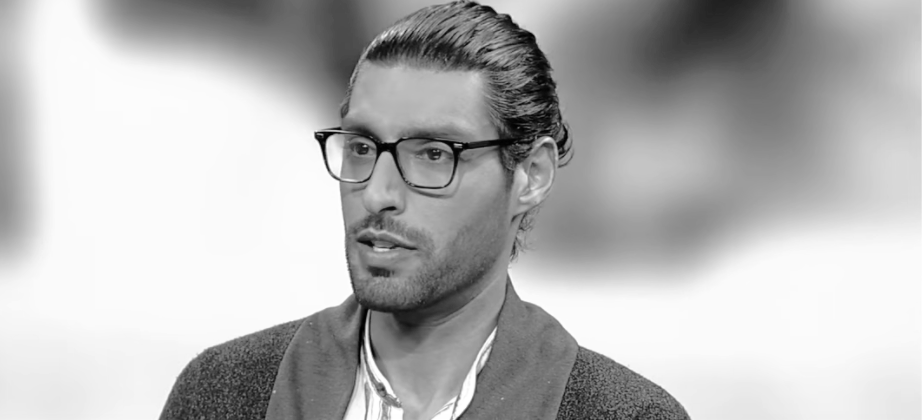
Alnoor LADHA, from a Sufi family, is a writer, activist, and co-founder of The Rules, a global collective focused on addressing the root causes of inequality, poverty, and climate change, and is also the chairman of Culture Hack Labs. His work has been published in Al Jazeera, The Guardian, Truthout, Fast Company, Kosmos Journal, New Internationalist, and Huffington Post, among others. He is the co-author of Post Capitalist Philanthropy: The healing of wealth in the time of collapse (Postcapitalist Philanthropy: Recovering Wealth in a Time of Collapse). In this conversation, provided by The Gaia Foundation, talks about culture, technology, and the cannibalistic economic system that is devouring life on Earth. Translation: Jiří Zemánek.
Tell us a little about yourself and your work at The Rules.
At The Rules, we try to connect the various issues happening in the world and expose their hidden adversary: the economic system itself. We work to bring more radical ideas into the mainstream and become the common way of thinking. We also work directly with social movements to support them. By focusing on both the meta worldview and local struggles, we can better see that we are not just fighting for land rights in India, for tax justice in Kenya, or against an oil pipeline in North Dakota, but that we are fighting against the logic of neoliberal capitalism itself.
How do you think digital technology fits into this logic? Is it more part of the problem or the solution?
The moral question we need to ask ourselves is: what kind of relationship do we want to have with technology – as individuals, as a community, and on a societal level? Do I think technology is out of control and a big part of the problem? Yes, of course. But it is unrealistic to think that we can return to a society without technology. At least not before the collapse.
It’s always a good idea to start with a quote from Terence McKenna: “Culture is not your friend.” Culture is a set of rigid beliefs that are reinforced by our unwillingness to challenge those norms. Will we examine our privilege? Will we try to understand or feel the destruction that is taking place on our planet? This destruction is directly proportional to the advantages that have accrued to countries (and territories before the emergence of nation states) that had a 5,000-year head start on totalitarian agriculture, that had a 1,000-year head start on colonialism, imperialism, slavery, and genocide. We are the heirs to this legacy. As Thomas Pogge points out, how can we reap the fruits of our ancestors’ sins without taking any responsibility for it?
Once we decide that we don’t want to make this deal, we begin to look critically at the culture that has nurtured our ignorance. The moral stance toward technology is not about “how to get rid of technology,” but rather about “how to become less dependent on it and synthesize its best aspects so that we can build the infrastructure for the transition to post-capitalist worlds.”
The Rules use the term “Wetiko virus” as a means of describing the way destructive cultures emerge, operate, and perhaps even develop technologies. Could you describe what the Wetiko virus is?
Wetiko is an ancient term that comes from the traditions of various indigenous peoples in North America. The word Wetiko existed before the term cannibalism. When a famine broke out among tribes or a member of a tribe found himself alone in the wilderness and ended up eating the flesh of another person, the result was the Wetiko disease. Wetiko had two main consequences: one was an unnatural desire to eat more and more flesh, even when there was plenty of food, and the other was a frozen heart and lack of empathy. The first time you taste your brother's flesh, something changes in you. The thought virus of capitalism is the logical result and heir of Wetiko.
From hunters and gatherers who trusted in the bounty of Mother Earth, we have become sedentary exploiters of the land, seeing it as a resource rather than the source of all life. At this point, we become the ungrateful cannibalistic children of Gaia.
Technology is an aspect of culture that was born from the Wetiko virus. Technology is a subordinate part of the economic system. And the operating system is dependent on its prime directive – growth. Economists and politicians tell us that the global economy must grow by 3 % every year to stay afloat. At this rate, the global economy will double every twenty years, which is of course incomprehensible. And yet the system forces us to believe that there is no other option. We are paralyzed. Our economic system is a form of diffuse fascism in which we have all become carriers of Wetiko.
How can we get rid of this destructive virus?
The first step is to stop identifying with your host culture. Patriotism, nationalism, and all forms of rigid ideology play a brutal role in our indoctrination and in our complicity in the current system. One possible antidote we can use against this is to begin to realize the real history of humanity, Western culture, and technology. The great advances we have made have not occurred independently of great plunder, destruction, wars, violence, and rape. We must begin to ask ourselves fundamental questions, such as: What is the role of technology in the service of its master, capital? What is the logic of the market economy? The answer is all around us. The logic of capitalism is short-term, greedy, exploitative, and life-destroying.
The second step is to start seeing technology as a product of culture. If we see technology as a byproduct of culture and capitalism, we can change the way we interact with technology.
We might start to wonder who actually decides what technology is developed and what research priorities are. As David Graeber reminds us, we thought we would have flying cars today, but in reality the pinnacle of technological progress was brought to us by 140 characters on Twitter. Who decided that our collective resources, our gifts and skills would be directed in this way?
The third step is to examine the collateral effects of technology. When we created the automobile, we did not realize that it would also create the modern city, the system of motorized highways, houses with two garages, our addiction to fossil fuels, wars in the Middle East, and in a sense, the hippie revolution. Similarly, we have no idea what the impacts of artificial intelligence or virtual reality will be in five, ten, or twenty years. Part of this examination is to ask ourselves, as a generation and as a civilization, a very important self-reflective question: Given our relationship to technology, what kind of ancestors do we want to be? And, even more importantly, what kind of ancestors are we already becoming?
Digital technologies are proven to amplify existing inequalities in access to power that come from “connectivity.” Is there a simple solution to this inequality, or do we need to address the system as a whole?
That's a difficult question. 70% of the world's population lives in the Southern Hemisphere today, and half of those people are under the age of 30. We have the youngest and southernmost population in human history, so in a sense the revolution can and will have to come from the global South.
People benefit in the short term from access to knowledge provided by the internet, mobile phones or tools like Wikipedia. However, in some ways we need to understand that this culture best serves those who created it. The desire to assimilate most of the world into cybernetic beings can be seen as a consequence of the idea of financial inclusion, which seeks to transform free people into consumer capitalists and ultimately imprison us all in a debt-ridden neoliberal economy. At the same time, we should use the tools of our masters and all the means necessary to free ourselves from capitalism and create new infrastructures and new stories.
Grounding, or walking barefoot, is one way to physically reconnect with the Earth. What is the significance of these practices?
Reconnection has a physical aspect, but my approach is based on the idea that we need to free ourselves from the influence of modern culture in a more holistic way. Anything one can do to shake the norms and socialization of the dominant culture is essential and necessary. Whether it is walking barefoot in nature, giving something to a stranger, dissolving boundaries with psychedelics or other shamanic initiations – we must do everything in our power to free ourselves from the bonds of identification with the deadly machinery of modernity.
In conclusion, I would like to say that we should not underestimate the forces we are up against. WH Auden writes in his book The Age of Anxiety:
"We would rather be destroyed than transformed"
We would rather die in fear
Before we climb the cross of this time
And they let their illusions die.”
That is the motto of the power elites, that is, 1 % of the population. They would rather destroy the entire planet than let their illusions die. We must maintain, refine, amplify, and cultivate a sophisticated critique of power, culture, and technology, because these are ultimately the product of a psychotic, suicidal establishment that will hoard and consume until our collective destruction. We must return to the primacy of Mother Earth, to the primacy of our bodies, our plant teachers and allies, our communities, our indigenous wisdom, our connection to the web of life, and our forgotten abilities to enter the presence of the eternal now.