

Freya Mathews is an Associate Professor of Environmental Philosophy at La Trobe University, Australia. Mathews’ philosophy is rooted in panpsychism, an approach that sees mentality as fundamental to the natural world. Her current main interests include the development of ecological civilization; indigenous (Australian and Chinese) perspectives on “sustainability” and how these perspectives can be adapted to the context of contemporary global society; the return of humans to the wild…
Tag: Translations
David Abram: Animism and the Alphabet / What a Mystery the Air Is

Two excerpts from the book by American ecophilosopher David Abram The Magic of the Senses / Perception and Language in a More Than Human World (DharmaGaia, Prague 2013): the first excerpt “Animism and the Alphabet” is from the 4th chapter of the same name (pp. 154-155, 163-164); the second excerpt “What a Mystery Air Is” is from the last 7th chapter of Remembering Air (pp. 271-273, pp. 310-313). Translated by Michaela Melechovská and Jiří…
Border Patrol: An Interview with David Abram

This interview by Jeremy Hayward with American ecophilosopher David Abram about his book The Spell of the Sensuous (Pantheon Books, New York 1996; in Czech Kozlo smyslů. DhramaGaia 2013) was originally published under the title “The Boundary Keeper” in the magazine Shambhala Sun (May 1997). It was first printed in Czech in an abridged version in the cultural weekly A2 (19 / 7.5. 2008) and was subsequently published…
David Abram: The Invisible World

This essay by American ecophilosopher David Abram was first published under the title “The Invisibles” as an introductory article in Parabola magazine (volume 31, number 1, Spring 2006). It was published in Czech in the anthology of the author’s texts Procitnutí do živé země (OPS Nymburk 2008, pp. 77-93, Czech translation by Jiří Zemánek and Barbora Svatá). The essay is also part of the author’s book Becoming Animal: An…
Satiš Kumar: The beauty of simplicity

There is no virtue greater than moderation. The sign of the moderate is that they are peaceful as the sky, firm as a mountain, flexible as a tree in the wind. They do not chase after a goal and make the most of everything that life brings them. Lao-tzu Satish Kumar (*1936) is a peace and ecological activist and publicist. At the age of nine, he joined the order of Jain wandering monks and later…
Vandana Shiva: We are the soil
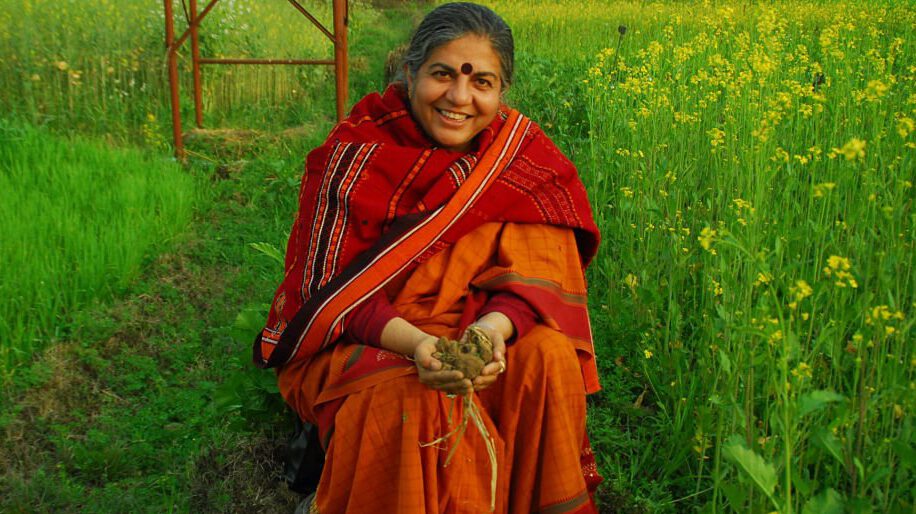
“Land, not oil, is the future of humanity.” Vandana Shiva Vandana Shiva is an Indian philosopher, environmental activist, and one of the most prominent figures in the global justice movement. She is particularly concerned with biodiversity and organic farming. She is the director of the Foundation for Scientific Research, Technology and Natural Resources in Delhi and one of the leaders and board members of the International Forum on Globalization. She is also…
David G. Haskell: Bird Voices and the Language of Belonging

David George Haskell is an American biologist and writer who is currently a professor of biology at The University of South Tennessee. He has published two books so far: The Forest Unseen (2012) and The Songs of Trees (2017). Both were nominated for a number of major literary awards (including the Pulitzer Prize), the latter of which received the John Burroughs Medal (John Burroughs…
Joy Harjo: Drinking Deeply What Cannot Be Drinked Away (poems)

“Imagining the spirit of poetry is like imagining the shape and size of a hunch. It is a kind of awakening light; it is the full-grown spirit of an ancestor who has accompanied me since the beginning, or a bear or a hummingbird. It is a hundred horses galloping across a landscape in a soft mist, or a woman undressing in the glow of a fire before her beloved. It is none of the above. It transcends all imaginable.” Joy Harjo, Crazy Brave…
Thomas Berry: A Great Work

The image of the mythical creature of the three-legged crow appears in the ancient mythologies of East Asia: in China, Japan and Korea. According to Chinese ideas, it is a bird-sun, inhabiting and symbolizing the sun. In Japan, this mythical creature is known as Yatagarus (Yatagarasu), the forest crow, and is understood as a divine messenger, as the intervention of the will and guidance of heaven; it is a sign of rebirth and rejuvenation. In Japanese…
Thomas Berry: Meadow Beyond the Stream

The essay “The Meadow Beyond the Stream” is the third chapter of Thomas Berry’s book The Great Work – Our Way into the Future, the Czech edition of which under the title Velké dílo – naše cesta do budukončiť is currently being prepared by Malvern Publishing House. Translation by Jiří Zemánek and David Sanetrník. “We need to understand the universe primarily as a celebration. … man can be identified as that being,…