

Permafrost contains microbes, mammoths, and twice as much carbon as the Earth's atmosphere. What happens when it starts to melt?
Published under the title “The Great Thaw” in The New Yorker on January 17, 2022 (Czech translation: Jiří Zemánek); https://www.newyorker.com/magazine/2022/01/17/the-great-siberian-thaw / Joshua Yaffa is a contributor to The New Yorker magazine and the author of “Between Two Fires: Truth, Ambition, and Compromise in Putin's Russia.” ("Between Two Fires: Truth, Ambition, and Compromise in Putin's Russia").
As I flew over Yakutia in northeastern Russia, I watched the dark hues of the boreal forest blend with patches of soft, pale-colored grass. I was strapped to a hard metal seat in the cockpit of an Antonov-2, a single-engine biplane known in the Soviet era as a kukuruznik, or corn duster. The plane roared and rose above a horizon of larches and pines and mud-colored lakes. It was impossible to tell through the dusty plane window, but the earth beneath me was breathing, or rather exhaling.
Three million years ago, as continent-sized glaciers retreated from the poles, temperatures in Siberia dropped to minus eighty degrees Celsius and vast areas of land froze underground. As the planet cycled through ice ages and interglacials, much of the frozen ground thawed, only to freeze again, and this process repeated itself several times. About eleven and a half thousand years ago, the last ice age gave way to the current interglacial, and temperatures began to rise. The ground that remained frozen year-round became known as permafrost. Permafrost now covers nine million square kilometers of the Earth’s surface, a quarter of the land area of the Northern Hemisphere. Russia has the largest share of it in the world: two-thirds of its territory lies on permafrost.
In Yakutia, where permafrost is almost a kilometer deep, annual temperatures have risen by more than two degrees Celsius since the Industrial Revolution, twice the global average. With warmer air comes warmer soil. Deforestation and forest fires—both acute problems in Yakutia—are removing the protective top layer of vegetation and further increasing temperatures underground.
For thousands of years, the frozen ground has absorbed everything from tree stumps to woolly mammoths. When the permafrost thaws, microbes awaken and feast on the thawing biomass. It’s a strange organic process, akin to unplugging your freezer and leaving the door open, only to come back a day later to find a chicken breast rotting in the back. In the case of permafrost, this microbial decomposition is constantly releasing carbon dioxide and methane. Scientific models suggest that permafrost contains one and a half trillion tons of carbon, twice as much as is currently in the Earth’s atmosphere.
Sitting next to me in Antonov was Trofim Maximov, a scientist who studies the impact of permafrost on climate change, shouting at the pilot in the cockpit. Maximov rents a plane once a month to measure the concentration of greenhouse gases in the atmosphere over Yakutsk. He described the melting of permafrost as a kind of feedback loop: the release of greenhouse gases causes higher temperatures, which in turn cause more melting of the permafrost. “It’s a natural process,” he told me. “Which means that unlike purely anthropogenic processes”—such as emissions from factories or cars—“once this process starts, you can’t stop it.”
A hose attached to the plane’s wing sucked air into a dozen glass bottles spread across the cabin floor. By comparing data on greenhouse gas levels over time and at different altitudes, Maximov can estimate how permafrost is affected by and contributing to a warmer climate. When he began taking these airborne measurements five years ago, he found that carbon dioxide concentrations in the air over Yakutia were rising twice as fast as historical averages. Methane has a shorter atmospheric lifetime than carbon dioxide, but it is more than twenty-five times more effective at trapping heat. According to Maximov’s data, methane is also being released at a faster rate: it is accumulating fifty percent faster than it did a generation ago.
But for now, I was mostly concerned with the way the plane was lifting as it descended in a sharp spiral. We descended to a few hundred meters above the ground so that Maximov’s colleague, a thirty-three-year-old researcher named Roman Petrov, could take one last sample, a low-altitude carbon image. The plane was shaking like a blown-up go-kart. Petrov clutched his stomach and buried his face in a plastic bag. I did the same. When we finally touched down on the grassy runway, I staggered out of the cockpit, my stomach still rumbling. Maximov poured me a plastic cup of cognac. After a long sip, I found that my spinning head had slowed and the ground beneath me had regained a sense of comforting solidity—although, as I learned, what had seemed like terra firma was more like a big, gooey piece of rotting chicken.
During the 17th and 18th centuries, as the Russian Empire expanded eastward, reports reached the capital of a “solid body of ice” in the ground that, in the words of one explorer, “no one had ever heard of before.” Early settlers in Yakutsk, the capital of Yakutia, sought to grow crops and find sources of fresh groundwater. Merchant Fedor Shergin, who had been sent to Yakutia by the Tsar as a representative of the Russian-American Company, attempted to dig a well in the summer of 1827. Shergin’s team of workers spent the next ten years digging a shaft that reached a depth of three hundred meters, only to find even more frozen ground. Finally, in 1844, Alexander von Middendorff, a prominent scientist and explorer, set out from St. Petersburg for Yakutia and correctly estimated that the ground beneath the shaft was frozen to a depth of at least six hundred feet. His findings shook the Russian Academy of Sciences and eventually reached European salons.

Today, the entrance to Shergin’s Shaft, as it’s called, is located in a log cabin in central Yakutia, wedged between a concrete apartment building and a burned-out former military academy. One afternoon last summer, I visited the site with Yuri Murzin, a scientist at the Melnikov Permafrost Institute in Yakutia. “This is where the study of permafrost began,” he said. “Before Shergin’s Shaft, practically no one outside Yakutia had any idea that such a thing existed.” Murzin and I wanted to look inside the shaft, which required lifting a series of heavy wooden hatches. A column of cold air rushed upward. I looked down, but all I could see was a black wall. The musty aroma of dirt and ice wafted into the cabin. “It smells of antiquity, of ancient times,” Murzin said.
In the 1920s, Soviet scientist Mikhail Sumgin, in his widely read monograph, called the frozen land "all frost", literally “eternal frost,” a neologism that was later translated into English as “permafrost.” Sumgin was a kind of eternal frost romantic, and wrote that “all frost It amazes the human intellect and imagination.” He compared it to the “Russian Sphinx” – an inexplicable, enticing riddle that needs to be solved.
For others, permafrost posed a complicated engineering problem. Soviet ideology contained a strong Promethean impulse, which captured Maxim Gorky’s axiom, paraphrasing Marx, that “by transforming nature, man transforms himself.” The construction of the Transpolar Railway was one of many infrastructure projects that under Stalin had to deal with the peculiarities of the soil, which could sink a few centimeters in summer and rise again in winter. As one scientist put it in the 1930s: “It is necessary to defeat the enemy— I smell the frost. – and not give up.”
The Arctic regions of Alaska and Canada are now home to fewer than two hundred thousand people and have no major cities; the Soviet Union, on the other hand, was once trying to populate its northeastern territories. With the influx of people and subsequent construction projects, a new problem arose: buildings generate their own heat, heating the permafrost and causing it to warp and twist. In 1941, the Yakut headquarters of the NKVD, the Stalin-era secret police, collapsed into the ground, one of its walls collapsing and sending plaster splatter onto a room filled with agents.

Yakutsk is one of only two major cities in the world built on areas of continuous permafrost—where the frozen ground forms a continuous layer below freezing. The other is Norilsk in Russia’s Krasnoyarsk Krai, where Gulag prisoners were sent to build new settlements in the 1930s. Norilsk is home to some of the largest nickel deposits on Earth. To service the mining and metallurgical industries, the city needed factories, apartment buildings, schools, hospitals, and lecture halls. Many of these early structures were short-lived. Valery Grebenets, a professor of engineering at Moscow State University, worked in Norilsk in the 1980s. Some of his colleagues there told stories of engineers who faced serious consequences when their projects collapsed. “When your neighbors start shooting, you start thinking a little more vividly,” Grebenets noted grimly. And he added that with advances in the study of permafrost, "people have begun to understand its properties and come up with new ideas."
One of the craziest proposals came from Soviet scientist Mikhail Gorodsky, who proposed placing an artificial dust ring around the Earth, similar to Saturn's rings, to create a thermal dome over the poles that would raise the temperature so much that the permafrost would disappear completely. In the mid-1950s, engineer Mikhail Kim, who had come to Norilsk as a gulag prisoner, proposed a more practical solution. His idea was to build buildings on concrete piles driven up to forty meters into the permafrost. The piles would raise the foundations of the building, preventing the ground beneath them from heating up while allowing cold air to penetrate deep into the soil. An Arctic construction boom followed.
Soviet engineers began to consider I'm freezing. for eternal, stable, unchanging. “They believed they had conquered the permafrost,” said Dmitry Streletsky, a professor at George Washington University. “You could build a five- to nine-story building on piles and nothing would happen. Everyone was happy. … this infrastructure was supposed to last thirty to fifty years. No one could have imagined that the climate would change so dramatically during that period.”
In 2016, a regional official said that 60 percent of buildings in Norilsk were at risk from melting permafrost. On May 29, 2020, a fuel storage tank belonging to Norilsk Nickel, one of Russia’s largest mining companies, burst, spilling 21,000 tons of diesel into nearby waterways, turning the Ambarnaya River a metallic red. The company’s management said the damage had been contained. However, Georgy Kavanosyan, a Moscow-based hydrogeologist with a popular YouTube channel, traveled to Norilsk and took samples from a location further north, the Pyashina River, which flows into the Kara Sea. He found that the concentration of pollutants was two and a half times higher than the permissible level, threatening fish populations and ecosystems for thousands of kilometers.

The Kremlin could not ignore the scale of the disaster, which Greenpeace compared to the Exxon Valdez oil spill. In February 2021, the state ordered Norilsk Nickel to pay a $2 billion fine, the largest environmental fine in Russian history. The company said the piles supporting the tank failed when the permafrost thawed. An external scientific review found that the piles were installed incorrectly and that the ground temperature was not regularly monitored. In other words, human negligence has exacerbated the effects of climate change. “What happened in Norilsk was a kind of demonstration of how serious the problem can be,” said Vladimir Romanovsky, a professor of geophysics at the University of Alaska Fairbanks. “But this is far from the only case. Many other accidents are happening on a smaller scale and will continue to happen.”
To get a sense of how melting permafrost is changing the landscape, I drove out of Yakutia with Nikolai Basharin, a 32-year-old researcher at the Permafrost Institute. Our destination was the village of Usun-Kyuyol, 50 miles away, where Basharin grew up. His family, like many others in Yakutia, had a cellar dug into the permafrost, where they stored meat, jam, and lake ice that they melted to make drinking water. “You live on it all these years, but you never really understand it,” Basharin told me, explaining his decision to study permafrost science. At dawn, we set off on the first ferry across the Lena River; the ever-changing effects of permafrost on soil structure had so far proven impractical for building a bridge.
The area on the right bank of the Lena, a valley covering an area of about twenty thousand square kilometers, is known for its extensive deposits of poisons.1/, a type of permafrost that is particularly rich in ice. While some permafrost is made up almost entirely of frozen soil, some are as much as eighty percent ice, forming solid, invisible wedges that can extend several stories underground. This is problematic for several reasons. Water is an effective conductor of heat, absorbing atmospheric heat and warming the subsurface permafrost. As permafrost thaws, it can create depressions in the ground that fill with water, a process known as thermokarst.
Jedoma is also a very absorbent carbon trap, storing organic matter in mud and sediment that has been frozen underground for tens of thousands of years. When this type of permafrost thaws, it can release ten times more greenhouse gases than other, sandier types of permafrost. Jedoma occurs in parts of Alaska and Canada, but is most widespread in northeastern Siberia; in Yakutia, it covers a tenth of the area.

Basharin and I drove past pools of melting ice. Some areas were the size of small ponds, others were actual lakes. We stopped at the edge of a large alas—a thermokarst lake that had dried up and become a hollowed-out crater. This alas had probably been formed over five thousand years. Basharin told me that fragments of 150-year-old birch trees had recently been found at the bottom of a smaller alas nearby, suggesting that a process that once took thousands of years had now taken place in a little over a hundred years. “Geologically, it’s no more than a millisecond,” he said.
We drove to Usun-Kyuyol, where Basharin had lived until he was twelve. Cows grazed in front of wooden houses, whose chimneys belched dark plumes of smoke. One stretch of the road was dotted with oval mounds several meters high. The slices had thawed slowly, leaving steep pits where the tops of the ice wedges had once been. It had begun, Basharin said, about twenty years ago, after a silkworm infestation in a nearby birch forest. The trees had died and the permafrost had become vulnerable to sunlight and rising temperatures. “At first people were happy—the next year was good for berries,” he said; but as the permafrost thawed, the road became so bumpy that it was impossible to drive on it, and the mule-shaped ski slope turned horizontal. A row of houses cracked as the ground caved in beneath them. Several of them now stood abandoned.
We stopped at the house of Basharin’s aunt and uncle, who invited us for lunch. “We watch TV, we hear about warming,” Basharin’s uncle, Prokhor Makarov, told me. “But we live in the village. Our main problem is to make sure we have enough hay for the winter.” Their house was not in immediate danger of collapsing, but the ground around it was bumpy and dotted with small depressions. The fence around their property looked like a sweating man in a bar who had had too much to drink. Makarov told me that in the summer he rakes the dirt around it to make everything even again. “We’re used to it,” he said.
After we left, Basharin told me, “People don’t understand how this story will end.” “Let them try to adapt as they want,” he continued, “the thaw will catch up with them anyway.”
Three days later, I flew by propeller plane from Yakutsk to Chersky, a small town on the Kolyma River near its delta, where the Kolyma flows into the East Siberian Sea. In the 1930s, Chersky was a transit hub for Gulag camps, later serving as a base for planes ferrying Soviet explorers on Arctic expeditions. These days, at the end of summer, its residents, who spent their holidays on the “mainland,” as Russia is called, are returning for the start of the new school year, bringing with them things that are rare and expensive in the northernmost reaches of Siberia. The plane was packed not only with people but also with trays of eggs, bouquets of flowers, and boxes of newly purchased televisions and blenders.
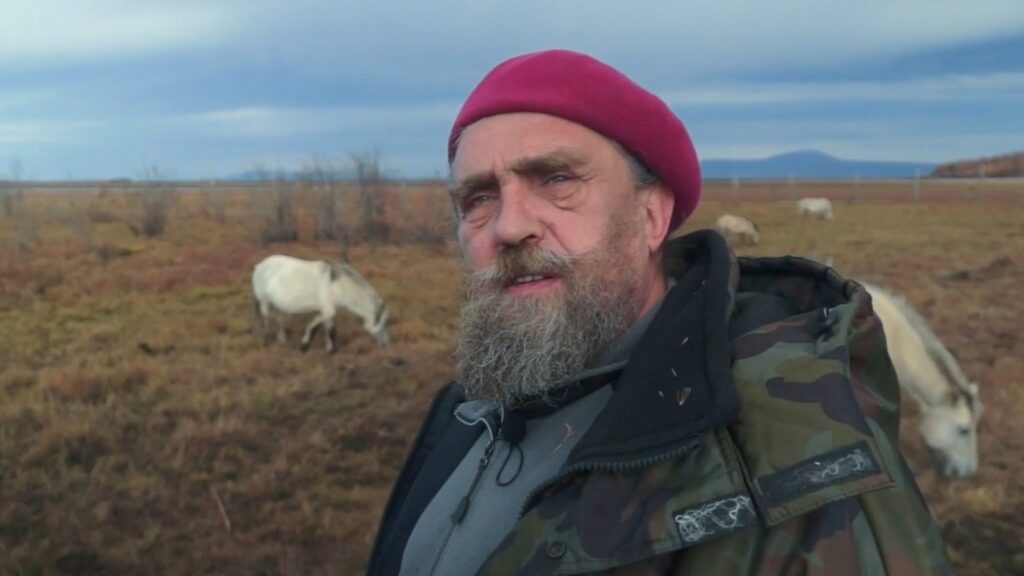
Upon arrival, I stepped out of the airport in Chersky, which is not much bigger than a small waiting room, and saw a Land Rover parked on the dirt road. Behind the wheel sat a man with a flowing silver beard and a black beret. I recognized him immediately as Sergei Zimov, who is something of a permafrost seer. “Get in,” he said.
We set off for the Northeastern Scientific Station, a research center on the outskirts of the city. Zimov, 66, studied geophysics in Vladivostok and moved to Chersky with his wife Galina at the end of the Soviet Union; their son, Nikita, was born shortly after. The collapse of the Soviet Union is just one of many events, past and future, that Zimov says he has predicted. “When you know the history of civilization, it’s very easy to make predictions, and I’ve never been wrong,” he told me. Over the next week, I listened to Zimov lecture on global population trends, Russian military logistics, and the gold standard. (“My rule is simple: when you get a dollar, use it to buy gold.”)
Zimov's scientific fame came from his ideas about permafrost. In the early 1990s, he was one of the first to come to several related findings: permafrost stores enormous amounts of carbon; much of this carbon is released as methane from thermokarst lakes2/ (the presence of water and the absence of oxygen creates methane, as opposed to carbon dioxide, which is released from the upper layers of the soil); and a significant portion of these emissions come from autumn and winter, cold periods that Arctic scientists previously considered unimportant from a climate perspective.

In the spring of 2001, Katey Walter Anthony, an American doctoral student who had met Zimov at an academic meeting in Alaska, arrived in Čerské to help collect data on methane emissions. “When I first saw him in Alaska, he seemed so wild to me, with his big eyebrows and wide eyes,” Walter Anthony told me. “But when I came to Čerské, I realized that although nothing had changed about him, he looked completely normal in this environment.”
Walter Anthony deployed methane traps made from plastic sheets around the thermokarst lakes in Čersky. “Sergey had really great ideas,” she said, “but he only collected as much data as he thought he needed to prove his point, which was far less than Western scientists would have liked to see.” Anthony returned to Čersky the following year, this time staying until the fall and the first frosts.
One morning after breakfast, she told me, Zimov suggested they visit one of the lakes together. The ice was still thin and brittle, and Anthony was nervous about walking on it. “Don’t worry,” Zimov told her. “Autumn ice is friendly—it’ll tell you before it breaks.” He pointed down. Anthony could see thousands of tiny air bubbles, giving the frozen surface the appearance of a starry night. “The ice was basically a map showing where the methane was coming from,” she said. This allowed her to place methane traps exactly where it was coming from, rather than, as she put it, “shooting an arrow into the sky.”
Walter Anthony found that methane emissions were five times higher than Zimov's original estimate. Radiocarbon dating showed that the gas was being released from organic matter that had formed twenty to forty thousand years ago, during the Pleistocene epoch, suggesting that the thawing of permafrost had affected deep, ancient layers. The research was published in 2006 in the journal Nature and immediately became a standard text for determining the impact of permafrost thaw on climate change.
When I was in Chersky, Zimov took me to the lake. We walked through the bushes and felt the crunch of bright red mulberries underfoot. On the shore of the lake, Zimov asked me, “Do you see those bubbles?” “No,” I replied. But once I knew to look for them, there was no missing them. It was as if the lake was a huge cauldron on the verge of a very slow, barely perceptible boil, with air popping in and out now and then—that was methane.
Zimov explained to me that even during the coldest winters, temperatures below the lake’s surface remain above freezing in Čerské. The unfrozen water allows microbes to digest organic matter long after the surrounding landscape is covered in snow. The water also has a powerful erosive effect. “The shoreline slowly melts and collapses, bringing fresh pieces of permafrost with it into the lake,” Zimov said—another fuel for methane release. Anthony, now a professor at the University of Alaska Fairbanks, told me, “Once the permafrost thaws to the point where it creates water-filled depressions, the melting starts to go deep and fast and it starts to spread laterally—we can’t really stop it.”
Over the past fifty years, the average annual temperature in Čerské has increased by three degrees Celsius. An equally pressing problem is the snow cover. “Snow is like a warm blanket – it doesn’t allow the winter cold to fully penetrate the soil,” said Zimov. One of the consequences of climate change is more precipitation in the Arctic ecosystem around Čerské. Annual snowfall has increased by up to twenty centimeters since the early 1980s, adding another two degrees of warming effect. As a result – explains Zimov – the permafrost, which used to be minus seven degrees Celsius, is now on the verge of melting, if it hasn’t already.
A decade ago, a paper about emissions from undersea permafrost sparked hysteria about a so-called methane bomb in the Arctic, poised to suddenly release devastating amounts of the warming gas. In the years since, most of the scientific community has come to view permafrost melting more as a slow-moving catastrophe. “Permafrost is not going to release a catastrophic explosion of carbon that would, say, double the amount of carbon dioxide in the atmosphere overnight,” Ted Schuur, who leads a project on permafrost melting and climate change at Northern Arizona University, told me. “Instead, this carbon will leak out from across the Arctic, and over time it will add significantly to the carbon that humans have already released into the atmosphere through fossil fuel combustion.”
The 2018 report by the UN’s Intergovernmental Panel on Climate Change (IPCC) put humanity’s maximum carbon budget at around 580 billion tonnes to have any chance of limiting warming to 1.5 degrees Celsius. The panel’s models have only recently begun to factor in different permafrost thaw scenarios, but they offer such a wide range of possible outcomes that permafrost has become, as Schuur put it, the “wild card” of climate science. He and his colleagues estimate that permafrost emissions could account for between five and fifteen percent of the carbon allocation estimated by the Intergovernmental Panel on Climate Change (IPCC).
The IPCC models also ignore a major cause of greenhouse gas emissions from permafrost. Its estimates assume that any melting will be gradual, driven by rising air temperatures, and they don’t account for thermokarst, or “sudden melting,” as Schuur prefers to call it, which can trigger nonlinear events like rapid erosion or landslides. “These events are essentially irreversible on human timescales,” says Susan Natali, a scientist at the Woodwell Climate Research Center in Falmouth, Massachusetts.
The average global temperature will rise by almost two and a half degrees Celsius this century. At the last UN climate change conference in Glasgow in November, participating countries reaffirmed the goal of keeping warming to one and a half degrees, although plans for how to achieve this remain unclear. Most models assume that temperatures will exceed that threshold and that successful global efforts to keep warming at manageable levels will include measures to reduce it again. “The problem is that permafrost melting cannot be simply turned off, let alone reversed,” Natali said. At some point, nature will take over. Even the most far-sighted legislator in the world cannot pass a law banning emissions from permafrost. As Natali put it: “You can’t refreeze the ground and bring it back to its original state.”
Across the Arctic, ecosystems are now changing from carbon sinks—taking up more greenhouse gases than they release—to carbon sources. One day, I visited a riverside site in Čerské, managed by a German research team from the Max Planck Institute for Biogeochemistry. Mathias Göckede, the project’s lead scientist, guided me through the surrounding landscape. We hopped between grassy tufts growing out of the tundra and came to a spot where his colleagues had deliberately degraded the top layer of permafrost seventeen years ago. The idea was to simulate the melting of permafrost to see how the landscape would respond and how the local carbon budget would change.
In the first year of the experiment, Göckede explained, the soil released more carbon dioxide than the vegetation could absorb, and the site changed from a carbon sink to a carbon source. Then larger shrubs and trees appeared, absorbing the emissions. The site settled into a new equilibrium, with higher levels of both carbon emissions and absorption than before. “I find that encouraging,” Göckede told me.
Earlier this summer, I visited Yamal, a peninsula that juts out like a crooked finger into the Kara Sea. Yamal is home to the Nenets, an ethnic group from the Russian north who are one of the largest remaining nomadic populations. The Nenets live in what are called chumas—the local equivalent of yurts—and drive their reindeer herds back and forth across the peninsula in search of seasonal pasture. Yamal means “edge of the world” in the Nenets language.
After a passenger ferry trip down the Ob River, I stopped at a Nenets family’s cottage to spend the night. I slept under a reindeer skin, and in the morning, after a breakfast of fresh fish, I set off upstream to the settlement of Yar-Sale, which serves as the administrative center for nomad camps in the tundra. There, I met reindeer herder Vitaly Laptander.
In July 2016, a heat wave hit Yamal, with temperatures reaching 100 degrees Fahrenheit. Laptander was with his herd of 2,000 animals near Lake Jaroto in the middle of the peninsula. “I’ve never experienced such heat,” he told me. One morning, he was met with a terrifying sight: his fifty reindeer lying dead in the tundra. There was no electricity or cell phone signal. Laptander walked for ten hours to call for help; he finally came across a Nenets camp with a satellite phone. By the time he returned to his herd, another two hundred had died. “I didn’t know what to do,” he said. “The situation was obviously really bad, and I was scared.”
A helicopter arrived and dropped off a team of medics and veterinarians in protective suits. They took samples from the dead reindeer and flew them to laboratories in Moscow and Siberia. Two days later, the helicopter returned and officials told Laptander that his animals were likely infected with anthrax.
Within a few days, specialists from the army's radiological, chemical and biological defense forces arrived on Yamal. They searched for reindeer carcasses and burned them where they lay. Thanks to quarantine measures and an accelerated vaccination campaign, the epidemic was brought under control after two weeks. By that time, more than two and a half thousand reindeer had been killed on the peninsula; the Laptander herd had been reduced by half. The infection spread from animals to humans. Dozens of people were hospitalized, and one twelve-year-old boy died.
It was the first case of anthrax in Yamal since 1941. Almost everyone, from scientists to herders, believed that the bacterial disease had long been eradicated. Two hundred thousand soil samples taken in the previous decade showed no trace of anthrax spores. In a normal summer, the top layer of permafrost in Yamal thaws to a depth of about twenty centimeters, but in 2016, the thawing of the permafrost in some places reached almost ninety centimeters. In a subsequent report on the causes of the outbreak, a group of Russian experts stated: “The emergence of anthrax was triggered by the activation of ‘old’ infection sites due to anomalously high air temperatures and their thawing to a depth exceeding the normal level.”

The thawing permafrost has brought to light all sorts of mysteries from millennia past. In 2015, scientists at the Russian Biological Institute in Pushchino, a Soviet-era research group near Moscow, retrieved a sample of sediment from a borehole in Yakutia. They put the frozen sediment in a sterilized culture box in their lab, and a month later, a microscopic invertebrate worm known as a bdelloid rotifer was crawling inside. Radiocarbon dating showed that the rotifer was 24,000 years old. In August, I traveled to Pushchino, where I met Stas Malavin, a scientist at the lab. “It’s one thing for a simple bacterium to come back to life after being buried in permafrost,” he said. "But this creature has intestines, a brain, nerve cells, and reproductive organs. We're clearly dealing with something of a higher order."
Malavin explained that the rotifer had survived the intervening years in a state of “cryptobiosis,” “a kind of hidden life in which its metabolism had effectively slowed to zero.” The animal emerged from this geological “time machine,” Malavin said, not only alive but also capable of reproduction. The rotifer lives for only a few weeks, but it reproduces repeatedly through parthenogenesis, a type of asexual reproduction. Malavin removed a direct descendant of the rotifer that had emerged from the permafrost from the laboratory refrigerator and placed it under a microscope. The oval plankton wriggled; I imagined this two-tenths-of-a-millimeter droplet as a nervous explorer who had awakened to find himself in a strange and unexpected future.
“Why be modest?” Malavin asked. Unraveling the secret of how an animal with complex anatomy could turn itself off and then back on again for tens of thousands of years could, for example, shed light on how cryogenic conditions could be used to preserve organs for the sick. The MIT neuroscientists chimed in. “Of course, I’m not saying that our findings will lead to people being put into prolonged cryogenic sleep tomorrow,” Malavin said. “But it’s a step in that direction.”

Perhaps the most interesting biological specimens to be recovered from the permafrost are the remains of mammoths, many of which are remarkably well-preserved thanks to thousands of years of natural cold. In Yakutia, I visited the Mammoth Museum, a two-story facility filled with bones, tusks, and teeth. Mammoths appeared 150,000 years ago, roaming the grassy steppes that stretched from the Iberian Peninsula to the Bering Strait.
This species of mammoth began to die out at the end of the Pleistocene, about 12,000 years ago, for reasons that have long been debated. One camp of scientists has argued that the mammoth was one of the first victims of anthropogenic extinction. “Mammoths had no natural predators—except humans,” Sergei Fedorov, the museum’s curator, told me. However, in October, an international team of scientists published in the journal Nature A study that was supposed to solve this case. By analyzing DNA from ancient environments, scientists found that rapid warming melted glaciers and flooded the tundra, destroying the mammoths' food supply. "Our results suggest that their extinction occurred when the last pockets of steppe-tundra vegetation finally disappeared," the authors wrote.
Yakutia is the world leader in mammoth finds. These remains, first discovered by Russian scientists in 1806, have given us a lot of information about the Pleistocene in general: the digestive tract of one mammoth, found in 1971, was so well preserved that scientists were able to analyze its last meal. Fedorov told me about an expedition that went to Maly Lyakhovsky Island off the northern coast of Yakutia in 2013; when scientists dug up a frozen mammoth carcass there, its flesh began to bleed. A British paleobiologist later described the specimen on site as “really juicy,” resembling “a piece of steak.”
For a group of scientists who dreamed of using gene-editing techniques to reproduce a living mammoth, the prospect of 40,000-year-old hemoglobin was exciting indeed. (The mammoth tissue samples from Maly Lyakhovsky Island ultimately did not yield enough usable DNA to reconstruct the animal’s genome.) George Church, a prominent geneticist at Harvard Medical School, co-founded a startup dedicated to efforts to de-extinct mammoths; he hopes his team will be ready to produce neomammoth embryos within the next few years.
Fedorov led me into a large freezer, where chunks of meat and fur were piled on metal shelves; the crescent of a bent tusk was unmistakable. As Fedorov explained, these mammoth remains, which had been dug up all over Yakutia, were stored at zero degrees Celsius, awaiting further scientific examination. The space was cramped and freezing—this is what it’s like to be trapped in permafrost, I thought. I held up the leg that had once belonged to a mammoth from Maly Lyakhovsky Island, a thick stump with reddish-brown fur. “Look, its foot is very clearly visible,” Fedorov told me. “You can see its nails.”

One clue to how permafrost might survive the current era of warming is how well it fared in the past. Five years ago, Julian Murton, a scientist and professor at the University of Sussex, led a team of researchers into the Batagayka Crater, a permafrost depression in central Yakutia. Batagayka Crater is the world’s largest thermokarst sinkhole, a half-kilometer-long chasm in the ground with walls up to two hundred and eighty meters high. The crater is constantly thawing and collapsing, growing by up to a hundred meters a year. Locals call it the “gateway to hell.” A more apt metaphor for it might be a geological layered cake, its exposed walls offering a rare glimpse of hundreds of thousands of years of permafrost at once.
Murton told me that the first thing that struck him during his time at the crater was the sound. “It’s like an orchestral piece,” he said. “In the summer, when the front wall thaws quickly, you hear a constant gushing of water, like a first violin. And then there are these huge chunks of permafrost, up to half a ton, falling with a big thud to the bottom. That’s the percussive sound.”
Murton and his team drilled holes in the crater walls and used luminescence dating to estimate the age of the excavated sediments. The bottom layer of permafrost turned out to be at least 650,000 years old. As Murton explained, this means that it survived the previous interglacial period, which began about 130,000 years ago, when parts of the Arctic were up to four or five degrees Celsius warmer than today. “So the oldest permafrost in Eurasia is over half a million years old,” Murton told me. “Given that it has survived intense global warming in the past, it must be quite resilient.”
That’s good news. “If you love permafrost as much as I do, you’ll have plenty of it in our lifetimes,” Murton said. But his hypothesis about permafrost’s resilience applies to permafrost that extends hundreds of meters below the surface. “The top few meters of permafrost are definitely at risk,” Murton says. That’s where the carbon is: the top three meters of permafrost contain half as much carbon as a similar depth of soil in other ecosystems on the planet combined. Moreover, as Murton points out, “even though the ecosystem seems to be able to protect the permafrost from high air temperatures, if that ecosystem is disturbed, the permafrost suddenly becomes very vulnerable.” The Batagajka crater itself was formed after a large piece of forest was cleared in the 1960s.

These days, the biggest threat to the landscape is fire. Last summer, Yakutia experienced its worst wildfire season on record, burning 8 million hectares—an area the size of Maine—and releasing more than 500 megatons of carbon dioxide from the soil. It’s hard to predict what the long-term impact of the fire will be on the permafrost. In some parts of Yakutia, the boreal forest has managed to regenerate itself after the fire, bringing in new trees and undergrowth that absorb carbon and bringing things back into balance. But in other places—especially those filled with ice-rich soils—the fires have caused irreversible changes to the landscape, such as a thermokarst lake or a crater like Batagayka. “In that case, the permafrost will never recover,” Sander Veraverbeke, a climatologist at the Vrije Universiteit Amsterdam who has done extensive fieldwork in Yakutia, told me.
One day, Sergei Zimov showed me a place in Chersky where he was trying to simulate the effects of fire on permafrost. He took us down the river in a motorboat, the wind cutting through my jacket and chafing my face. We tied the boat to some bushes and set off on foot through the spongy moss of the tundra. “I actually hate this kind of terrain,” Zimov told me. “Everything is soft and gooey, and there are mosquitoes everywhere.”
After half an hour, we came to a clearing that had the same bumpy character I had seen in the village of Usun-Kyuyol. In 2003, Zimov used a “very, very large bulldozer” borrowed from a nearby gold mine to uproot bushes and moss and remove the topsoil, much like a fire. “This is exactly the kind of experiment Sergei likes,” Göckede told me. “For him, the bulldozer is a scientific tool.” Within a year, the ice in the yurt began to melt, the soil subsided, and the permafrost thawed deeper and deeper.
Zimov and I each carried a long metal probe, the classic field tool of permafrost scientists. The point at which the probe tip hits the hard ice reveals the depth of the permafrost thaw. Zimov has an ear for frozen ground and can judge its consistency by the sound it makes when it hits the metal. “It’s loose, it’s ready to break up,” he said. Thirty years ago, during an average summer, the permafrost had thawed to a depth of less than a meter. Now, in a bulged spot, Zimov had to attach two probes together and eventually hit solid ice at a depth of three and a half meters. All that thawed soil produced carbon dioxide and, in the deeper layers where there’s less oxygen, methane. “It would take five very cold, raw winters in a row for it to freeze again,” Zimov said. “And I don’t really believe that will ever happen again.”

In May, Russia’s environment minister proposed a nationwide system to monitor climate-induced changes in permafrost, warning that its melting could cause more than $60 billion in damage to the country’s infrastructure by 2050. Vladimir Putin, who in 2003 remarked that global warming simply meant “we’ll spend less on fur coats,” said the following month of the country’s permafrost zone: “In the Arctic, we have entire cities built on permafrost. If all of that starts to melt, what consequences will Russia face? Of course, that worries us.”
It is possible to imagine technical solutions that would prevent the worst effects of thawing permafrost on buildings, industrial facilities, or even entire residential areas. In Yakutia, I walked past residential buildings whose foundations had been fitted with large metal pipes filled with a coolant that condenses and flows underground during the winter to keep the ground frozen. In Salekhard, the capital of Yamal, temperature sensors have been lowered into boreholes under the foundations of some buildings – if there is a threat of thawing, scientists will receive an alarm signal from the sensors, probably in time to take appropriate technical measures. Yaroslav Kamnev, director of an initiative launched by the regional government to study soil warming, told me: “You just need to understand what is happening inside the permafrost and the house will remain standing just fine.”
But what to do with the vast reserves of carbon in the earth waiting to be converted into greenhouse gases? We can’t effectively monitor, let alone cool, millions of square miles of uninhabited tundra. “Technological solutions are impossible,” said Merritt Turetsky, director of the Institute for Arctic and Alpine Research at the University of Colorado at Boulder. The most obvious answer to that, which is tragic in both its banality and its improbability, is for humans to quickly and dramatically reduce their burning of fossil fuels. “There is one way to preserve permafrost that we know is tried and tested—to reduce human emissions,” Turetsky said. “Focusing on other solutions can be interesting, but ultimately it’s a distraction.”
But Zimov has his own idea. As a graduate student, during his field research in the Arctic, he was amazed by the bones and other miscellaneous remains he found there from mammoths, horses, bison, elk, and wolves. While walking along an eroding slope near the Kolyma River near Chersky, he came across the dark brown skull of a wild horse. Zimov’s son Nikita, who now manages the day-to-day operations of the Northeastern Research Station, estimated the skull to be between twenty and forty thousand years old.
During the Pleistocene, the Arctic was covered in grassy steppes that acted as a natural buffer against the permafrost, preventing it from thawing. The mammals that roamed this now-lost savannah depended on it for food and for its survival. Zimov wants to recreate this ecosystem. “We have to restore order to nature,” he said. “Then it will take care of the climate.”

This theory relies on the warming effect of snow. As Sergei Zimov explains, there is little hope of rapidly cooling air temperatures. But reducing the snowpack during the winter would allow more cold air to reach the permafrost. “You could do it mechanically, by sending three hundred million workers with shovels across Siberia,” he said. “Or you could do the same thing, for free, with the help of horses, musk oxen, bison, sheep and reindeer.” These animals would break up bushes and break up the soil, allowing grassy areas to re-emerge. In summer, thanks to the albedo effect—light surfaces reflect heat, dark ones absorb it—the light grass would stay cooler than the brown bushes that cover the tundra today.
Zimov brought the first horses to the so-called Pleistocene Park, a fenced-off area an hour’s boat ride from the research station, in 1998. Since then, the park has expanded to thirteen square kilometers and is now home to one hundred and fifty animals, not only horses but also bison, sheep, yaks and camels. To help them clear the land, Nikita Zimov would race around the park in the family’s “tank” – a massive all-terrain vehicle with treads – cutting down trees and undergrowth.
Two years ago, Sergey and Nikita completed a study with a team of scientists from the University of Hamburg that showed that the animals had reduced average snow density by half and average permafrost temperatures by almost two degrees Celsius. The scientists estimate that by introducing large herbivores on a large scale, 37 percent of Arctic permafrost could be saved from melting. (Not all scientists are so enthusiastic, though: Duane Froese, a geology professor at the University of Alberta who has done extensive research on Pleistocene ecosystems, told me, “The density of animals you would need to affect vegetation in the way that Sergey envisions is far beyond anything that could be sustained naturally.”)
Nikita, 38, has a degree in applied mathematics, but he is not a scientist in the strict sense of the word. His knowledge of the world of permafrost comes from years spent with his father, Sergei, around the station, an informal education that has made him an energetic steward of his father’s vision. For most of the time I was in Chersky, he was following a shipment of a dozen bison that had set off from a farm in Denmark, nearly three thousand miles away. They were on a container ship sailing across the Arctic Ocean, but storms at sea meant their journey took longer than planned. One morning, Nikita told me he was going to the park to install a new greenhouse gas flow sensor that a group of scientists from the University of Alaska Fairbanks had sent there to measure emissions. I offered to go with him.
It was a clear autumn day on the river, and the golden foliage of the bushes and stunted tundra trees gave the scene the feel of a miniature New England autumn. An hour later we pulled up at the park entrance, marked by a few wooden steps built into the muddy riverbank. Nikita carried the sensor in his backpack up the hundred-meter tower and fiddled with it for a moment without success. After he climbed down, we walked through an area where knee-high pockets of grass rose from the flat surface. “We’re not reinventing the wheel here,” he said. “All of this has been around before, we know. But how do we recreate it now? That’s the question.”
We came upon a caravan of camels, munching grass and warily avoiding us. They seemed out of place so far north, but the fossil record shows that camels once roamed throughout the Arctic, their fat humps providing them with energy reserves for the long winters. Like mammoths, Arctic camels disappeared during the late Pleistocene, along with giant beavers and sloths, horses and cave lions—a Noah’s Ark of lost Arctic species.
For a while, the permafrost was kept underground. But it couldn’t stay out of harm’s way forever; neither could humans, for that matter. Whether we thaw the permafrost or fight to keep it frozen, its presence, like the presence of so many things on this planet, is not nearly as eternal as we once thought. “Humans didn’t start acting like gods fifty or a hundred years ago, or even a thousand years ago, but ten thousand years ago,” Nikita said. “The question is not whether it’s OK to act like a god, but whether you act like a benevolent or wise god.”

1/ Jedoma is an organically rich permafrost with a content of 50–90% of ice. It is abundant in cold regions of eastern Siberia such as northern Yakutia, as well as in the Yukon, Alaska.
2/ Thermokarst is a type of terrain characterized by a very irregular surface of marshy depressions and small hills that are formed by the melting of frozen, ice-rich permafrost. This type of surface is found in Arctic regions and, to a lesser extent, in mountainous regions such as the Himalayas and the Swiss Alps.