
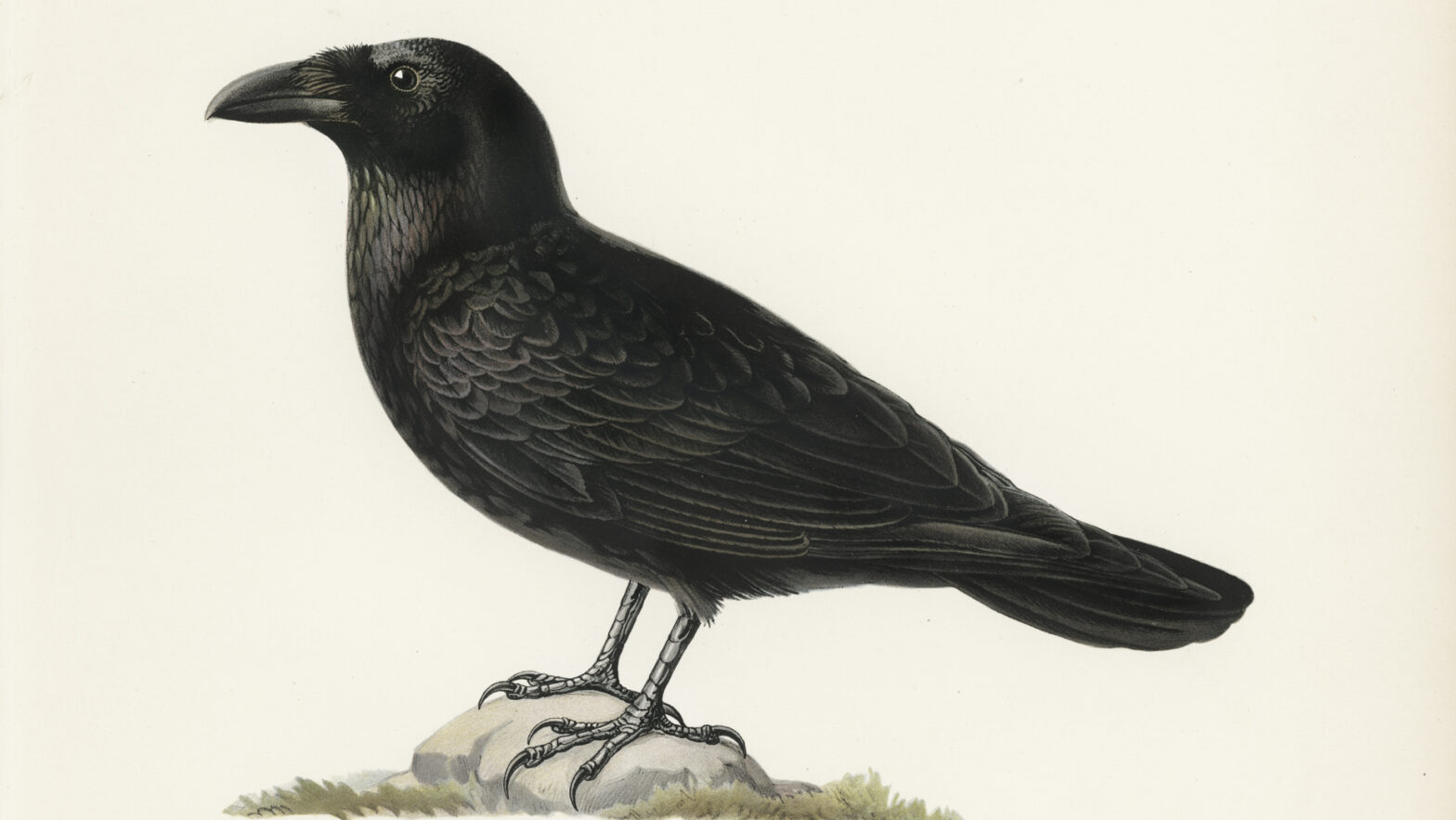
Maybe you've experienced it before. You're walking through a forest and suddenly you hear the guttural croo croo croo of a flying raven. At that moment, everything seems to stand on its hind legs. The forest you're walking through is no longer the same forest. It has changed. The needles on the pine trees are more prickly than they were a few moments ago. The bark of the trees is covered in a shiny crust. The mosses have acquired richer shades. The sky between the crowns has brightened.
At such a moment, you vividly feel that you are in the presence of a powerful consciousness that knows. I know in my own way. He knows in his own way. And he undoubtedly senses more than you can imagine. A consciousness so powerful that its mere presence changes the mood and appearance of the world around him, often hundreds of meters away.
Something similar has happened to me countless times with ravens. Sometimes such mutual penetrations can be accompanied by behavior that only underlines their infectious fluid, their charisma – like when one curious raven decided to circle me several times, crowing, on a path through pastures, where there was no other person for a long time. Maybe with a warning. Maybe with a completely different kind of message. But you know how it is with ravens. They created the world. They whisper to the gods. They are relatives of the sun.
You may have experienced it before, but maybe it wasn't a raven, but another animal. Perhaps a three-toed woodpecker in a snowy spruce forest below the peak of a certain South Bohemian mountain - just you and a rare woodpecker that is undisturbedly searching for food on the spruce tree in front of you and letting you watch it for long tens of minutes until you have light frostbite on your fingers and cheeks. Perhaps a tiger spotted from a hotel balcony in Sri Lanka - a hot ripple in the stripes of green. Perhaps a peregrine falcon in the glow of the setting sun over the Fatra peaks. Or a long-eared falcon in the semi-darkness of a housing estate; pale wings silently gliding around a street lamp.
Sometimes we can even experience unpleasant feelings. A sense of threat, a chill down our spine. Feelings that can inimitably awaken big cats on the hunt – hidden, patient, quiet, focused.
And sometimes the vicarious presence of a creature can have similar qualities. That's when you find a bleached deer skull or a shed antler - even in the deer's absence, it still has a tangible effect on its surroundings, charged with living energy. Or a wolf's paw print in the snow. Or an almost untouched wing of a sea eagle. Or an owl's talons with tufts of gray-brown hair and crushed of tiny mouse bones. Or the footprints of a grey heron in the burnt mud of a pond.
This is of course also true for animal voices and singing, although it may not be the most resonant sound on earth. The haunting winter humming – the dream of a song, the ghost of a song – of a blackbird hidden in the undergrowth, barely audible unless you are standing nearby, for which the charming name has become common in English subsong. As far as I know, this unstructured, free-flowing recital for no one, so typical of young birds who are just learning their song (which they fully unleash in its found form at the beginning of spring), inspired at least one excellent book – a collection of poems of the same name by the British poet Holly Corfield Carr, in which birdsong is originally mixed with geology, rhythm – lower songs – underground.
I know from personal experience that we can watch dozens of nature films that illustrate the remarkable abilities and personalities of animals at close range, in the highest possible resolution, and in the most vibrant colors of tomorrow, but none of them can replace these intricate experiences in the field, however fleeting. Nothing can burn itself into us so sharply. So permanently. Nothing can blur us so much.
I have experienced it so many times. And yet I hunger for many more transformations-entanglements – meeting meetings. And after what comes out of these meetings, if I allow it, if I submit.
The importance of such encounters cannot be overstated in a world where internet search results and social media feeds are overwhelmed with the ballast of generative artificial intelligence models – images or videos of non-existent creatures as if from medieval bestiaries or, conversely, with existing ones captured in unrealistic situations, which many unsuspecting people share as representations of real animals.
The risks associated with this are obvious: the already noticeable alienation from the real and breathing can be further exacerbated. And frequent visits to zoos, which nowadays are becoming more like multi-sensory amusement parks, where the animals (compared to the surrounding attractions, dull and indifferent) are somehow secondary, will certainly not save the situation. Perhaps today, At a time when virtual space is no longer just an occasional refuge from the valley of tears of a vulnerable world, but an integral part of our existence, an extension of our identities, we need such encounters – and to meet them – more than ever.
Every such full-blooded encounter reminds us of an extremely important thing: we are here with you, you are not alone in the universe. And also, as Christopher Brown beautifully writes in the book Natural History of Empty Lots, allows us to feel a touch of the instinctive excitement that our ancestors once experienced - long before we pushed large and charismatic animals like ravens into the mountains, forests and reserves. And some, I would like to believe, will learn something about the nature of life itself through them. Although biologists define this differently, I think that every somewhat credible definition of life should start from the fact that life always takes place, develops in connection with someone – together.
In other words: in a meeting.