

“We are reinvesting in communities that care and are compassionate not only with each other but with the Earth. I think we are really moving towards a kind of interspecies justice and we are starting to realize that this mutual responsibility that we have for each other is our primary spiritual responsibility. It is not just pragmatic, it is ‘practical respect.’”
Robin Wall Kimmerer
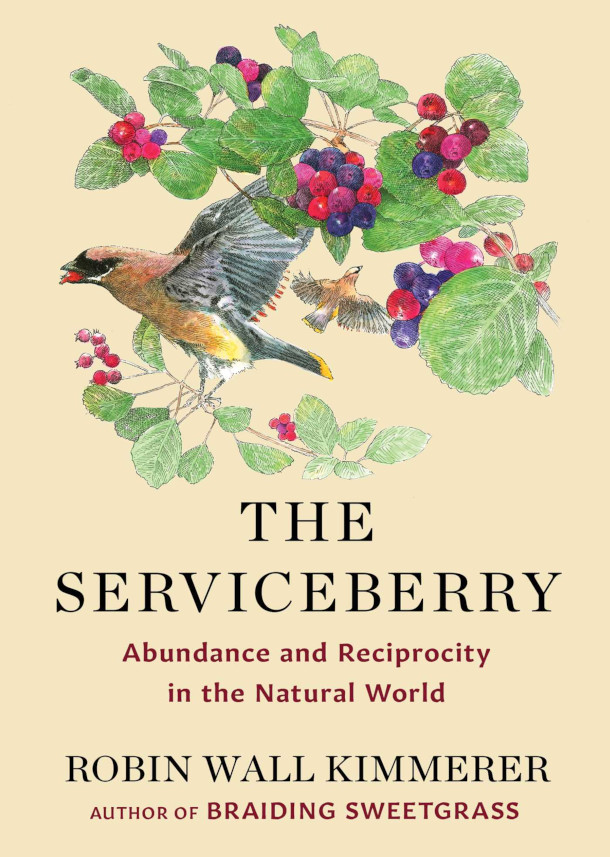
This interview was published under the title "Practical Reverence" in the magazine Emergence November 21, 2024. In a wonderful dialogue with Emmanuel Vaughan-Lee, Native Potawatomi botanist Robin Wall Kimmerer introduces us to the serviceberry as a living model of a gift economy that recognizes the sacred nature of the Earth. In an interview about her latest book The Serviceberry: Abundance and Reciprocity in the Natural World, which develops her 2020 essay “The Serviceberry / An Economy of Abundance” for Emergence magazine, Kimmerer offers a framework for embodying practical respect: an ethic of care, reciprocity, and gratitude for the Earth and its abundance. Translation: Jiří Zemánek.
Robin Wall Kimmerer is a mother, scientist, college professor, and member of the Citizen Potawatomi Nation. In addition to the book, she is also the author of Braiding Sweetgrass: Indigenous Wisdom, Scientific Knowledge and the Teachings of Plants (Sweetgrass braiding: Indigenous wisdom, scientific knowledge and learning about plants) and Gathering Moss: A Natural and Cultural History of Mosses (Czech: Listening to Moss: The Natural and Cultural History of Bryophytes). Kimmerer lives in Syracuse, New York, where she is a professor of environmental biology at the State University of New York (SUNY) and is the founder and director of the Center for Indigenous Peoples and the Environment. Emmanuel Vaughan-Lee is an Emmy and Peabody Award-nominated film director and Sufi teacher; he is the founder and executive editor of of Emergence Magazine.
Emmanuel Vaughan-Lee: Robin, it's a great pleasure to speak with you today. Welcome.
Robin Wall Kimmerer. Thank you for the invitation.
EV: I just finished reading your new book. The Serviceberry, which was based on an essay you wrote for our magazine Emergence and which was the most widely read essay we’ve ever published in our magazine—which I think shows how much it struck a chord with people. Your new book expands on that essay and is not only a beautiful celebration of the earth’s bounty, but also a really powerful manifesto for abundance and mutuality as models for a new economy that works in right relationship with the Earth. But before we delve deeper into that, I want to ask you to introduce the book’s namesake, the serviceberry. Who is this plant and what is our relationship to it?
RWK: Yes, I would like to start here. Serviceberry is a plant with many different names: juneberry, saskatoon, sarvis, shadblow, shadflower. It has so many names because it has so many relationships. And if you were to encounter it, it would probably be at the edge of the woods, near water. It is a small tree, more of a shrubby nature, and it looks quite inconspicuous in its own way – it has oval leaves and smooth gray bark. You could just walk past it without visibly noticing it; but when spring comes, the serviceberry is literally an explosion of flowers in the forest, before anything else in it blooms. So some of the relationships of the serviceberry are connected to these early spring pollinators. In July or June, depending on where you live, the serviceberry will have heavy clusters of delicious berries hanging from its branches, and it will certainly catch your eye at that time. And even if you miss the fertility flood, the swifts and swiftlets will let you know about it, because they call, chirp, and say: " Berries, berries, berries". Everyone come and feastSo your attention is drawn when the fly agaric bears fruit.

EV: You mention in the book that in the Potawatomi language, the name of the flycatcher is a complete revelation, because it is also the root of the word for "gift."
RWK: Yes. That little word minutes means "berry" in my language, but it's also the root of a word that relates to giving and to a gift. And I like that poetics, because berries, of course, feel like a gift, don't they? They just show up here, hanging there all red and blue, sweet and juicy, and we didn't deserve them. We don't deserve them. We don't own them. And yet they're here, like a gift from the tree. And so I like that it's present in our language.
EV: Berry picking is a distinctly seasonal affair, and for many it is a ritual of the warm months that embodies the gift of summer. Throughout his work, but especially in the book The Serviceberry, you write about how the abundance and summer bloom of berries and flowers, fruits and vegetables, lead us to characterize this period as one of profound abundance, of fertility, even though we can find this idea of abundance and feel it in different ways in all seasons. But in the book The Serviceberry You also reorient us to look at this seasonal abundance differently, and show us how it can be key to changing the way we think about an economy that is currently based on scarcity. Could you comment on that?
RWK: You know, actually – back to the language – our word for summer, niben, means a time of prosperity, a time of abundance. And the idea of abundance that plants provide us is for us: I think of it not only as berries, but also as medicines for us, as materials for us, as plants for making baskets, as all these kinds of things that plants, by their way of life and by the surplus they create, offer us in abundance. That is, if we know them, if we know their gifts and if we pay attention to them. And I like what you said, that it is not only in summer: even in the middle of winter, plants offer us medicines, teachings and materials. EV. In the book you point out the need to change our ideas about consumption: we have to learn to perceive that most of the time we already have what we need. And you write that recognizing enough is a radical act in an economy that constantly urges us to consume more.
RWK: Yes, absolutely. Think of all the messages that come to us tirelessly from the media and advertising that say: You know, if you bought this, you'd be really happy. You must have this. Our measure of a successful economy is actually an economy that is constantly growing, which means that consumption is constantly increasing. Is that right? Whereas the idea of abundance – doesn’t it make you feel good when you think about it? Saying: I have what I need. Everything I need is provided by the earth. And that awakens in me a sense of gratitude and a sense of sharing, and that’s why I say: I have enough. That means that when I have enough, I can share the rest, the surplus. And this concept of abundance as a radical act can actually curb consumption. And we know that it is precisely excessive consumption that is putting us on the brink of climate catastrophe. Is that right? And so saying: I have enough is not only a radical act in the economy, but also a real act of healing the earth and the people. I don’t need to take more. That then releases this abundance for others to thrive too.
EV: What you're talking about is radical, especially in the capitalist economy we live in. But in many ways it's not radical, because this way of living in harmony with abundance and the ethic of sharing has been practiced for thousands of years by cultures around the world that live in close relationship with the land. In the books The Serviceberry and Braiding Sweetgrass You talk about a canon of principles that govern this practice in many indigenous cultures, including yours, called the Honorable Harvest. Could you talk about that?
RWK: First of all, I want to thank you for acknowledging that this is nothing new or radical. Fair Harvest is actually the fundamental principles of sustainable local living; principles that we have forgotten, that we have been forced to forget by an economy that doesn't want us to have enough, that wants us to consume more and more. But in order to talk about Fair Harvest, I also have to talk about the fact that the things that the Western extractive economy wants us to consume are understood as materials. They are simply things. They are objects. So if we are just consuming objects and if these objects belong to us, if they are our property, we don't really need any ethics about consumption, because they are just things.
But in the indigenous worldview, which sees these plants, these animals, and Mother Earth as our relatives, as our kinship, we talk about the fact that in order to live, we must eat our kin. So what opens up to us is not natural resources, but our kin, our kinship that gives us gifts. And that creates both a pragmatic and an ethical imperative to follow the guidelines that regulate the way we consume. And these are collectively called Fair Harvest. I learned the principles of Fair Harvest while picking wild berries and digging up medicinal roots, kind of step by step. Before we learned to take from nature, we always learned responsibility. And Fair Harvest starts with never taking what is first; whether it's berries, firewood, or plants in a basket, we never take the first. And this restraint also means that you never take the last. So Fair Harvest has a conservation ethic built into it. Different cultures think about it differently, but sometimes the rule is that you don't harvest until you see the fourth, seventh, or tenth plant growing, depending on what your family's rules are. And then never take more than half, because you always have to leave something for the plant to flourish, but also for others, for other beings who also want and need the fruit or the medicine.
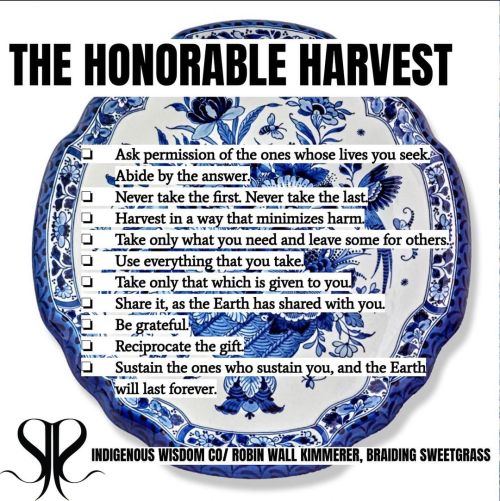
When we see, let's say, the fourth plant, we ask its permission. I'll literally introduce myself and address it -- I did this recently when I was collecting some mosses for an upcoming Moss Ecology lesson. And I had to speak to those mosses and say, "Would you come into my lab and teach my students? Is that okay?" And by taking that step of asking for permission, we're acknowledging the sovereignty of the plant. We're acknowledging that the plants don't belong to us, that they belong to themselves. And so if we're going to ask them for permission, we also have to listen to their response. There are many ways we can do that. We can use Western science to do that and look at the demographics of the population; look at its health, its vitality, the quality of the soil. Is it doing well? And if it is, you say, I think it has enough supplies. But if the plant population is weak, if it's chlorotic, if it doesn't have any young, you say, no, I can't harvest here because this population doesn't have what it takes to produce.
But if a plant can give, then, as I said, you only take half of the plants, and even less than half; you only take what you really need. And you take it in a way that causes as little harm as possible. You don't disturb the whole place to take what you need. In indigenous cultures, there's a long protocol of gathering fruit, taking plants from the ground, as opposed to the Western way of just going into the forest and just taking what you need. Is that right? And when you harvest, you again take only what you need, and you give thanks. You stop and thank these plants, because after all, they gave you their bodies, in some cases their offspring, that you take home in a basket. And so you really show them gratitude, not just with a fleeting "thank you," but a real recognition that your life is inextricably linked to their life. So it's a deep expression of gratitude.
And then I was also told that we never go home with our basket without returning the gift, without giving it back to the plants. We took something, the plants gave us something. So how do we give it back to them? Sometimes it's a spiritual gift. It's always a spiritual gift, actually, but it's also a material gift: maybe the plants need a little more sun. Maybe you should grow some weeds around them. Maybe you should put some fertilizer on them if they look like they need it. So you have to know the plants; you have to know what they want and help them. Then you have done the best for them. It's an Honest Harvest because you got what you needed and you didn't do any serious harm - and in fact some of the harvesting methods that we learn help the plants reproduce. If my reciprocal gift is to move some of those roots to another place where that plant can flourish, then I have just used my gift of mobility to complement the gift of the plant that is creating the medicine. So often the ways in which we harvest actually multiply the abundance.
EV: You've written before that this knowledge continues in stories and that these stories help us restore balance and put us back in the circle. Can you say something about this circle?
RWK: What I'm talking about is a circle of mutual flourishing with our kin. These stories remind us that the Earth doesn't belong to us, that we are blessed to receive the gifts of the Earth, and then we must return those gifts. That's the circle, right? It's a circle of giving and receiving that recognizes that everyone in the circle has a gift. And it's our responsibility to use whatever gift we have to support the flourishing of our kin, the leafy, the feathered, and the furry.
EV: Throughout your book The Serviceberry You're referring to a concept or way of thinking that sees the currency of the gift economy as a relationship, which you express perhaps most directly in the line, "I will lay my flesh in my brother's belly," which is repeated throughout the book. I really like that line. Could you talk about it?
RWK: That's the core of the book and the essay, right?
EV: Yes.
RWK: It comes from research by a linguist who was working in the Amazon with the indigenous people there. And in his reports, he tells the story of a hunter and his family who were really successful in hunting and brought back a big game. And as they were preparing it, the anthropologist and the linguist who were watching said, "And you know what you're going to do with the surplus? How are you going to store it?" Because there was obviously a lot more meat than the family could consume. And the hunter said to them, "Are you going to keep my meat?" The anthropologist and the linguist didn't really understand that, so the hunters suggested, "Well, dry it or smoke it and store it until you need it." And the hunter said, "I'm putting the meat in my brother's belly." So the hunter had a surplus, he had an abundance of food, so he had a feast. And the whole village, the hunter's whole family, all his friends and neighbors were invited to join in this feast. So the storing of that meat was about good relationships, about feasting, about telling stories, and about singing, which accompanied the hunter sharing this gift of the forest with other people. And this idea of storing my surplus in my brother's belly, of course, means that you are creating relationships of reciprocity, and that these reciprocal relationships are going to manifest in food security in the future, because there will come a time when abundance is not guaranteed, right? There will also come times of scarcity.
And at these times you feel that the people who came to your feast before will share with you; when they have a big net full of fish, they will invite you to their feast. And so the certainty of having enough food comes from good relations with your neighbors and the trust that abundance will always be shared.
EV: You write about how our current economic model has its roots in colonization projects, and how the dispossession of indigenous peoples was intended to eradicate the idea of land as a source of belonging and replace it with the idea that land is nothing more than a source of wealth, which you pointed out earlier. And that in turn has narrowed the definition of well-being from common wealth to individual wealth and from abundance to scarcity, which really gets to the heart of the crises we are experiencing.
RWK. The idea that land is a gift that we can only harvest honestly, that we hold the land collectively, not individually, is completely at odds with the Western concept of property rights and prosperity. Within this Western concept, gifts of land are used to make individuals prosper and prosper, as opposed to the community as a whole. And in this country, that was a very dangerous idea—for the colonizers, and especially for the colonists who came to North America specifically for the land. That's what they wanted. So the idea that land should be communal and that it should be held sacred was dangerous to them.
And so when we look at the projects of forced assimilation, like through boarding schools and other tools of indigenous cultural destruction, most of them, including the erasure of our language - the attempts to erase our language - were largely aimed at replacing the idea of common land with the idea of private land and private property in this imperialist way. That allows for the commodification of land, the commodification of forests, water, and wildlife, so that all the benefits go to individuals. And of course, corporations are now considered persons. So that falls into that framework as well. Yes, it's essentially replacing the indigenous idea of commonality with the idea of private wealth.
EV: You talk about how the equations we use to measure economic value, like GDP, only take into account what can be bought and sold. And there's a great line in the book that speaks to this: "There's no room in these equations for the economic value of clean air, for carbon sequestration, and the untold richness of a forest full of birdsong. Where's the value of a butterfly whose species has thrived for millennia and lives nowhere else on the planet? There's no formula complex enough to capture the birthplace of stories." I was very moved by that statement, and especially the last line.
RWK: You know, economists, especially ecological economists, try to quantify the values of clean water, the values of air quality, forests, and so on, through this language of ecosystem services. And the idea is that if we could put a monetary value on ecosystem services, then we could include them in this equation. And so that line of thinking is absolutely valid. But the problem is, when we try to put an economic value on birdsong and water, then we turn a gift into a commodity.
EV: Yes.
RWK: Its monetization takes away from its inherent value. It says that the value is in the dollars associated with it, not its intrinsic, truly sacred nature. And so there's quite a lot of resistance to valuing ecosystem services on philosophical grounds, but it's also true that it's an attempt to bring these things back into the equation.
EV: I want to talk a little bit more about the idea of the gift, which we've already touched on, because this model of harvesting only what we need to survive is really an example of the gift economy. And I'm wondering if you can say something about the ethical constraints that the gift economy supports in terms of the accumulation and distribution of things.
RWK: The ethical constraint of not making a gift a commodity is best illustrated, I think, by thinking about water. When you turn on the faucet, you think of it as just a liquid that comes to you from a public source. But when you focus on really understanding what comes out of your faucet, you know that this beautiful water—which we usually think of as finite and that we will never have more of than we have today—falls freely from the sky and waters our gardens and makes our food grow and our flowers bloom. This water that can be dew, clouds, snow, this long-traveling molecule that animates life on the entire planet and without which life simply would not exist. Oh, and now you start looking at water and saying to yourself, it is so much more than just this clear substance that comes out of your faucet. It is no longer an object to you. It is a gift.
So when you think about this gift of water, it belongs to all of us. The rain falls on all of us, right? So why does a corporation have the right to say that they're going to filter this freely given gift and put it in plastic bottles and sell it for more than the price of gasoline? That they're going to make all sorts of money off of a gift that's freely given to us - that seems like an ethical travesty to me.
EV: I agree.
RWK: And of course, think of all the environmental damage that has been caused by the privatization of water, the use of single-use plastics, etc. But I think the really important thing is that water should be a public good, a common good, and that it should not be privatized. So that's just one example of thinking about what I think is the ethical threat to a freely given gift by privatization.
EV: Yes, you write that “to name the world as a gift is to feel one’s belonging to a network of mutuality,” which really challenges what you just described as the way we currently perceive, for example, water.
RWK: Yes, exactly.
EV: You look at the fly agaric plant itself as a model of gift exchange, watching it engage in hundreds of gift exchanges before you even put a berry in your mouth. The plant takes in elements from different parts of the ecosystem to grow and in return gives back to many other parts of the ecosystem what they need. You say this is an important part of the ethos of the gift economy, which keeps the gift moving so that it doesn't stagnate.
RWK: Yes. If we look at the economy, for example, the fly agaric, if you will, it's a circular economy. It's an economy in which the production of this beautiful plant is in constant circulation. It's not hoarded. It's given away from the pollen on those beautiful, frothy white spring flowers that the bees feed on at the beginning of the season. Is that right? It's given away. If we think about the leaves - those beautiful solar panels of leaves that power the growth of this tree and that are the only food for certain types of caterpillars - this production is given away, as if it's being released to those caterpillars. When the time comes for the fruit to ripen, everyone - all the birds, all the small mammals, and even humans - shows up to share in this abundance. So the plant produces these baskets full of berries, and they fly off in all sorts of directions. Not to accumulate, but to become part of life: to make more birds and more birdsong and more meadow voles and more jumping mice and everything up and down the food chain. And then when autumn comes, the leaves fall to the ground and feed this whole network of detritivores, which create soil, which then allows more flycatchers to grow. So it's a circular economy. Everything that's created is given away, it's sent on to support more life, which then supports the flycatcher. So it's a circulation model.
And we know that these circular, regenerative economies are the ways in which nature provides abundance. And our industrial economies are largely the opposite of that. They're just short industrial pipelines that go from production to waste with amazing efficiency. But in a natural economy, there's no such thing as waste: a waste product becomes a resource for someone else's life. And in that sense, I mean, the whole point of this book of mine is the idea of biomimicry. Can't we look at how nature provides its goods and services in this regenerative way? And why don't we design our human economies to mimic nature, not to destroy it?
EV: You say that in response to gifts, our first intuitive reaction should be gratitude. But gratitude is not just a learned behavior, a simple out loud thank you that we are used to. It is rather an acknowledgement of debt that leads us to realize that our life is nourished by the body of Mother Earth. Can you say more about this acknowledgement of debt that is the essence of gratitude?
RWK: Yes. That's what the simple ritual of politeness, of simply saying thank you, turns into a recognition that our lives are interconnected; that our physical lives are intertwined. If it weren't for you, I wouldn't be alive. And that's a powerful kind of gratitude, isn't it? To say, you know, I couldn't be without you. And really what it takes is this attention and a kind of humility, a beautiful kind of humility... In the Western world, the idea of humility often means something like meekness or self-flagellation. But in the teachings that I've been taught, humility means - in the Potawatomi language, the word is edbesendowen – understanding that I am not more important than you are. Which doesn't mean that I am not important. It means that you are important, that we are important to each other. So it's a way of lifting all lives up and saying that we are all important to each other. We wouldn't be here without each other. And that's a really deep kind of gratitude that makes you feel happy. Isn't that right? And that creates a really different orientation to the world; not in the sense that I'm going to try to take more from it, but in the sense that I'm going to respect what I've been given.
EV: You repeat this idea in the book Braiding Sweetgrass, where you write that expressing gratitude for what the Earth gives us is revolutionary in a consumer society. This contentment represents something radical. Gratitude creates an ethic of fullness, and we live in an economy that thrives on emptiness.
RWK: Yes, exactly. And that's why the idea of gratitude, of sufficiency, of abundance is felt to be an important antidote to the endless need to consume. It's the idea of contentment. And we're back to the concept of abundance.
EV: Yes.
RWK: It just makes you say, I have everything I need.
EV: You also say that we need to move beyond just gratitude, that we need to become a culture of reciprocity. What do you mean by that?
RWK: You know, gratitude is like saying thank you for our lives. But then when someone gives you a gift, you want to give something back to them. You're kind of indebted to them, and you want to honor and value them the way they value you. And that opens the door to reciprocity, to saying, what gift could I give you in return for the water, for the berries, for the birdsong, or whatever it is we're talking about. And that requires a deep self-examination to realize what our gift is. Which of my gifts are what the world really needs right now? And we're talking about a meaningful life, right? When you say, oh, I matter too. My participation, my gifts, have to be in the world for the world to flourish. And that then changes our sense of self, which goes far beyond just being a consumer. We have been given the story that we humans are just recipients, that we are just consumers, and that that is all we do. But through reciprocity, we can regain the feeling of being givers, of being fully involved in the flourishing of the world. And that is a joyous realization. It gives you a sense of belonging, purpose, and influence that rivals the sense of agency and purpose that birds and trees have.
EV: Gratitude and reciprocity, as the currency of gift exchange, are truly a renewable resource. And as you write, with each gift exchange, their energy is concentrated as they pass from hand to hand. Could you elaborate on what you mean by that and what is revived in both the giver and the recipient during this exchange?
RWK: Lewis Hyde writes about this beautifully in his book The Gift and other philosophers and anthropologists talk about this. Let's take the example of a gift, like if I wanted to give you a cup of tea - I could go to the local shop, buy a cup, and give it to you. But what if the cup that I gave you belonged to my great-grandmother, who brought it back from a long journey, told stories with it, and had tea parties? In both cases, they are containers for hot water, but the second one has been exchanged so many times, is much more well-known, has much more meaning and value, and is also much more admired. And that's the way that relationships refine the gift and make it even more valuable. And then when you take that gift and give it away - and you say, Robin gave me this in honor of our friendship and in honor of her grandmother - that whole story continues, right? And so the gift, as it is passed down in the sense of a material gift, it accumulates intangible values and stories that are attached to it. From an ecological perspective, gifts also become concentrated in a sense as they reach higher levels of the food chain.
EV: Yes.
RWK: And that's another way to think about ecological gifts, is that you think about plants that get an abundance of sunlight. When trees produce berries that birds eat, the birds concentrate only about one-tenth of the energy that the tree produced in them. So the birds are a more condensed form of that energy. And the person who eats that bird, the fox that just picked the thrush off the ground, gets only ten percent of it back. So now it's one-hundredth of the energy that the plant produced. And so as you go up the food chain, the energy also gets more and more condensed. And that's another way to think about it, as gifts are passed on, they become more valuable. That's why there are fewer birds in the world than grasshoppers, because the energy of the bird is more condensed. In a sense, this gift becomes more valuable as it is passed on up the food chain. So it's both a cultural and an ecological gift.
EV: Yes. I liked what you said about how a material gift preserves a story when it is exchanged, when it is given to others. And that makes me think about the spiritual exchange as well, the energy that is present in the story and is allowed to condense as it is used and to be enlivened as it is passed on in exchange. And how when we interrupt that exchange by saying, no, that is mine, it is as if we have stopped the flow of everything that has happened up to that point.
RWK: Absolutely. Is that right? Yes. Exactly.
EV: One of the main questions we are asking ourselves now about the gift economy model is how to harness and scale it up so that it is feasible for society as a whole? But you question this notion, saying that you are not sure if this is the right question, because it is the small scale and community context that makes the flow of gifts meaningful.
RWK: Yes. There's a lot of scientific evidence about gift economies, all over the world. These economies occur in small, close-knit communities, and for good reason, because they're based on trust. They rely on the fact that people know about them, and that if you invited me to your party, I'll invite you too. In a society that's too big and too complex, you can be anonymous, and anonymity creates opportunities for cheating within the system. But where everyone knows each other and where they're related through the exchange of gifts, there's a high level of trust. So this diffuse reciprocity can work well here.
And so you could say that in a society like the United States today, gift economies can never prevail. But I don't think that's entirely true, because what we crave as individuals is community and a sense of belonging. Gift economies are not going to replace extractive capitalism. But I think they can exist in it because we're creating and valuing these small communities today. We saw this during the Covid pandemic, with neighborhood self-help groups and community gardens. People have found a way to create these small, very local networks of reciprocity and care. And that's, I think, the challenge: to do things that allow us to honor the currency of relationships rather than the currency of money. And so when I say that we shouldn't expand gift economies, I mean that these economies probably wouldn't work at a scale of five hundred to a thousand people, but they work really well at a scale of two hundred people.
So how do we invest in our neighborhoods and communities to create opportunities for sharing tools, for community gardening, for sharing food? I'm thinking, for example, of "buy-nothing" networks that are deeply communal. These are gift economies. I think that through these exchanges, we get benefits not only in terms of goods and services, but also in terms of human relationships, in terms of mutual respect and a sense that we matter, that this network needs us and what we bring. And in a society where I think people are craving not only community but also meaning, those are pretty good benefits.
EV: I want to talk a little bit about the deeper spiritual values that are present in this book of yours and certainly in your work in general, and that your exploration of the gift economy seems to be moving towards. You could say that there is a crisis of disrespect for the Earth as a spiritual being, and that we are not valuing the Earth and all that it brings because of systems that have distanced us from it, sometimes very violently. And your work is very much about calling people to change that, to change the bleak future that is often promised to us today and to fix that relationship. So I wonder if you could say something about the deeper spiritual values that the gift economy might actually lead us to and help us learn to reincarnate.
RWK: Yes. This is, of course, work that goes beyond human communities and the exchange of goods and services. It means reinvesting in communities that care and are compassionate not only with each other but with the Earth. I think we are really moving towards a kind of interspecies justice and we are starting to realize that the mutual responsibility that we have for each other is our primary spiritual responsibility. It is not just pragmatic, but it is – and I like that term too – “practical respect.”
EV: I like that a lot.
RWK: Because it's deeply practical, but it has a sacred dimension, right?
EV: Yes.
RWK: It’s about mutual care and respect for the gifts that come to us. The gift economy and our responsibility to participate in it, I think, is closely tied to our spiritual responsibility, which in the teachings that I’ve been given and that I follow, is that in exchange for living in this beautiful complicated place, we’ve been given a gift that we’re supposed to bring here. Each of us is supposed to bring that gift. And not to give it is to betray a kind of spiritual responsibility, a spiritual equation. And so gift economies offer individuals the opportunity to say, “Here’s a gift that I carry and I’m going to share it with you to enliven our community, to enliven the life around us.” And this deep sense of purpose is also spiritual.
EV: The enormous popularity of both your book Braiding Sweetgrass, so your essay “The Serviceberry” seems to me to speak to a deep hunger in humans for this way of being, rooted in mutuality, for this sense of practical respect, for being in a nurturing mutual relationship with all life around us; we clearly yearn for models and ways to live in spiritual connection with the Earth again. I wonder if you could talk a little about this apparent hunger—the innate desire that remains within us, even if it is often buried—to be in conversation with this Earth.
RWK: Oh, yes. You know, one of the joys of the work that has been done in the world, especially Braiding Sweetgrass (Sweet grass braiding), there is an almost daily influx of messages from readers who are communicating exactly what you are talking about: a desire to be in a right relationship with the Earth. And all these stories around us that distract us from that, telling us, no, it doesn't really matter. That's not what it is... That's not why you are here. I think Braiding Sweetgrass has given many of us permission to feel this desire. And the idea of a right relationship with the earth – given that our species, especially in this country and in industrial economies, has done so much damage to the beautiful creation around us – can also bring up this feeling of shame and dishonor. You say to yourself: this is not me. This is not who I want to be.
And practical respect offers almost a notion of redemption: no, you're not just a taker, you're not just a destroyer. You can be medicine, medicine for the Earth. You can be a healer. You can participate in regenerative economies. You can participate in ecological restoration. You can contribute to justice within our own species and within interspecies justice. People yearn for the privilege of being truly themselves in right relationship with the earth. And I'm very pleased to see them take charge of that, to feel free to say, I could be a giver. Yes, that's what I want to do. You know, someone said to me, I'm going to get involved in this education system that teaches us to be just consumers; I don't want to participate in it anymore. I'm going to start another school or write its curriculum. Or someone wrote to me, I worked most of my professional life in finance on Wall Street, but now I can't do that anymore; I'm going to take my wealth and start a regenerative farm. You know, there are so many stories of people feeling liberated to be in a right relationship with the land, which for some reason they thought was impossible. And that's the power of collective storytelling.
EV: Yes.
RWK: Because when one person says, this is how I see it – it’s contagious and it gives people the ability and the authority to take these steps to not be complicit in the destruction. Because this complicity weighs on us, doesn’t it? It weighs heavily on us. And the ability to take these steps in the gift economy, in the regenerative economy – to step out of this complicity and to resist it in any way – really gives us a sense of power and influence and rightness.
EV: In the book, you give a beautiful example of how intuitive and innate the gift economy is for us humans. That gift-giving is a fundamental element of human relationships. And you point out here the “maternal gift economy”: how a mother gives her baby milk, which is truly a “pure gift.” Mothers do not sell their milk to their children. The currency of this economy, this exchange, is gratitude and love, which supports further life.
RWK: Isn't that a powerful idea? Genevieve Vaughan was the first to talk about it. And I was just trying to understand the work that's happening around the maternal gift economy today. I want to learn more about it. And I'm planting it as a seed for readers to learn more and to ask themselves, what would it look like if we lived in a way that really honored these exchanges of life? These thinkers, these amazing feminist thinkers, are arguing that gift economies are a biological imperative. If we didn't do that, we simply wouldn't exist. So how could that translate into ways of social and economic organization that would be based on blurring the line between me and us? That's part of the beauty of the maternal gift economy: the line between mother and child is so permeable, isn't it? It really exemplifies the idea that all flourishing is reciprocal. Our lives are so interconnected, but really, all of our lives are interconnected. And when we start thinking about the ultimate mother from whose body we are nourished – Mother Earth – what does the maternal economy of gift look like in this area? It's a really exciting area to think about.
EV: Hand in hand with what the maternal economy of gift shows, you continue by suggesting that, just as in the economy of nature the sun is the “source of flow,” the source that replenishes the flow of gifts, in the human economy of gift it is probably love.
RWK: I think there's no dispute about that in the maternal gift economy, right?
EV: Definitely.
RWK: But again, it's a kind of practical respect for love and milk. We need both. Love alone won't feed that baby. And if we think again about the story of the hunter who says, "I'll put my flesh in my brother's belly..." - isn't that love, isn't that an expression of his love for his people? And there's also the blurring of the line between "me" and "we": the gifts of the Earth, the food that's been caught, don't belong to me alone, but to all of us. And I can be the intermediary who distributes that abundance among us. And I think all of this really leads us to realize that this society that we live in is so hyper-individualistic, and that's why we think that all the benefits should go to individuals and their close circle. But what would it mean if we thought in terms of an ecological system, where the benefits go to the whole community?
EV: Robin, it was a great honor to speak with you today. Thank you so much for joining us.
RWK: Thank you for the useful interview.