Summer seminar of the Traveling University of Nature
A profound law at the core of existence: the key to ecological civilization?
Three lectures by Freya Mathews

August 13 to 15, 2024
Toulcův dvůr, ecological education center
Australian philosopher Freya Mathews is professor emeritus in Environmental Philosophy at La Trobe University in Melbourne and a Fellow of the Australian Academy of Humanities. Mathews' philosophy is rooted in panpsychism, an approach that sees the mentality of the natural world as fundamental. Her main interests include the development of ecological civilization, Australian and Chinese indigenous views of "sustainability" and how these perspectives can be adapted to the context of today's global society and the pursuit of a return to the wild. In addition to her research, she manages the private biodiversity reserve Barabungle Park on Mt Korongo in northern Victoria. Freya Mathews has presented the most elaborate vision yet of a new form of ecological civilization that would serve and support the biosphere at all levels.
From published books: The Ecological Self (1991), For Love of Matter: a Contemporary Panpsychism (2003), Reinhabiting Reality: Towards a Recovery of Culture (2005) and The Dao of Civilization / A Letter to China (2023). Mathews' texts were published in Czech in the anthology Everything around me lives, feels, like me … (Pilgrim 2019) and in the magazine Seventh generation; inMalvern Publishing House, in collaboration with the Pilgrim Association, is currently preparing a Czech edition of the author's book. Journey to the Source of the Merri / Journey to the springs of Merri (2003) and her key works For Love of Matter: a Contemporary Panpsychism / For the love of matter: contemporary panpsychism (2003).
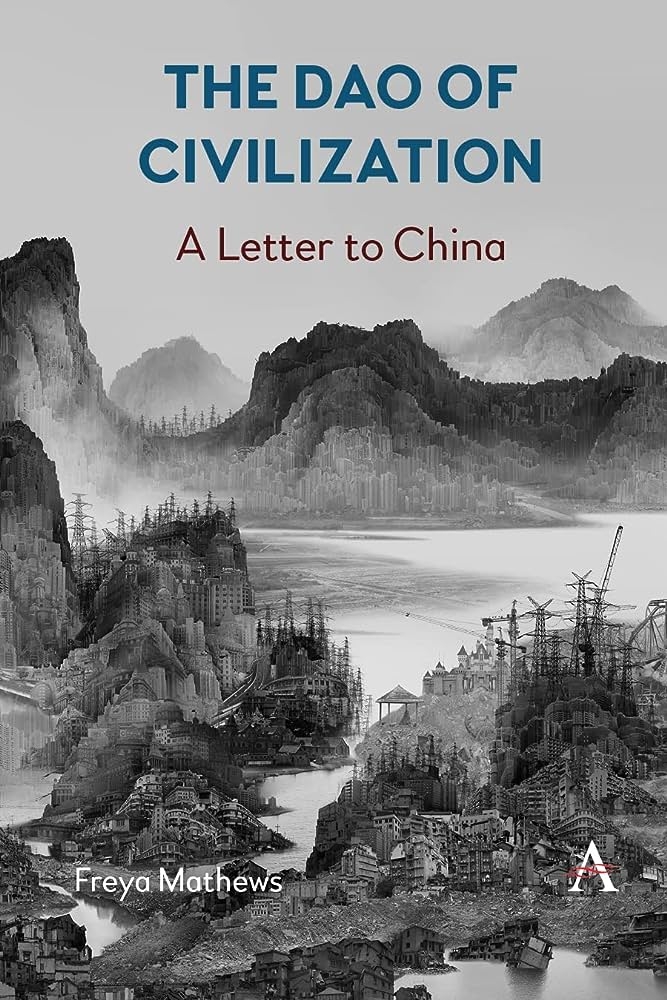
Since 2019, Freya Mathews has been a regular lecturer at the PILGRIM Association's Traveling University of Nature (PUP) summer seminars. At this year's seminar From the Anthropocene to the Symbiocene (Toulcův dvůr, Prague-Hostivař, 13.-15.8.) in a series of three lectures “The Deep Law at the Core of Being: The Key to Ecological Civilization?” she will outline her idea of the emergence of ecological civilization, as she elaborated on it in her latest book The Dao of Civilization: a Letter to China (The Tao of Civilization: A Letter to China).
Summary
The starting point of my argument is the claim that modern civilization is based on a deep philosophical division between the realm of man and the realm of nature: modernity is characterized by a strongly dualistic and anthropocentric consciousness that views man as separate from and superior to nature – to the extent that the human-made environment today threatens to dominate nature and completely disorganize the Earth's natural systems.
In order to challenge this dangerous dualism and move contemporary societies toward a more ecological perspective, we must first understand why different forms of consciousness emerge in different societies. I will argue that the consciousness or worldview that characterizes a society at a particular historical moment is not merely the result of intellectual inquiry, but is an expression of the fundamental ways in which that society provides for itself materially—an expression of its basic economic modalities. (This account of social consciousness loosely follows the Marxist doctrine of historical materialism, but my overall argument is otherwise independent of Marxism.) For example, hunters and gatherers, whose livelihoods depend on natural ecosystems, exhibit characteristically ecologically sensitive and informed forms of consciousness for the simple reason that they need a sophisticated level of ecological understanding if they are to survive. This ecological understanding then shapes their basic assumptions about reality and, consequently, their social identity and values. In contrast, the consciousness typical of people living, for example, in highly industrialized societies of the late 20th century is based on a variety of mechanistic and instrumentalist assumptions. This is so for the simple reason that such assumptions are a necessary part of the skills that people need if they are to function successfully in the highly technologically mediated conditions of their daily working lives. In other words, these assumptions reflect the actual material relationship of people to reality in industrialized society.
Based on this historical materialist perspective, I believe that the profound dualism of man and nature, which is such a defining and problematic feature of modernity, can be traced not only to the scientific revolution of the 17th century, as is often claimed, nor to ancient Greece alone, as is also often suggested, but to the Neolithic Revolution, when agrarianism, as an economic practice that involved the blanket imposition of man on nature, began to replace earlier forms of subsistence that required an intimate understanding of and care for local ecology. From this historical-materialist perspective, then, one can expect that all agrarian and post-agrarian societies will exhibit dualistic tendencies. Since the concept of civilization (from the Latin civitas, meaning city) is generally understood as a form of social organization based on cities, and since such forms of social organization necessarily rely on agrarian forms of practice, it follows that all civilizations to date must have shared this dualistic tendency.
If we want to restore an ecological form of consciousness today and to base a new form of civilization on it, then it seems that we will have to make a radical departure from the history of civilizations to date. It will not be enough to defend an ecological worldview on an intellectual level – for example, through philosophy or science. We must also discover basic forms of economic practice that will reproduce the defining features of pre-agrarian practice in the greatly changed conditions of our contemporary world.
Lecture overview
What pits us against nature • August 13
In this lecture we will ask why the worldview on which contemporary industrial civilization is based is leading us to dismantle and destroy terrestrial systems. The fundamental problem is undoubtedly the philosophical dualism that separates mind from matter and attributes mind exclusively to humans, leaving nature as the realm of all that is gross, blind, and meaningless—and therefore without intrinsic moral meaning. Philosophers have tried to remedy this problem by conceptually returning mind to nature. They have attempted to do so in various ways and to varying degrees, on the assumption that returning mind to nature at the conceptual level will restore moral meaning and value to our natural environment, and this will compel us to treat it with due moral consideration. But will this really be the case? Could we not attribute mind to all matter and yet not feel obligated to treat it with due consideration? To ask this is to ask a deeper question: is it not only the fault of contents our knowledge, but also the ways in which we know. Isn't it our ways of knowing rather than just our theories about the universe that set us against nature?
Theoretical and Strategic Ways of Knowing • August 14
In this lecture we will deal with the above-mentioned epistemological question and the opposing ways of knowing that lead to a dualistic and analytical view of reality and, on the other hand, ways of knowing that lead to a truly holistic grasp of reality. I refer to the first ways of knowing as theoretical (according to the Greek theory, which means "to look" in the manner of a spectator) and I call the other ways of knowing strategic (according to the Greek strategos with the connotation of directing action). Theoretical ways of knowing have been characteristic of the Western tradition since the time of ancient Greece and appear paradigmatically in philosophy and later in science. Strategic ways of knowing are more characteristic of pre-agrarian societies – for example, (i) the Aboriginal people of Australia and (ii) the society of early China, since early Chinese thought is reflected in the Taoist tradition, which has its roots in China’s pre-agrarian past. I will argue that if we are to re-establish a considerate and respectful relationship with the living cosmos, we will need to restore these embodied, communicative and participatory forms of knowing, not to the exclusion of scientific and philosophical reason, but as a necessary broader framework for theory-based thinking. Strategic ways of knowing reveal to the knower at an inner level that at the core of what Is is Duty.– that normativity is woven into the fabric of reality. With respect to indigenous and Taoist thought, we could call this Duty a profound Law. In light of this Law, it is clear that the role of man, like that of all beings, is to contribute to the continuous evolution of the living cosmos.
Synergistic Forms of Economic Practice and the Profound Law • August 15
To restore the embodied, communicative, and participatory forms of knowledge that emerged in pre-agrarian societies and that stem from an ecological consciousness informed by the Law, our contemporary societies need to find new, ecologically grounded, reciprocal forms of economic practice that functionally re-immerse us in natural ecosystems. But are such forms of practice possible in today’s vastly altered and ecologically threatened conditions? How could contemporary industrialized societies, with a human population approaching eight billion and natural ecosystems devastated and destroyed, restore anything resembling pre-agrarian modes of practice? Although it is difficult to imagine at present, I will argue that modern societies have the resources at their disposal to initiate a shift toward pre-agrarian types of consciousness. Large-scale ecological forms of climate change mitigation, food security, and the acquisition of production materials are currently emerging under the term “nature-based solutions.” We will explore some of these “solutions” in this lecture. If this nature-based approach were supported and further developed, it could help accustom people to the idea that our human needs can be met, so to speak. free natural ecosystems, if these systems are given a chance to recover to full functionality on a large scale. A politically driven shift to such an approach could thus begin to change the way societies think about nature at a very basic, subconscious level – and thereby perhaps pave the way for a broader restructuring of human lives to be more closely aligned with the profound Law.
Translation: Jiří Zemánek