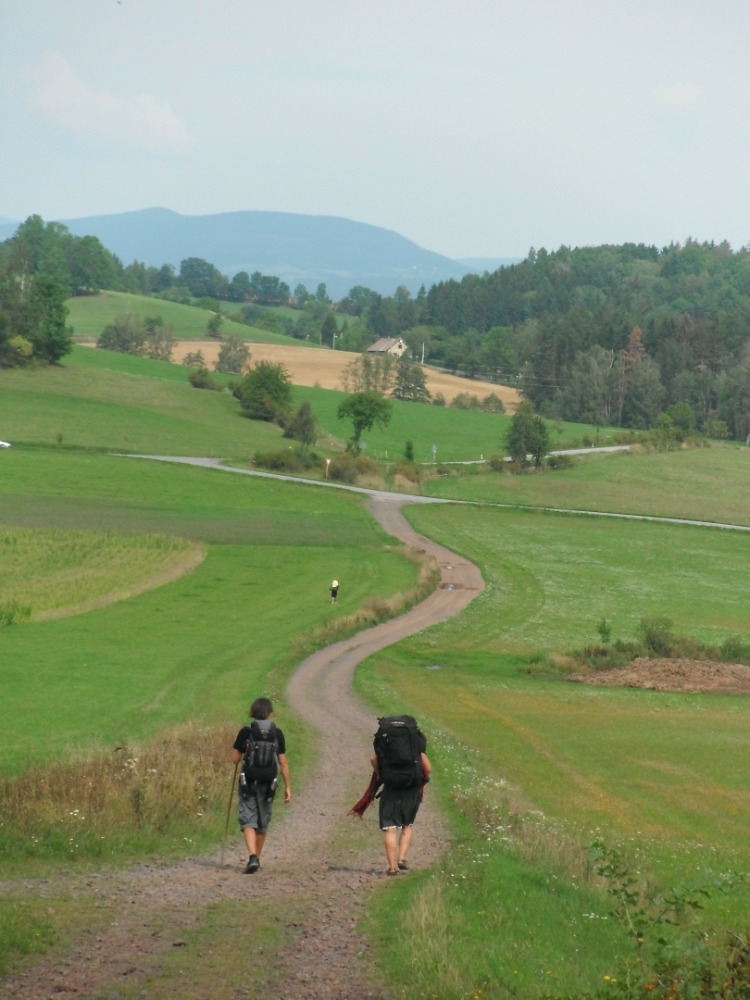
"We are not here to control the world. We are here to connect with the greater Earth community."
Thomas Berry
In the mid-1990s, when I began to realize that we were in a time of great civilizational crisis and transformation – a time searching for a new story –, I asked myself how we could integrate our lives, our culture and spirituality more deeply into the life of the landscape in which we live. How could we align our desires with the needs of the biosphere and be truly beneficial to the earth rather than permanently devastating it. I felt that our current story, based on a sense of separation from the earth, which we consider to be a mere usable object or at most an aesthetic backdrop, was not only wrong but deeply destructive. So how could we re-establish our connection with the living earth around us? Re-awaken the awareness of its liveliness and sacredness and seek our own wholeness within it, thereby regenerating the damaged landscape and renewing our own culture? These reflections, which combined deep ecology with art, spirituality and cosmology, led me after 2000 to the practice of pilgrimage and subsequently to exhibitions. Wilderness – nature, soul, language (2002) and From the ground, over the hill to the sky... / about walking pilgrimage and sacred landscapes (2005), which I dedicated to the artists of Romanticism: the poet Karel Hynek Mácha and the German painter Caspar David Friedrich.
"There is only one question - how to love this world."
Mary Oliver
I have been inspired by other poets, artists and philosophers (Henry David Thoreau, Gary Snyder, Josef Váchal, Robinson Jeffers, Thomas Berry, David Abram) as well as indigenous cultures, especially the Australian Aborigines and Navajo. For me, pilgrimage is a type of activity that allows me to establish an intimate relationship with a more than human world. bond and to partially step out of the current story of separation and create with others within this consumer culture the seeds of a new regenerative culture of coexistence that can integrate one's life within the larger community (family) of the living earth. For me, it is a process of letting go or abandoning oneself, "slimming down" thinking, mutual reconnection and renewal, in which qualities such as patience, tolerance, resilience, sociability and interspecies dialogue can develop. Key to this process are multi-day walks, sleeping under the stars and poetry, or rather the practice of poetics, because it is not necessarily just about composing or reading poems. In other words, a practice that loves attention, listening and celebrating. We set out on a journey not to gain something - to conquer heights and mountain peaks - but to unite, fall in love and become engaged; to feel more deeply that the life we share with all creation is a gift for which it is good to thank this Earth and this Cosmos.
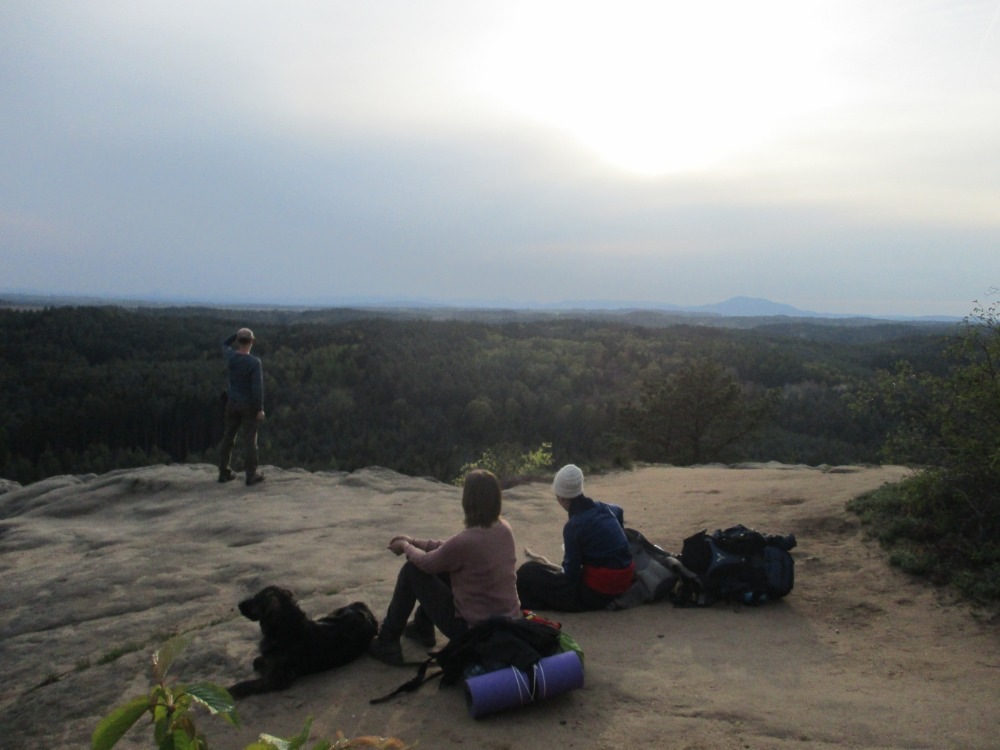
"Earth... I live with you, in you, on you, I feel with you and in you as you feel in me."
Karel Hynek Mácha (The Return)
Part of the pilgrimage activities of our association PILGRIM – The Wandering University of Nature, which was officially established in 2009, are primarily annual multi-day pilgrimages to certain specific places in the Czech landscape. They usually have the character of regular seasonal rituals and are mostly associated with poetry. The inspiration from the life story of Karel Hynek Mácha, the great poet-pilgrim, was key for us in this regard. Mácha traveled through many Czech landscapes during his short life and portrayed his experiences from these journeys in his work, in poems and prose, and in his Diaries. We followed in his footsteps, first to Kokořínsko and the Bohemian Karst, and later to the Giant Mountains. At the beginning of May 2003, I organized the first public “little máchov wandering", leading from Mělník via Kokořín and Houska to Bezděz. These May trips have become an annual tradition, although their route has gradually shifted more to the western Kokořín region, to the area of Vlhoště, Holanské rybníky and Úštěk, and to the eastern Bohemian Central Mountains (Mount Sedlo).
On the occasion of the exhibition From the ground over the hill to the sky …then I organized for the first time “great máchov pilgrimage", following in the footsteps of Mácha's legendary pilgrimage from Prague to Sněžka, which he undertook in 1833. We set out on this journey with a group of ten pilgrims on August 21, 2005, from Mělník. Since then, we have organized eleven more such large Krkonoše pilgrimages, on which we set off from Prague or Mělník. Since 2014, I have started to thematize the Krkonoše pilgrimages - the first time it was dedicated to the theme of the rite of passage (KH Mácha, Stanislav Grof, Malidoma Somé), in 2015 to the poet Vladimír Holan, the next year to the poets Kamil Bednář and Robinson Jeffres, in 2017 to Rainer Mario Rilke, and the following pilgrimages to the poets Václav Bolemír Nebeský and Milot Zdirad Polák and the painter CD Friedrich. In 2012, we began to reflect on Mácha's pilgrimage as a journey poetry also involved the landscape of Prague. We proposed a project The journeys of the poetry of Karel Hynek Mácha and Prague poets, which leads across the landscape of Prague: from Charles Square (where Mácha lived) through Vyšehrad, the Vltava embankment, Kampa, Petřín, Prague Castle, Letná and Stromovka to the observatory in Ládví, from where Mácha set out from Prague on his journey to Sněžka; the project commemorates important poets associated with Prague – R.M.Rilke, Jaroslav Vrchlický, Vladimír Holan, Jaroslav Seifert, Josef Hora, etc. – and evokes it as a city of poetry.
"In a sense, we all have to become poets."
David Abram
The concept of Karel Hynek Mácha's pilgrimage as paths of poetry It is related not only to the effort to commemorate Mácha's poetry and the poetry of some other poets within the local landscape, but also to the question that I also ask myself in this context, how we could revive or poeticize the world today. As the American philosopher Becca Tarnas says: "The earth needs new poetry."If we want to begin to address today's ecological devastation and truly care for the landscape, we must break free from the current detached language in which we speak only to ourselves and discover a new language that will allow us to develop a living contact with the more than human world around us. According to philosopher David Abram, "...language is primarily a matter of expression, it is the structured sounds by which our bodies call to other bodies, whether to the moon, or to the geese cawing overhead, or to another person. It is truly a kind of singing."So, couldn't we, on our journeys, like the Aboriginals do with their songs on their "song lines" ("song paths"), make the local landscape sing? Fill it with creativity and "songs" and truly connect with its life?
In connection with Mácha's great pilgrimage to Sněžka, my friends and I have been thinking about it for a long time, and in 2011 we even made a serious attempt to officially mark its route as a publicly marked pilgrimage route. The powerful story of Mácha's pilgrimage to the Krkonoše, which he reflected in his mystically tuned prose Pilgrimage of the Giant Mountains, also bears all the signs of an initiation pilgrimage; and also the origin of the famous poem May and the novel Gypsies is locally connected to the route of his journey. This offers the opportunity to present Mácha's life and work as part of a pilgrimage route and pay tribute to him, or to insert quotes from his poetry (including poetry by other poets) directly into the landscape and depict some of Mácha's themes through sculptural works. The topology of the route of this Mácha pilgrimage is also interesting: it begins in the center of Bohemia in Prague, leads through Mělník - the place where the two main Czech rivers Vltava and Elbe meet -, near which the mythical Czech mountain Říp is located, and then passes through Kokořínsko, Pojizeří, Český ráj, Jičínská kotlina and Podkrkonoší up to the Krkonoše to the highest Czech mountain Sněžka, where the Elbe originates. The route therefore passes through half of Bohemia, leads through several types of landscapes and provides a rich cross-sectional picture of the local cultural landscape. If it were officially established, it would create a field for artistic-ecological creative activities (festivals, celebrations, workshops) and would offer pilgrims the opportunity to better understand the Czech landscape and its rich cultural history. It would also create a natural zone of ecological and cultural stability, defending the organic integrity of the landscape, a “landscape without barriers”, without unnecessary fragmentation and devastation. And it would arouse in people a natural respect for the local Czech landscape as a whole. Such a great pilgrimage route, based on local cultural tradition and also connected with poetry, would undoubtedly be interesting in the European context.