
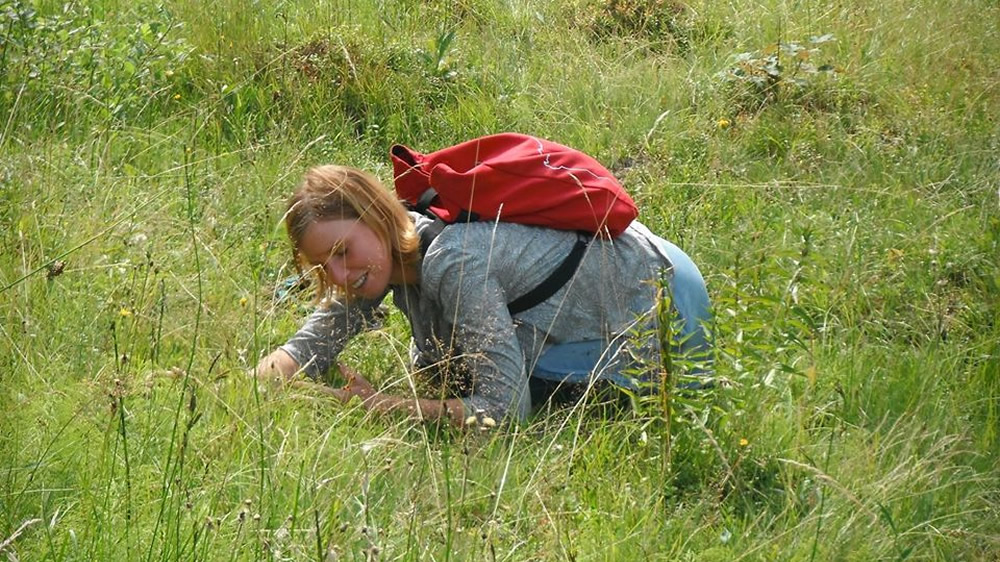
Barbora Kinkalová (born in Prague) studied film production at FAMU. She worked as a producer and executive producer on feature films, fiction films and documentaries (Czech Lion for Best Film of 2008 – The Karamazovs); she headed the production department at the National Film Archive. In 2018, she and her friends created the film Happy Farmers about the farm at the Plum Village Buddhist monastery in France. This experience led her to creative work as a director of ecological videos (for the AMPI Association, the Soil Foundation). See also: www.happyfilm.czHe also collaborates with Jan and Matyáš Trnkov (Zahrada 2) and promotes books by the Alferia publishing house.
One of the things that we often miss today, and at the same time, is resurfacing more and more as a theme, is our connection to the earth: the earth beneath our feet that carries and sustains us, and the entire planet that strives to maintain the conditions for life. How is it possible to truly physically perceive the earth? For me, that connection has become the experiences of working with plants and soil.
I harvest tomatoes. I touch their delicate skin, peel them from the branches, and put them in a crate. They have the fragility and at the same time the perfect firmness of just-ripe fruits, saturated with the summer sun, waiting to be picked and added to a large salad bowl in a few hours. I revel in the rich shade of red they have turned over the past few days. I breathe in their sweet, spicy aroma, which is exactly what I know from my childhood from my grandmother's harvest at the cottage. Sometimes I stop for a moment when an extra-nice tomato tempts me to put it in my mouth. Inhale, exhale, this is what paradise tastes like.
One tomato falls into the mulch that covers the long beds. I look for it under a thick layer of straw and feel the ground. The touch tempts me to stick my fingers all the way into the soil. It is incredibly plump, fluffy, it makes me want to rummage through it and let it tickle my palms. It is cooler under the surface, pleasantly refreshing in the summer heat. I scoop up the soil with both hands and stick my nose in it. It is such a rich and rich scent that I can't tear myself away, I inhale it like a wild animal and try to absorb all the subtle shades of this luxurious perfume. There are also a few bugs and mysterious mini-animals that are looking to quickly burrow inside, into the darkness. I look at a large earthworm crawling out of the edge of the hole. The earthworm can't see me, but it knows where it feels good and burrows back into the dirt.
After some time of work, I can even perceive whole plants. The hairy leaves of tomatoes, the crunchy knees of twigs, the firm stems rooted in the breathing soil under the straw. When I touch them, I feel that it is pleasant for them, just as they gently touch me. I know exactly what they need, just as they know what I need from them. My fingers and the branches of the plants have entered into a whirlwind of a common dance. The further we continue, the more graceful and economical the movements become, in a rhythm that is just right for me to harvest this row by lunch. The sound of a bell breaks me out of my fluidity – a moment to stop, inhale, exhale, straighten my back, look around, squint at the sun. I have solid ground under my feet, warmth begins to flow into them, they gain their weight and strength. Thanks to this support, my body can pleasantly soften, loosen, as if a person were to sink into a couch. I feel the earth where I stand on it and at the same time gradually in all its vastness, as it spreads out from me in all directions, beyond the hills with vineyards, where it can no longer be seen, to where it bends into an arc. This moment penetrates my body with all my senses and stays there.
Where can you experience this while harvesting tomatoes? Certainly anywhere, but for me the place was the Happy Farm eco-farm at the Plum Village Zen monastery in France. It was founded on the monastery grounds by long-term lay friends who participate in the monastery's operations by growing vegetables, organizing retreats, and sharing their practice.
But it wasn't just that. The ability to feel connected to nature was initiated for me by daily attempts to become aware of my own breath, body, emotions, thoughts, and by focusing on living in the present. The first step was to connect with myself, and then it was possible to expand my sensitivity further. Sensitivity to myself brings sensitivity to other living organisms.
In short, they call it that in the monastery "mindfulness practices" (mindfulness practice) and the most effective for me was the combination of these practices with work on the farm. Of course, meditation with hundreds of monks and visitors has great power, but all the other practices that are part of everyday life at Plum Village were equally powerful for me.
For example, walking meditation: people focus on their breath, on individual steps, they can perceive contact with the earth as if they were kissing it, they can enjoy the beautiful nature around them, and gradually the group connects into one larger whole and flows like a river. Or a short morning "meeting" of farmers, which they say "check-in", where after a moment of collective concentration, everyone can say how they feel. Thanks to this, others have the chance to find out whether it is better for a given person not to talk much that day, or if, on the contrary, they are full of energy. And thanks to this, the leader has the chance to assign people tailor-made work. Once or twice a week, an afternoon advisory circle is held, where individual members of the community can confide in others whatever is on their minds. It is a very healing practice, both for individuals and for the whole group, where participants often say what they themselves did not know until that moment. Eating can also take place in a quiet, calm perception of each bite, which was a problem for some passionate consumers of local food (they make their own great pastries, tofu and tempeh!), fortunately, perfection is not the goal. A great tool for returning to reality is certainly "mindfulness bell", which is a bell that hangs in the middle of the farm. Anyone can ring it, for everyone within earshot it is a signal to stop, to wake up from the endless stream of thoughts back to the perception of their own breath, to the place and moment where they are right now. It is practical, so such a bell can even be downloaded as an application for a mobile phone.
And above all, a balance between work and rest is important. Over the years, it has been discovered that farmers tend to overwork themselves during the peak season, which is not conducive to their satisfaction or community relations. That is why they also involve short-term interns – volunteers – during the summer. This way, the work is divided among more people and the farmers can maintain their daily routine with enough time for themselves. One day a week is called "lazy day" – a “lazy day” when we need to ask ourselves and others whether we are really lazy enough today.
On a symbolic level, this connection to nature and the Earth is also aided by plant metaphors, which the monastery's founder, monk, poet, and activist Thich Nhat Hanh, likes to use. "No mud – no lotus", or "Without mud, the lotus will not bloom" means that all difficulties can be a source of nutrients for a person for better times to come, for his further flourishing. And that he can deal with this mud you can sometimes encounter quite intensely during your stay here! The metaphor of composting has a similar theme, where it is about the realization that, just like waste materials, thoughts and feelings that we do not like can eventually become rich support for life, if they are given the right attention, care and enough time to transform. Also practical is “watering flowers” – “watering the flowers, which means consciously supporting and appreciating the good qualities and actions of others. It works, people really flourish when someone notices what they are doing well. And sometimes they even realize it themselves thanks to feedback from others.
But back to the ground. There are certainly many ways to truly perceive the land – or rather the Earth –, for example in a magical place in France, thanks to Zen practices. Or in the garden of a grandmother who has been talking to plants for a long time. Among indigenous peoples, who still have a connection with the land in their blood. Or in agriculture anywhere in the world, where man manages nature in harmony. But it will always be about an emotional connection, in which love is an important ingredient. The awareness of a relationship that has been with us from the beginning. We often don't know about it, but when we discover it, it's like finding a real treasure.
Film on the topic: 34-minute documentary "Happy Farmers" (directed by B. Kinkalová, cameraman J. Šípek) can be found on the portal www.dafilms.cz