
Summer seminar of the Traveling University of Nature
Program: Everything around me lives, feels, like me…

Finding a path to regenerative culture
dedicated to the poet Joseph von Eichendorff
August 10 — August 15, 2020
Ecocenter Rychleby
Luděk Čertík, Martin Nawrath, Pavel Janšta and Hiromi Ogata, Tomáš Daněk, Jaromír Bláha, Tomáš Hrůza and Andrea Průchová Hrůzová, Barbora Kinkalová, Jana Kožnarová, Tomáš Gardelka, Alena Malíková, Hana Bernardová, Lenka Kubelová, Michal Kristýnek, Zdeňka Morávková-Řezbová, Stephan Martin, Freya Mathews, Lara Mallien and Johannes Heimrath and George Zemanek.
“We have no independence, no integrity of our own as a species separate from the other species of this world, no collective existence as a creature separate from the living Earth. …Our true collective body is not the body of “humanity” as an independent abstraction, but the living Body of this breathing biosphere. That is us.”
David Abram
To live poetically…
Today we face the challenge of moving from the current destruction of the planet’s life systems to a new culture of regeneration and care that seeks the benefit and richness not only of us humans but of life as a whole. It is nothing less than an attempt to reintegrate human culture into nature. To move from the still prevalent and mostly foolish and unfortunate efforts to control and dominate nature to a deeper mutuality and synergy with the world. Cosmologist Thomas Berry once wrote that human society and the natural world will either go into the future as one integral community or they will experience misfortune along the way.
The basic premise of such a cultural transformation is a turn in our metaphysics, an abandonment of the dualistic idea of our separation from nature, which is now rejected even by science itself. The biosphere is clearly not just a collection of objects, but a community of subjects with which we are multifacetedly connected and in whose life we participate. Reality cannot be reduced to the mechanical laws of cause and effect; it is permeated with a psychoactive principle. It is an inexhaustibly living communicative world, which is capable, as ecophilosopher Freya Mathews states, of responding to us and establishing meaningful connections with us in the language of poetics.
This new panpsychic understanding of reality therefore gives us the opportunity to open ourselves to a deeper synergy with the world, which, according to Mathews, “it signifies entry into an expanded realm of eros, in which self and world mutually awaken to a greater and more radiant state of fulfillment." According to the German biologist Andreas Weber, nature embodies the desire for connection. When we are in contact with it, we are involved in an intense mutual exchange that stimulates our connection with other beings, which awakens our deeper selves and allows us to participate in the flowering of vitality within the biosphere. It is a path to a fuller and more mature life, which is the core of true sustainability. Recognizing the subjective nature of the world, according to Mathews, allows us to unite our desires with the desires and needs of the biosphere itself and to actively complement and co-create it and develop a truly ecological ethic. In this sense, I understand the quest for cultural regeneration as a challenge: Live poetically!
George Zemanek
Seminar
During the seminar, we will theoretically familiarize ourselves with some concepts of the above-mentioned ideological and cultural transformation: ecology of perception and ethics of language. David Abram, the philosophy of panpsychism and the practice of ontopoetics by the Australian ecophilosopher Freya Mathews, erotic ecology and the vision of the culture and politics of vitality of the German biologist and philosopher Andreas Weber, but also the concept of "return of enchantment" by Thomas Moore and the concept of the ecozoic era by Thomas Berry. Together we will then explore issues of ecological ethics (the rights of nature, ecocide) and learn about current efforts in the field of regenerative culture in the world and in our country.
At the same time, we will be inspired by the work of some poets and artists (Johann Wolfgang Goethe, Joseph von Eichendorff, Robinson Jeffers, Mary Oliver, Miloš Šejn, etc.) in how to listen to the world, how to unite with the inner dynamics of nature, how to read meanings from the language of the world. We dedicate a separate program to the last great romantic poet Joseph von Eichendorff (1788–1857), who came from the Upper Silesia region and spent the last two years of his life at the Jánský vrch chateau in Javorník. Two contemporary Czech poets will also present their poetic work to us. Ludek Certik and Martin Nawrath. A Pavel Jansta and Hiromi Ogata will introduce us to the Japanese classical poetry form of haiku.
Every day we will take trips to the captivating nature of the Rychleby Mountains. We will visit the Dance Hall in the Račí údolí nature reserve and Čertovy kazatelny, the Jánský vrch chateau near Javorník, Travná and Zálesí, Borůvková hora, Vysoký kámen and the ruins of the Rychleby castle. During the trips we will try to develop a deeper sensory and contemplative participation with the nature around us – with animals and birds, with plants and trees, with forests and meadows, stones and rocks, with the sky and stars, with the sun and earth, with the Moon and the Milky Way, with air and water, with light and gravity – in an effort to deepen our ability to identify with all life. We will use wandering, poetry, meditation, dance, song, a consultative circle, the language of myths and archetypes, ritual. We will develop poetic perception and poetize the world. Our guides on these trips will include, among others, a painter and a curator. Zdenka Moravkova-Rezbova, which will introduce us to the history and reconstruction of the Dance Hall and its other rich cultural curatorial activities (in Zálesí and Jeseník), and Michal Kristynek, a guide to the Rychlebské Mountains.
After the seminar, on Saturday, August 15th at 2 p.m., we will go to three-day hike from Račí údolí to the top of Králický Sněžník (1424 m above sea level). Some pilgrims will continue from here through the Orlické Mountains, Stolové Mountains and Broumovské Stěny to the peak of Sněžka (1602 m above sea level) in the Krkonoše Mountains.
"Jánský Vrch is a breathtaking place. It is an ancient, powerful castle on a high mountain, at the foot of which the picturesque town of Javorník lies. Around the castle is a large, very beautiful park with fountains. On one side there is a view of rocks and forest hollows, on the other an immense view of half of Silesia."
Joseph von Eichendorff
Jánský Vrch Castle in Javorník
City of Javornik in Silesia, near which our seminar will take place, is located on the geographical border between the Rychleb Mountains and the wide Polish plain with the nearby Otmuchów and Nysa lakes. This position on the border of the two areas is usually the place of greatest creativity. It seems that this creativity with the potential to regenerate culture is really dormant here, or rather, waking up, and that is also the reason why we are holding our seminar here.
Day 1, Monday, August 10
Accommodation in Ecocenter Rychleby (White Creek 152; 1 km northwest of the town of Javorník) will be possible from 2 p.m.
FROM 6:00 PM
Dinner
FROM 19.00 TO 22.00
Seminar launch and video call with Stephan Martin
Initial welcoming of seminar participants, introduction to its lecturers, program and location.
First, we will introduce you to the main ideas of the seminar and briefly introduce its program and its main actors. We will also discuss practical matters related to the stay at the Ecocenter and introduce ourselves to each other. We will briefly introduce you to the anthology of texts by David Abram, Andreas Weber, Hildegard Kurt and Freya Mathews, which we have published for this occasion. Finally, we will recall our last year's seminar on cosmology in the Beskydy Mountains with the American astronomer Stephan Martin, with whom we will connect via Zoom. Stephan will tell us something about his current collaboration with the educational cosmological platform Deep Time Network, which is dedicated to the new cosmology of Thomas Berry and Brian T. Swimm; and also something about what role he thinks the new cosmology could play in shaping a regenerative culture.
Day 2, Tuesday, August 11
FROM 8.00
Breakfast
FROM 9.00 TO 10.30
On synergy or how to think and create from within the world – lessons from David Abram and Freya Mathews / lecture by Jiří Zemánek
How to overcome the detached, reflexive attitude that is characteristic of our Western approach to reality and how to "return to the world" again? How to open up to synergy with animals, plants and larger living systems and think and "create from within the world"? Illustrated by examples of the work of some poets and artists (Goethe, Jeffers, etc.)
FROM 10.30 TO 11.15
On Panpsychism and Ontopoetics / online lecture by Freya Mathews
Lecture combined with communication (questions) with seminar participants.
FROM 11.30 TO 12.30
Lunch
FROM 12.40 TO 17.30
Trip to the Račí Valley, to the Dance Hall (10 km)
From the Ecocenter we will take the road to Javorník to the Jánský Vrch chateau, which we will pass, and we will follow the red trail to the spring of St. Anthony and then through the Devil's Pulpit to the Dance Hall in Račí údolí. Here, curator Zdeňka Morávková-Řezbová will introduce us to the history of the Dance Hall, its recent reconstruction and the rich cultural activities that are taking place here. Here we will see the current exhibition of paintings by the painter Jan Pražan and talk about his work. We will return to the Ecocenter via an alternative route.
FROM 6:00 PM
Dinner
FROM 19.00
An evening dedicated to the poet Joseph von Eichendorff / J. Zemánek with friends
We will learn about the life and work of this last great German Romantic poet, who is buried in nearby Nysa, and read his verses, which are characterized by a unique musicality and conciseness of form. According to Eichendorff's excellent Czech translator, the poet Ivan Slavík, Eichendorff's most characteristic note is "a quiet rapture over the world and over oneself, over beauty and pain."
"To live is to dance with an unknown partner whose steps we can never fully predict..."
David Abram


Dance hall in Rací údolí 
A look at the current exhibition of paintings by Jan Pražan in the Dance Hall
“The characteristic of synergy is that it allows for a very immediate experience of intersubjectivity. In synergy, your subjectivity immediately affects my subjectivity. … Take dance as an example: in forms such as tango and contact dance, the subtlest movements of each partner shape the movements of the other in an unmediated and spontaneous way…”
Freya Mathews
Day 3, Wednesday, August 12
FROM 8.00
Breakfast
FROM 9.00 TO 10.30
He feels everything – on the erotic ecology of Andreas Weber / lecture by Luďek Čertík
With reference to the “Revival Manifesto”: Traditionally, ecology is understood as the science of the relationships between living beings and their “enlightenment”. However, the German biosemiotician and natural philosopher Andreas Weber offers a different perspective; he understands ecology as a “tender” erotic practice. But all this is preceded by the question: What is life?
FROM 11.30 TO 12.30
Lunch
FROM 1:00 PM TO 5:30 PM
Trip to Travná and Zálesí (19 km)
Let's go to Mosquito valleys, to Seven crosses and follow the green to the crossroads AIRPORT (734 m above sea level). From here we descend to the chapel Our Lady of Sallet with the Stations of the Cross and on to Grass with a beautiful neo-Gothic church Immaculate Conception of the Virgin MaryFrom Travná along the blue path to the upper part of the village Woodland at the state border to the chapel St. Urban, a former pilgrimage site; there is a beautiful view of the valley with the village of Zálesí from here. Zdeňka Morávková-Řezbová, who transformed the chapel into a gallery space where she exhibits contemporary art, will introduce us to her curatorial activities and will also present the installation in the newly opened museum of the history of the village of Zálesí that she created there. Luděk Čertík will spontaneously improvise his poetic speech to the world at the chapel, accompanied by a (North American) Indian flute. Then, led by Barbora Kinkalová, we will set off on a wordless, silent Zen meditation walk, inspired by the reading of a text by the great Buddhist teacher Tich Nhat Hanh.
FROM 6:00 PM
Dinner
FROM 19.00
Reading of poems by Luďek Čertík and lecture by Tomáš Daňek
Luděk Čertík will read poems from his poetry collection together with his friends. Many rivers. Then a lecture by Tomáš Daňek (Palacký University in Olomouc) Alone in the midst of (too) many. A panopticon of the lost on the threshold of human age : "We live in a world where there is too much of everything that has to do with humans. The organic flowing mosaic of nature has turned into a clip-like collage of its representations, through which we cannot see. However, we should not drink the current ocean of information, but learn to swim in it. I will try to show a few windows and maybe we will even catch a glimpse of nature."
"In order to protect the biosphere, we must focus our activities on the image of living reality."
Andreas Weber


The village of Travná with the Church of the Immaculate Conception of the Virgin Mary 
Installation by O. Bystrický in the Chapel in Zálesí
give the bees a drink
Ludek Certik
from my heart
let the tigers sleep
on the threshold of your dreams
Be gentle with life.
in a time of hatred
Day 4, Thursday, August 13
FROM 8.00
Breakfast
FROM 9.00 TO 10.15
On the Soul of the World and the Return of Enchantment / Lecture by Martin Nawrath
Martin, instructed by James Hillman and Thomas Moore, will circle around his fascination with the world on his life's journey and try to bring it into a common dialogue about today and possible forms of conversation with and about the Earth.
FROM 10.15 TO 11.00
The classic Japanese poetic form of haiku / Pavel Janšta and Hiromi Ogata
Haiku expresses the essence of a perceived moment, a natural phenomenon, a life situation in an extraordinary brevity. It is connected to the path of Zen and in the original haiku masters (Basho, Buson, Issa, etc.) it is characterized by the ability of an enchanted child's view of the world, in which the self and the world mirror each other. We will read some of the classic haiku poems and then, on a trip led by Pavel and Hiromi, we will each try to compose our own haiku.
FROM 11.30 TO 12.30
Lunch
FROM 12.45 TO 17.30
Trip to Vysoký kámen and Borůvkova hora (18 km)
We are going to the crossroads. Border stream , from there follow the red road to the gamekeeper's lodge Hosticky stream and on to Tall stone (691 m above sea level), to a 20 m high gneiss rock, from where there is a beautiful view of Poland; then we will continue under White Rock except for Blueberry Mountain (899 m above sea level), where the lookout tower is located. From Blueberry Mountains we will return after the blue AIRPORT and from there on the green through Seven Crosses to the Ecocenter.
FROM 6:00 PM
Dinner
FROM 19.00
Joint debate on ecological ethics
We will try to think together about how our ecological ethics, which applies to the entire earthly community, could develop when we realize that we live in a living, i.e. psychophysical world, not just in a world of material resources. We will deal with the dilemmas of the rights of nature and the challenge of ecocide. The discussion will be moderated by Luděk Čertík; also Jaromír Bláha from Hnutí DUHA, Martin Nawrath, Tomáš Daněk, Jiří Zemánek, Lenka Kubelová, etc.
"Nature is a magical place, and human culture is an effort to evoke and maintain the magical."
Thomas Moore


High Stone (691 m above sea level) 
Borůvková hora (899 m above sea level)
Like a stream
Monk Ryokan
winding with moss
I am clean and transparent.
Day 5, Friday, August 14
FROM 8.00
Breakfast
FROM 9.00 TO 9.40
New Utopias / Tomáš Hrůza and Andrea Průchová Hrůzová
Introducing the new issue of the magazine Photographer, which aims to look at the phenomenon of utopia from a new perspective of 21st century society - with the help of sharing knowledge, resources and emotional support. It shows personalities and projects (Futurefarmers, etc.) that in today's time of crisis and uncertainty can inspire one's own activities, crossing the boundaries of imagination towards the public space.
FROM 9.40 TO 10.50
Islands of the Future / on forms of regenerative culture in the world / Jiří Zemánek and Martin Nawrath
About visions (T. Berry, A.Weber, Ch. Eisenstein, F. Mathews) and current forms of regenerative culture. We will recall some intentional communities (Tamera, Damanhur, Findhorn, Klein Jasedow, etc.) and urban communities (Transition Town), which develop a new story of coexistence and discover new technologies, reconnecting man and nature, body and mind, etc.
FROM 10.50 TO 11.30
Presentation of the activities of the community from Klein Jasedow / communication via zoom with Johannes Heimrath and Lara Mallien
The German community from Klein Jasedow, with which we have been working for twenty years, is one of the most inspiring communities in Germany (magazine Oya, Center for Transformational Learning, European Academy of Healing Arts) with a long history. We will learn about their activities, experiences and opinions on the current civilizational transformation.
FROM 11.30 TO 12.30
Lunch
FROM 12.45 TO 17.30
Trip to the Račí Valley (15 km)
We will set off along Border stream and at the edge of the forest we turn red onto the road to Grass; we will walk around it Chapel of the Secret Passion up to God's torment with a statue of the knitting Madonna (guerilla art). We will continue along the road towards Woodland, but at the crossroads we turn left and follow the green path until we reach the The Devil's Pulpits and continue along the red road to the castle ruins Rapids. Here Martin Nawrath will read us his poems and texts and we will complete a voice workshop with Jana Kožnarová. Then we will return the same way and go down to Račí údolí, where we will organize a dance celebration in the Dance Hall, led by Milena Chalupová, which will end the seminar.
FROM 6:00 PM
Dinner
FROM 19.00
Forms of regenerative culture in our country
We will imagine how efforts to "revive" - landscapes, economy, agriculture, forest care, culture, politics, education - are developing in our country. What are ecological organizations doing in this direction and what is new in this field today. We will also present our own activities: moderated by Martin Nawrath; participants will include: Alena Malíková, Hana Bernardová, Jana Kožnarová, Barbora Kinkalová, Lenka Kubelová, etc. We will end the debate with a consultative circle.
"Only when our new allegiance to all life becomes our cultural aspiration will the Anthropocene truly deserve the label 'the age of humanity.'"
Andreas Weber and Hildegard Kurt


Braided Passion of Jesus near Travná – knitting Madonna (guerrilla art) 
Ruins of Rychleby Castle
Day 6, Saturday, August 15
FROM 8.00
Breakfast
FROM 9.00 TO 9.30
Final meeting, farewell and departure home.
"I do not believe that we have much chance of curing our social ills or the numerous injustices we cause in various parts of human society without reviving the wild eros between ourselves and our sensory surroundings - without 'falling out of love' (R. Jeffers) into this earthly cosmos that embraces us."
David Abram
Lecturers
- George Zemanek — art historian, curator, translator and cultural activist / PILGRIM
- Ludek Certik — environmentalist, poet, publicist, editor-in-chief of Milk & Honey magazine
- Martin Nawrath — facilitator, therapist, lecturer, consultant, essayist and poet / Partnership Foundation
- Pavel Jansta — conceptualist, haiku author, traveler, municipal politician
- Hiromi Ogata — Japanese painter, graphic artist, bohemianist, translator
- Tomas Danek — university lecturer, researcher and coordinator of environmental studies at the Faculty of Science, Palacký University in Olomouc
- Tomas Hruza — artist and educator / ArtMap, Fotograf magazine, PILGRIM
- Andrea Průchová Hrůzová — teacher at Charles University and Scholastica, researcher at the Czech Academy of Sciences – Institute for Contemporary History, founder and dramaturg of the FRESH EYE project
- Jaromir Blaha — veterinarian and ecologist, head and founder of the Forests program in the RAINBOW Movement;
- Barbora Kinkalova — producer of feature and documentary films, director of eco-videos / PILGRIM
- Jana Koznarova — in the AMPI Association, she takes care of developing relationships within the KPZ, voice therapist / PILGRIM
- Hana Bernardová — interpreter, translator, liaison, guides advisory groups, cooperates with the Pro Půdu Foundation
- Milada Chalupova — Dances Universal Peace teacher (round dances of all traditions)
Communication via Zoom
- Stephan Martin — American astronomer, lecturer, psychotherapist, associate professor of psychology and holistic science at John F. Kennedy University in Pleasant Hill, California
- Freya Mathews — Australian philosopher, professor of ecological philosophy at La Trobe University in Melbourne
- Johannes Heimrath — German composer, sound therapist, personal development consultant, publicist, editor, co-founder of the creative community in Klein Jasedow
- Lara Mallien — German journalist, editor-in-chief of OYA magazine, dancer / community in Klein Jasedow
Collaborators
- Tomas Gardelka — graphic and web designer / PILGRIM
- Alena Malikova — administrator of the Moravian Gate regional center in Příbor / PILGRIM
- Lenka Kubelova — visual artist and editor of the Alferia publishing house
- Petr Lisy — astropsychologist, translator, interpreter, editor-in-chief of the Archea magazine
- Michal Kristynek — surveyor, cartographer, personal development guide and guide to the Rychlebské Mountains
- Zdenka Moravkova-Rezbova — painter, illustrator, curator of programs and exhibitions at the Dance Hall in Račí údolí, dramaturg of the festival In the center / Im Zentrum in Jeseník
Venue
Rychleby Ecocenter / Bílý Potok 152, 790 70 Javorník in Silesia

Rychleby Ecocenter – building A 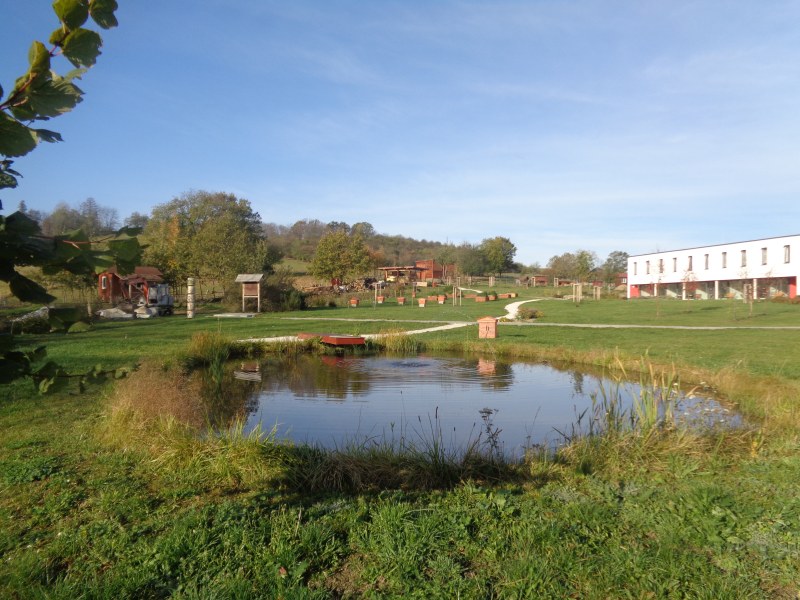
Rychleby Ecocenter – building B and pond
Transport
From Prague you can get to Javorník in Silesia by bus with a transfer in Jeseník or by train with a transfer in Zábřeh and Lipová lázně.
Train connection on Monday 10 August from Prague Main Station:
Departure. 9:23 (Prague main station) → arrival 11:22 (Zábřeh na Moravě) – departure 11:31 (Zábřeh na Moravě) → arrival 12:50 (Lipová Lázně) – departure 13:09 (Lipová Lázně) → arrival 13:57 (Javorník in Silesia).
Departure. 11:23 (Prague main station) → arrival 13:22 (Zábřeh na Moravě) – departure 13:31 (Zábřeh na Moravě) → arrival 14:49 (Lipová Lázně) – departure 15:09 (Lipová Lázně) → arrival 15:57 (Javorník in Silesia).
From the train station in Javorník, it is 1.5 km to the Rychleby Ecocenter by walking to the center of Javorník and from there along the road towards Kemp Červenka.
"When we learn 'about' nature, nature becomes the object of study, which leads to its exploitation. But when we learn 'from' nature, we establish a close relationship with it, which presupposes humility and respect for the mystery of natural processes."
Satish Kumar

PILGRIM – The Wandering University of Nature
Nature for us is not primarily a collection of objects or a reservoir of usable raw materials, but above all a community of soulful subjects, a meaningful world that shapes, inspires, nourishes and supports us and with which we feel connected. We share Gregory Bateson's conviction that nature holds the secret to revitalizing our human systems, to growing the health of human communities and to healing our relationships. Today, we need to expand our intellectual knowledge of nature by learning directly from nature itself, by experiences and experiences that allow us to connect intimately with its processes.
Contacts and other information
George Zemanek
sarvanga@centrum.cz
777 117 466
Alena Malikova
alena.malikova@bioinstitut.cz
604 905 611
Tomas Hruza
tomashruza@gmail.com
775 052 607
Barbora Kinkalova
B.KINKALOVA@seznam.cz
776 123 969
As if he were here from heaven
circle of earth kisses
and had to in the glow of flowers
just dream your dream about him.
The van touched the field,
The ears of corn were swaying,
The forests rustled below
and the stars rose.
My soul was expanding
spread your wings in wide flight,
She passed through the silent world,
like flying back home.
Joseph von Eichendorff, Moonlit Night
(translation: Ivan Slavík)