
May journey in the footsteps of Dresden romantic landscape painters Adrian Zinng and Caspar David Friedrich
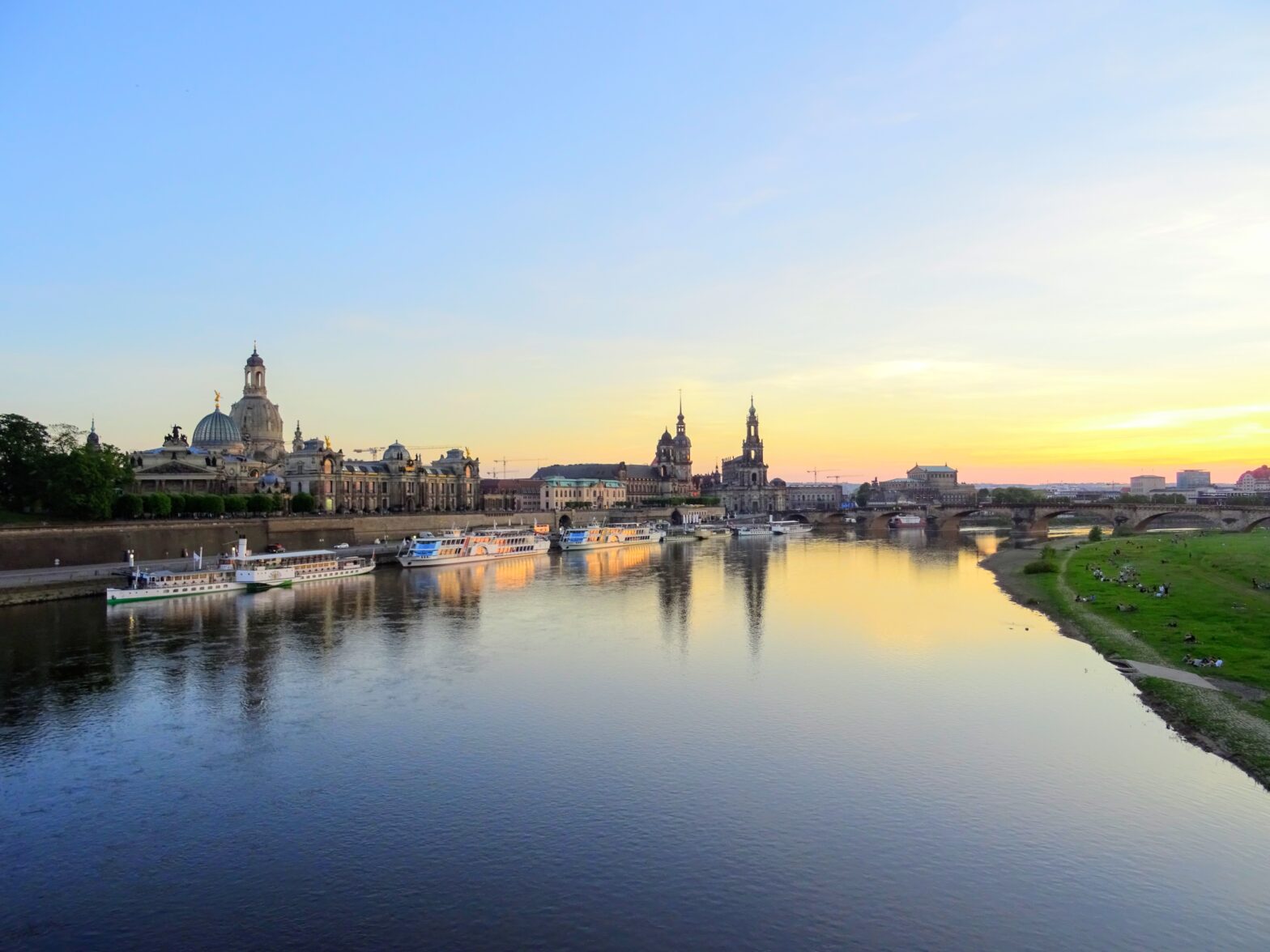
Dresden (reprophoto)
along the "Painter's Path" route from Dresden through the Saxon Switzerland National Park to Bohemia
Dresden, Pillnitz, Borsberg, Lohmen, Liebethal Valley, Uttewald Valley, Stadt Wehlen, Bastei, Hohnstein, Brand, Altendorf, Lichtenhain Waterfall, Kleiner Winterberg, Grosser Winterberg, Schmilka, Kaiserkrone, Zirkelstein, Hřensko (82 km)
Thursday, May 8 – Sunday, May 11, 2025
"Dresden – beauty was invented here. Nothing but the river and meadows – in the softest colors and in fairy-tale light."
Johann Joachim Winckelmann (1755)
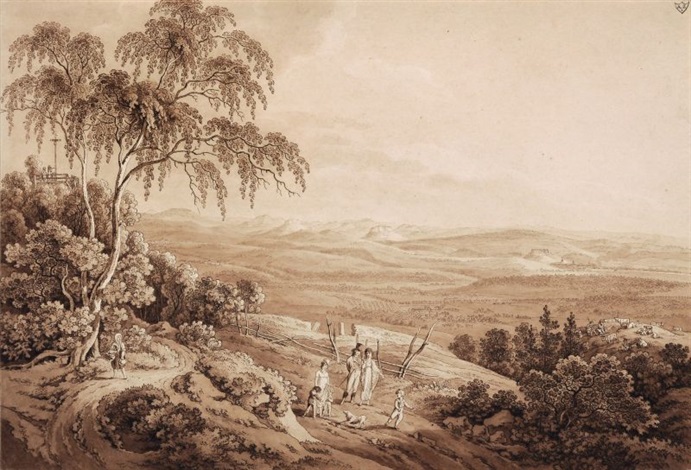
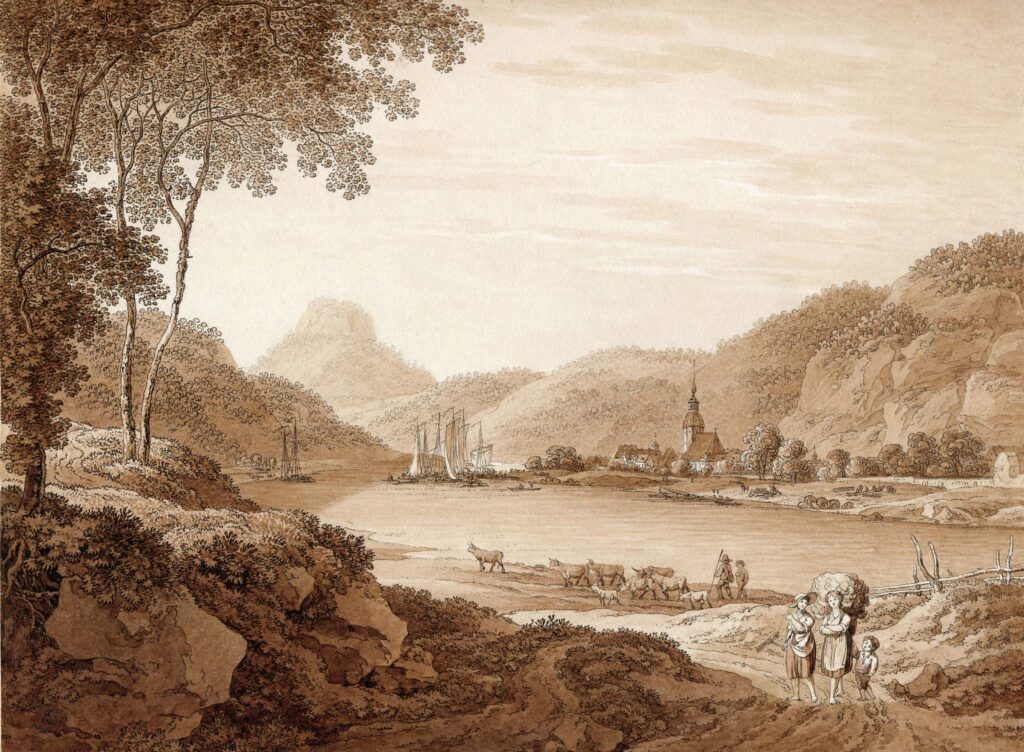
Dresden has been an important European art center since the mid-18th century, where a number of outstanding artists worked, primarily painters and graphic artists, but also poets, writers and philosophers. Even before that, Dresden painters (such as JAThiele) had already begun to set out on foot in search of their landscape motifs into the Elbe Sandstone landscape, to the mesas of Königstein and Lilienstein and further into Bohemia. However, the discoverers of this unique rocky landscape are primarily two Swiss artists – the landscape painter and copper engraver Adrian Zinng (1734-1816) and the portraitist Anton Graff (1736-1813), with whom the origin of its name Saxon Switzerland is also associated; both came to Dresden in 1766 to become teachers at the Dresden Academy of Arts. However, the real artistic discoverer of the landscape of Saxon Switzerland is primarily Adrian Zinng, who was fascinated by this landscape from the beginning and who captured its motifs in many of his drawings and graphics. As a teacher of etching at the Dresden Academy, Zinng influenced a number of Dresden landscape painters, including the painter CD Friedrich (1774-1840), who is considered Zinng's most important heir. If Adrian Zinng is the pioneer of Dresden Romantic landscape painting, CD Friedrich is its most important representative.
On our second May journey this year, we will set off from Dresden to the countryside of Saxon Switzerland, mostly along the so-called Malerweg (Painter's Path). We will primarily remember the work of Zingg and Friedrich, but also other important Dresden artists (Johann Alexander Thiele, Johan Christian Dahl, Carl Gustav Carus, Adrian Ludwig Richter). We will also try to explore how CDFriedrich saw certain motifs that he depicted in his paintings and how he composed his paintings. The painter's paintings can teach us to sharpen our vision and awaken our senses.
Thursday 8. 5.
Prague – Dresden, Zwinger, Großen Garten, Pillnitz Castle, Borsberg (19 km)
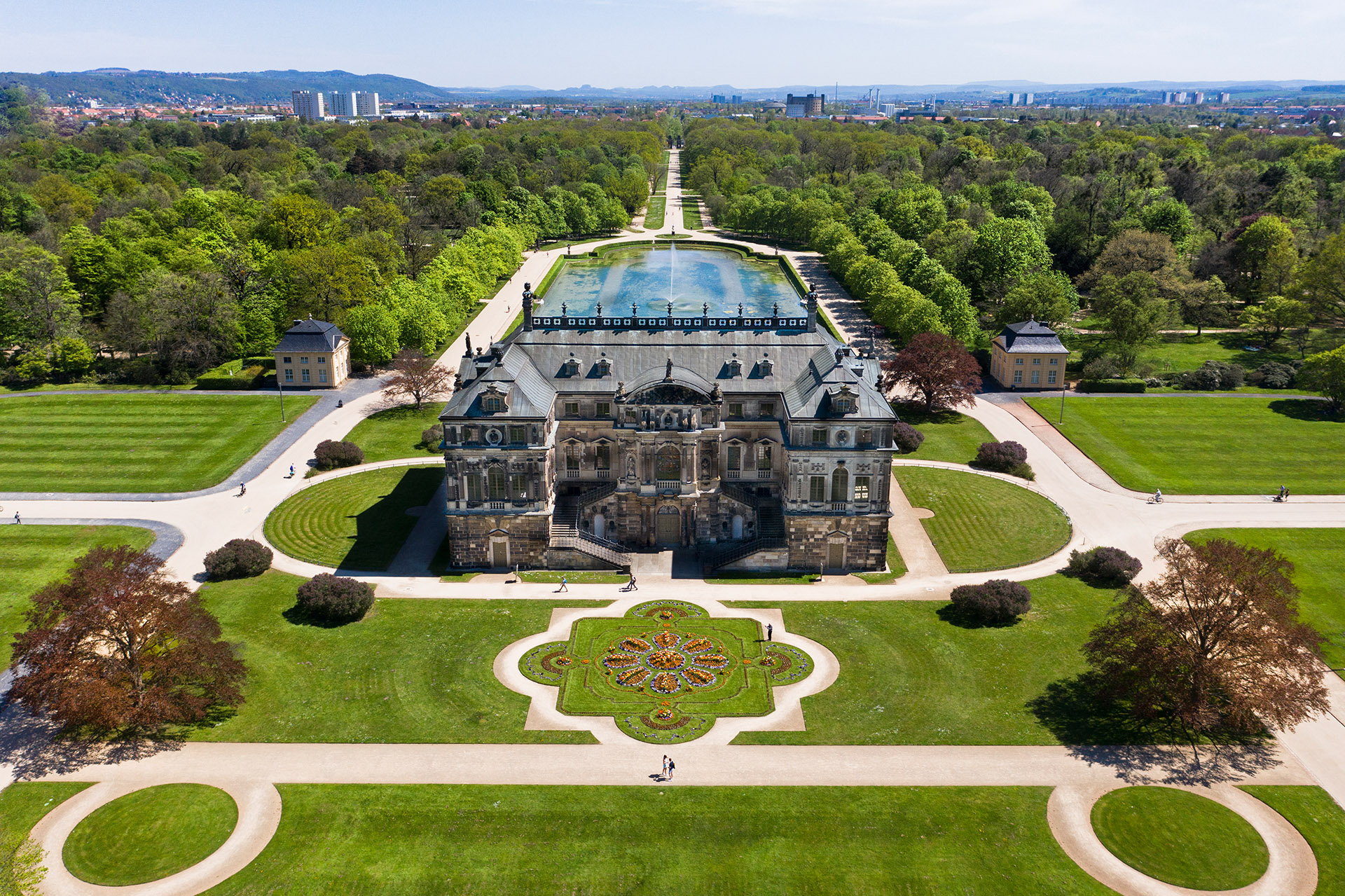
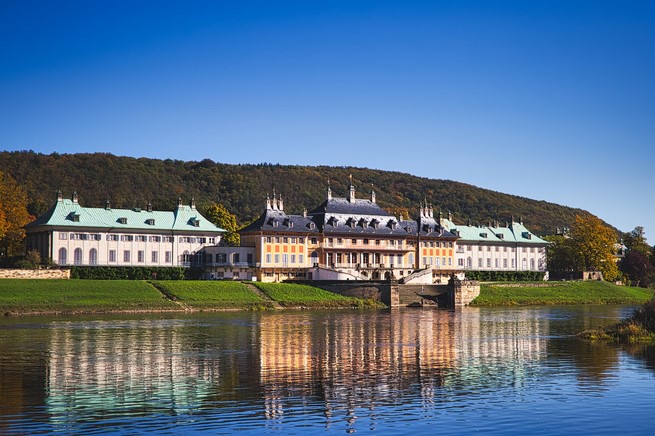
We will meet in Prague at the main train station, from where we will leave at 6:28 by express train to Dresden, where we will arrive at 8:50. From the train station we will head to the old town, where in Albertina we will visit the Paula Modersohn-Becker and Edward Munch exhibition. Then we will stop for lunch at Neumarkt and then head to Large Garden, the largest and originally Baroque park in Dresden, in the center of which there is a beautiful Summer Palace, an important German early Baroque building, which we will visit. We will reach the end of the park, take the next 7 km to the Elbe by public transport and then take a ferry across the Elbe to Pillnitz Castle. The castle, which originally served as the residence of the Saxon electors, is an example of the European chinoiserie style, imitating Chinese interiors and exteriors; its upper palace was modeled after the imperial palace in Beijing. The Danish writer Hans Christian Andersen described Pillnitz Castle as a “great Chinese toy”. We will explore the interiors of the castle and its garden, then follow the red-marked path into the idyllic forest area above the Pillnitz vineyards and reach the top Borsberg (362 m) with a six-meter-high sandstone obelisk. From here, it is possible to see for the first time a magnificent panoramic view of the mountains of Saxon Switzerland, which was depicted in the works of many Dresden artists - including Adrian Zinng - who set out on their expeditions from here. We will spend the night under the Borsberg in the forest under the Śrík.
"Konigstein, Lilienstein, Pfaffenstein and then Winterberg and behind it the huge mountains of Bohemia... it was incredibly beautiful."
Phillip Otto Runge after visiting Saxon Switzerland in May 1802
Friday 9.5.
Borsberg, Zachsendorf, Leibethal Valley, Lohmen, Uttewald Valley, Stadt Wehlen (20 km)
In the morning we will leave Borsberg for Zaschendorf and from there through the forest to Liebethalto the river Wesenitzwhere the famous begins Liebethal Valley and also the Painter's Path (an alternative route leads here via Graupa and Jessen). From Liebethal we will continue through the deeply cut rock valley of the Wesenitz river to the monument to the composer Richard Wagner (the largest Wagner monument in the world from 1912) and to the former mill and the lake of the same name Lochmühle, near which there is a beautiful river waterfall. Richard Wagner stayed in nearby Graupa in 1846 and often passed through the Liebethal Valley on his trips to Saxon Switzerland; he is said to have written part of his opera Lohengrin here. The dramatic rocky landscape of the Liebethal Valley with the currents of the wild Wesenitz River was captured in their graphics and paintings by Adrian Zinng, Johann Christian Dahl, Ludwig Richter and others. From Lochmühle we reach the mill Daubemühle and we will continue through Muhldorf to Lohmen Castle and from there along the Wesenitz River to the weir Lohmener GorgeHere we turn onto the Painter's Path and follow it to the eastern part of Lohmen on Basteistrasse.
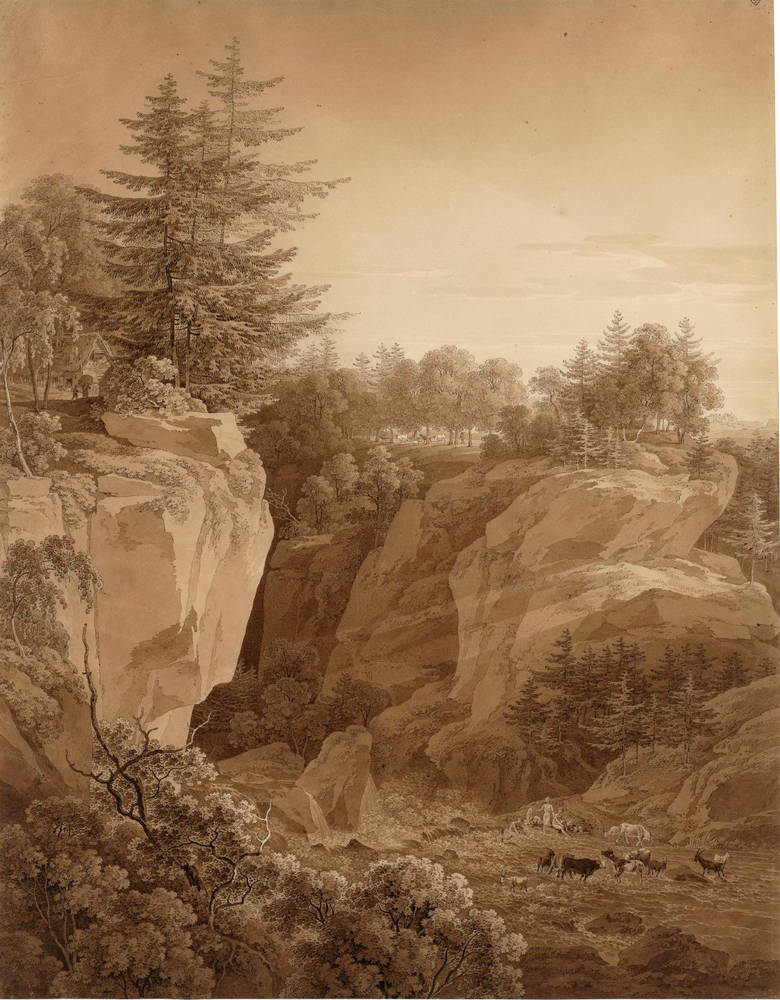
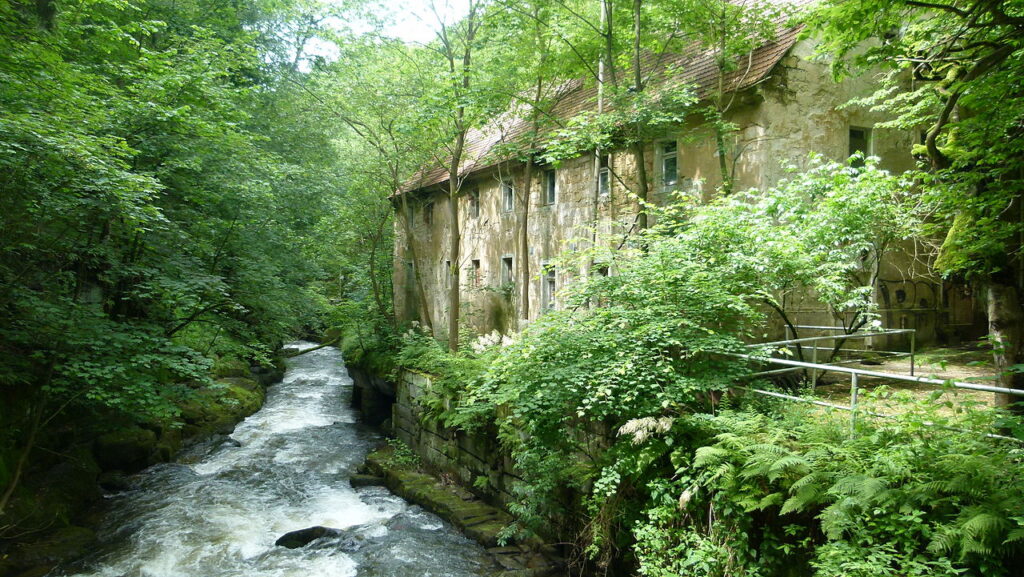

Around 1800, Lohmen was already considered the gateway to Saxon Switzerland. At that time, the Lohmen pastor and passionate tourist Carl Heinrich Nicolai worked here, who wrote the first tourist guide, which caused a sensation and established a standard route through Saxon Switzerland, which is now called the "historische Malerweg". From Basteistrasse we turn onto Sandweg and continue to the village Uttewalde and from there to Uttewald Valley. The sudden and steep descent from Uttewalde down narrow steps into a deep, narrow and dark rock gorge, whose 35-metre-high walls rise steeply upwards, has on ordinary human perception the effect of a surprisingly intimate immersion in solitude and the deep chthonic silence of the earth. And this is precisely what made this place so powerfully impression on Caspar David Friedrich on one of his first visits. In 1800, he spent a whole week here in complete solitude, and 25 years later he depicted this experience in his magical painting Uttewald Valley. A year later, he transformed the drawing of the famous rock gate, which he had sketched there in 1800, into an impressive sepia print, in which he expressed feelings of horror at the great power of the forces of nature and at the same time reversible feelings of ecstatic delight. Similarly, the Dresden art historian Karl-Ludwig Hoch said about the Uttewald Rock Gate: "Here, horror has turned into delight."
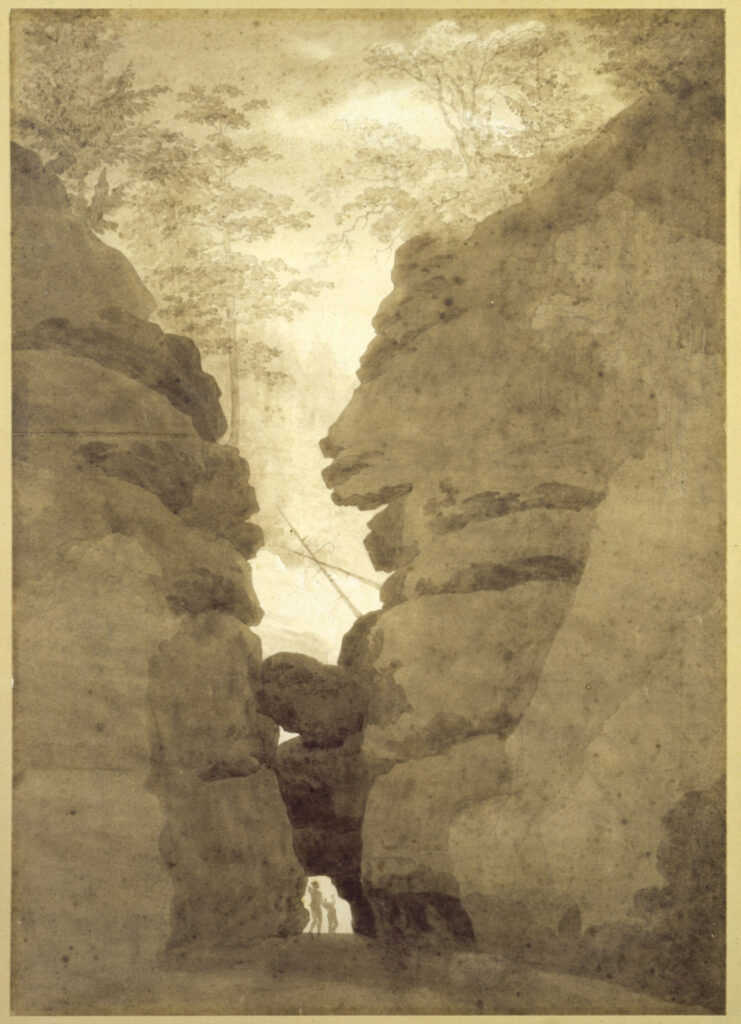
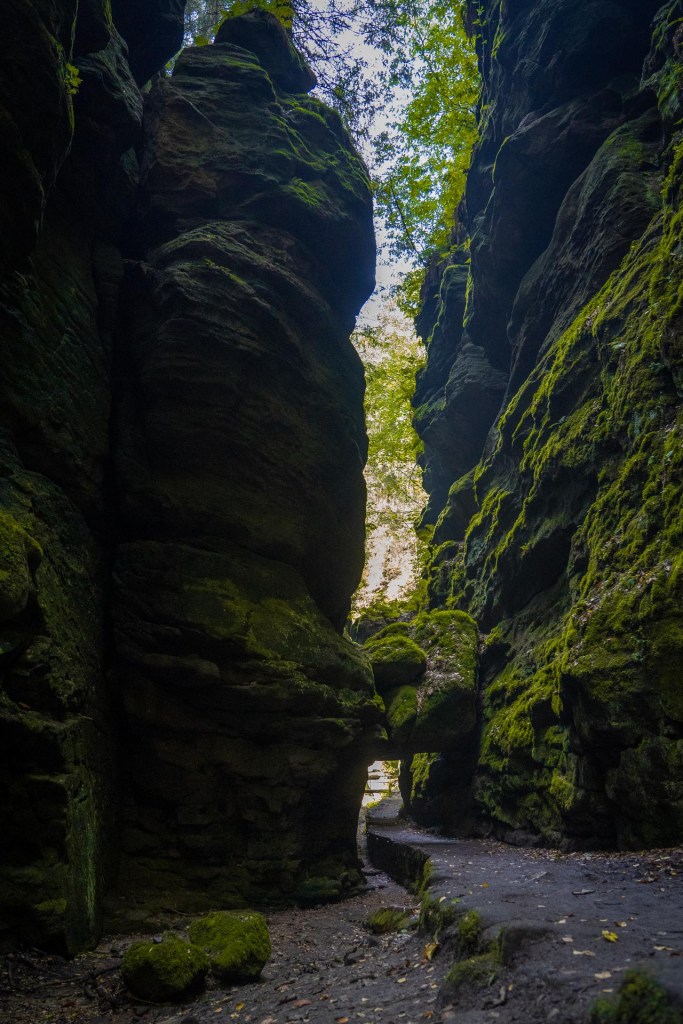
"I need solitude to communicate with nature. I once spent a whole week in the Uttewald Valley among the rocks and fir trees and in all that time I didn't meet a single person."
Caspar David Friedrich, 1800
“As we pushed our way along the narrow, hollow path, the rocks rose vertically to the right and left, closing us in with walls. … Various hollow paths branch off from the main path, winding in many directions and passing through vast, strangely shaped caves, some open to the sky, others dark and deep.”
Mary Shelley, 1841 (Rambles in Germany and Italy)

From the rock gate we will continue through the valley to other interesting rock formations. Devil's Kitchen and Devil's Chamber and finally we will go down to the Elbe River to the charming old town City of Wehlen, where we will have dinner. Then we will head along the banks of the Elbe towards Rathen, where we will look for a place to spend the night.
Saturday 10. 5.
Stadt Wehlen, Bastei, Kurort Rathen, Hockstein, Hohnstein, Brand, Waitzdorf, Altendorf (24 km)
In the morning we will head upstream from the Elbe River and at the gazebo we will turn right along the path into the valley. Hirchgrund, which we will take to the old "Fremdenweg" and follow it to the viewpoint Bastei. There is a unique view of the Elbe Valley and the mesas of Saxon Switzerland from here. It is interesting that CD Friedrich never used tourist attractions such as the Bastei lookout or the Pravčická Gate in his paintings. We will reach the famous Neurathen rock gate, whose central motif of a group of rocks CDFriedrich depicted in his painting Rock gorge (1822-23) as a typical romantic picture of the Elbe Sandstone landscape (without the tourist bridge, however). The picture expresses the inaccessibility of the top group of rocks, pointing like fingers of a hand, pointing upwards to the sky, in contrast to the dark wild abyss with an uprooted tree. We descend to Rathen Spa and we'll go here to Rhododendronpark, from where there is supposed to be a nice view of other remarkable rock formations of Saxon Switzerland, which Friedrich captured in his drawings and watercolors: Little Goose, Feldstein, Hönigstein and GamringWe know that Friedrich probably stepped on Lilienstein (409 m), from where unique panoramic views towards Bohemia are offered. We will eventually climb to Gamring (253m), which Friedrich drew in 1808 and later transferred to the famous painting "Pilgrim above the Sea of Fog" (1818).
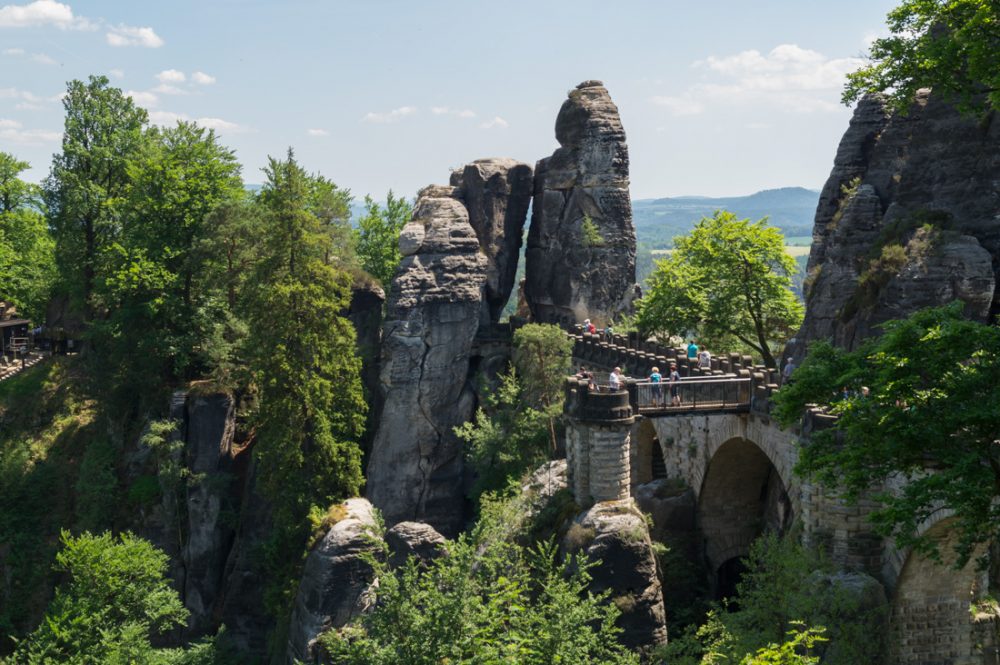
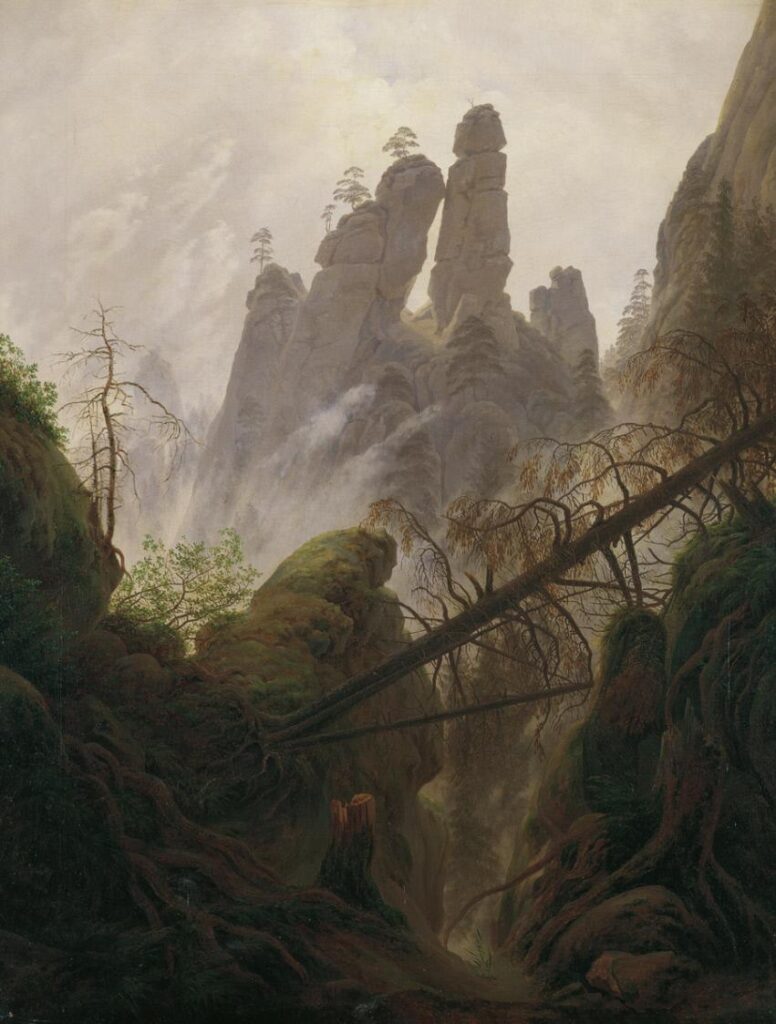

“As soon as you enter the valley through which the Grünbach River flows, you immediately encounter a remarkable peculiarity. On the opposite hill, a single high rock face catches your attention… This strangely pierced large rock is called the Feldstein and is… surrounded by cornfields.”
Wilhelm Lebrecht Götzinger, 1804 (Schandau und seine Umgebung)
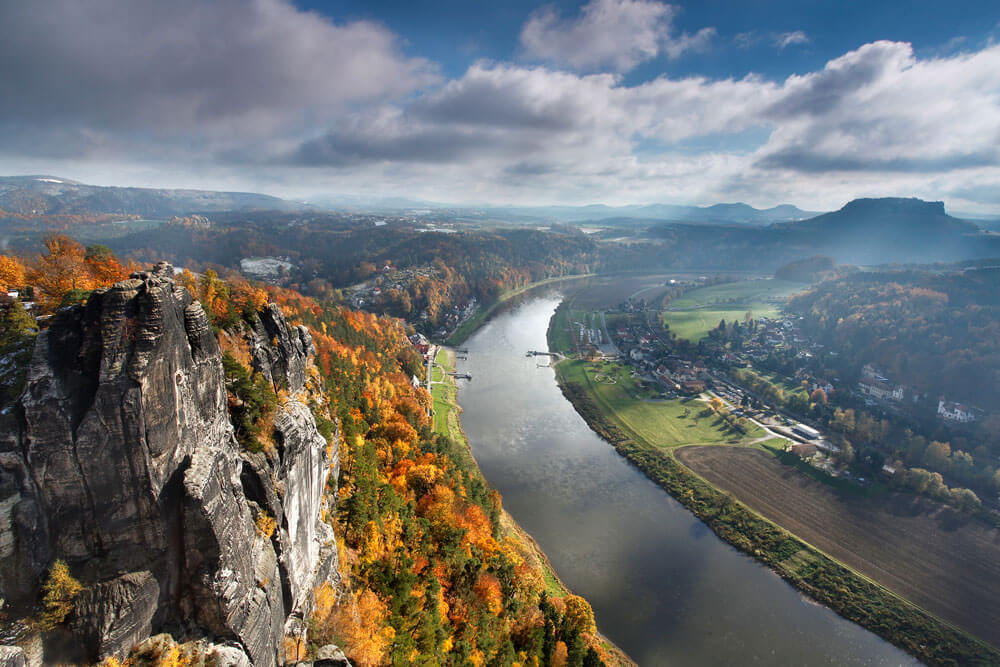
From the Elbe from Rathen Spa we will go to the valley Amselgrundthrough which a river flows Grünbach; after about a kilometer we turn right onto the green marked path that will lead us to the top Hockstein (291 m), where the castle once stood. We will climb it through Devil's Bridge (Devil's Bridge), which Hans Christian Andersen colorfully describes in his travelogue Saxon Switzerland (1831). From Hockstein you can see into a deep valley with a meandering river Polenz and to the picturesque historic town Hohenstein, depicted by many painters and graphic artists including Adrian Zinng and CDFriedrich, who loved this secluded area of the Elbe Sandstones; just as the young theologian WL Götzinger loved it, who published its first descriptions in 1786. The narrow Wolf's Gorge we will descend into the valley of the Polenz river, from where we will set off along the stream Schidergraben through the ravine forest (which was captured in 1800 in his drawings by CDFriedrich) to Hohenstein, which is dominated by the building of the central castle, which rises 140 meters above the river valley on a sandstone rock. We will see the castle and have lunch here.

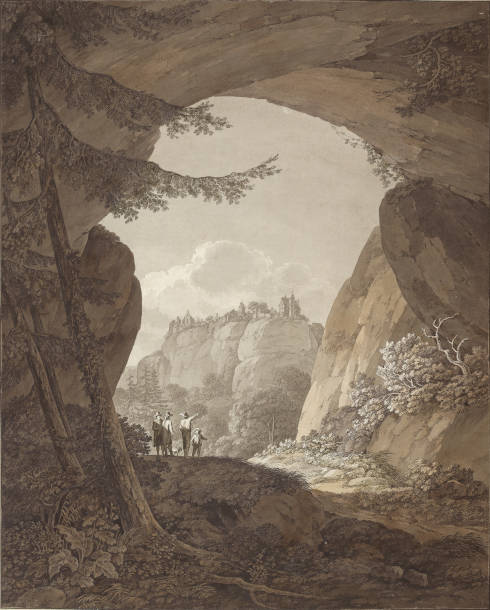
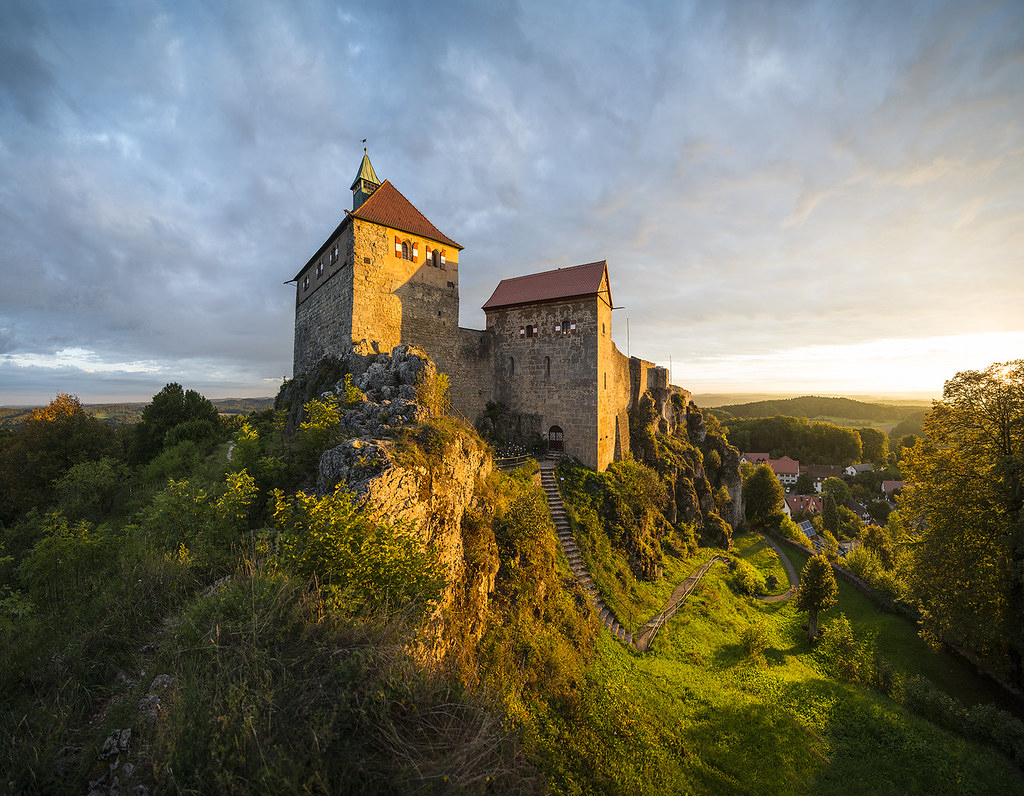
"Soon we were at Hohenstein, a small mountain village with a castle. Its dingy arches had once been a prison; I found that fresh, fragrant rose, which someone must have lost, and it touched me far more here than if I had found it in the shimmering sunlight on a green twig swaying above the stream."
Hans Christian Andersen, 1831 (Report of a trip to Saxon Switzerland)

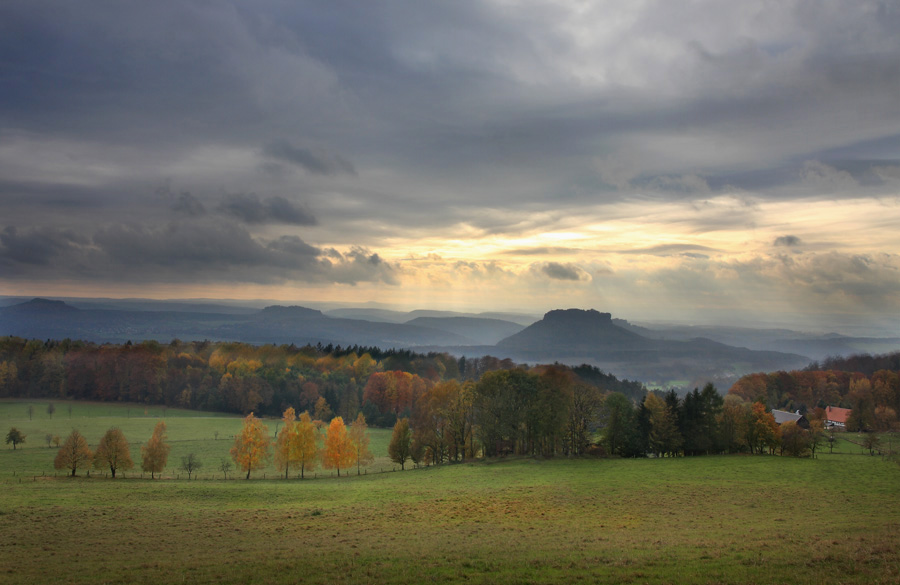
From Hohenstein we will set off on the Painter's Trail through a pleasant mixed forest to the area Half Ground until we get to Brand, where there is a rock terrace, which is called the "balcony of Saxon Switzerland". There is a beautiful view of the mesas Königstein and Lilienstein and Pirna from here. The view from Brand is just as popular as the view from the Bastei. From Brand we will continue to Deep Ground and Waitzdorf and on until Kohlmühle in the valley of the Sebnitz river and from there to Altendorf. Altendorf together with Adamsberg (302 m) is one of the most beautiful viewpoints in Saxon Switzerland, which was regularly visited by spa guests from the 19th century. Bad SchandauWe will sleep under the open sky in the meadow below Adamsberg.
"All nature was to me a lyric, dramatic poem in every possible verse. The stream argued in exquisite iambics, and the stones that stood in its way, the rocks, stood there as proudly wide as venerable hexameters. The butterflies whispered sonnets to the flowers as they kissed their fragrant leaves, and all the singing birds chirped, as their beaks grew, in Sapphic and Alkaic verses. While I was silent - and here I will be silent too."
Hans Christian Andersen, 1831 (Report of a trip to Saxon Switzerland)
Sunday 11. 5.
Altendorf, Lichtenhain waterfall, Kuhstall, Kleiner Winterberg, Grosser Winterberg, Schmilka, Kaiserkrone, Zirklstein, Hrensko (19 km)
We will leave in the morning Altendorf along the Painter's Way through Mittelndorf up to the valley of the river Křinice (Kirnitztal) to Beuthen Waterfall (Beuthenfall), which is less well known than the neighboring Lichtenhain Waterfall, which we will get to in a moment. The Lichtenhain Waterfall, which was previously called the “Great Waterfall”, has become one of the main attractions of Saxon Switzerland. In 1830, the originally small waterfall of the village stream Lichtenhain was slightly raised with a short sloping channel to increase the tourist attractiveness of the place and supplemented with a retractable weir with a gushing outlet. One of the citizens of Lichtenhain was hired as the “waterfall puller” and since then the weir has been pulled out every half hour: the “puller” let the water flow down the rock like a stream to the accompaniment of music. This tourist enterprise also included and still includes a pub, built in 1852. In 2021, the waterfall was damaged by a flood. The weir was then reconstructed and the official reopening of the Lichtenhain Waterfall is planned for this spring.

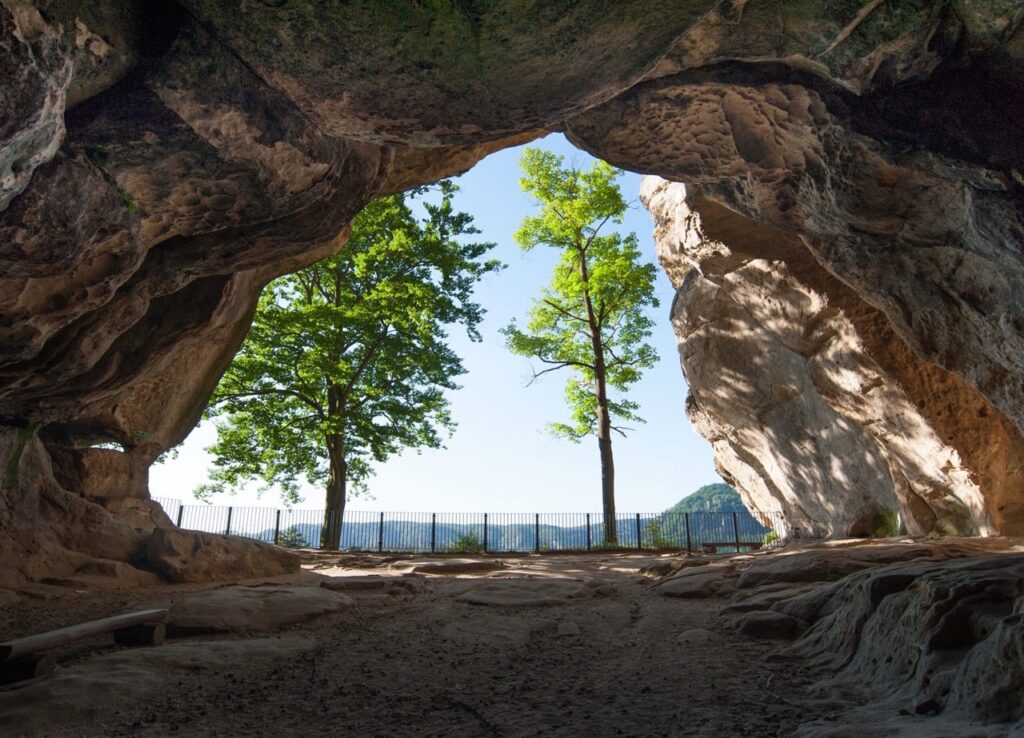
From the Lichtehain Waterfall we will head through the forest to the rock castle. Neuer Wildenstein (337 m) with the famous rock gate Cowshed, from which there is a unique view of the back of Saxon Switzerland. Kuhstall is the largest rock gate in Saxon Switzerland, which is 11 meters high, 17 meters wide and 24 meters deep. The huge layered cave is an extraordinary work of nature. Pastor Götzinger, who was one of the first to describe it, called it the "Wildestein rock hall"; it was a mythical place for him. In the wild times of the Thirty Years' War, people from the surrounding villages hid here with their cattle, hence its name. From the very beginning, this place fascinated artists. One of the first to be literally bewitched by this work of nature was Adrian Zinng, who depicted it as early as 1766; his sepia sheets of Kuhstall from 1786 and 1800 are also known, as well as the later, ballad-like depiction of this motif from 1815, which seems to have fallen out of a fairy tale by Ludwig Tieck. The Kuhstall was also depicted several times by Johann Carl August Richter, and Caspar David Friedrich also sketched it in May 1818 while traveling with his friend Carl Gustav Carus; we also know that Friedrich subsequently created the painting "Remembrance of the Kuhstall near Schandau", which unfortunately has not survived. In 1831, the writer Hans Christian Andersen stayed overnight at the Kuhstall during his journey from Dresden to Bohemia.
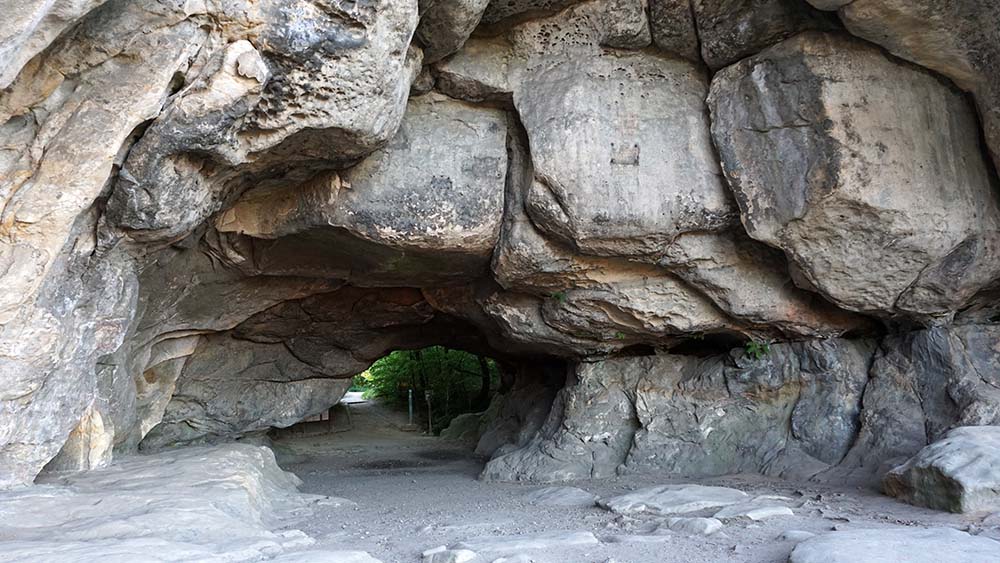


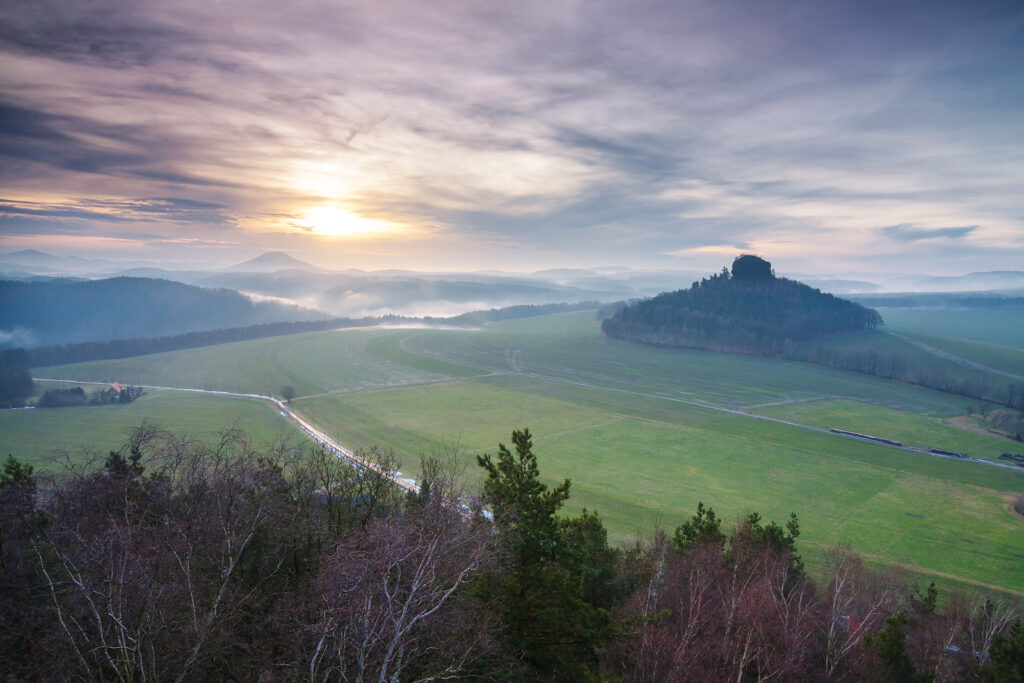
From Kuhstall we will continue along the Painter's Path to the nearest mountain Kleiner Winterberg (500 m), from whose viewpoint below the summit offers a unique view of the back part of Saxon Switzerland and further towards Bohemia, as Hans Christian Andersen beautifully described in his travelogue. From here we will set off along the old Oberer Fremdenweg to the Empire-style viewing pavilion below the Kleiner Winterberg peak and continue on to Grosser Winterberg (556 m) on the state border with the Czech Republic. We will descend from it to Schmilky on the banks of the Elbe and we will cross the river by ferry to the other side.

"So we reached Little Winterberg. ... Deep down in the wildly overgrown abyss, the Elbe weaved like a thin string that got lost near Dresden, whose towers and domes rose against the blue Meissen hills. The most beautiful view, however, belonged to Bohemia. I had never imagined that dark blue outline of the mountains. Like a petrified sea, the mountains lay before me, and far away on the distant horizon, the Giant Mountains with their snow-capped peaks rose, like an airy land made of clouds ..."
Hans Christian Andersen, 1831 (Report of a trip to Saxon Switzerland)
From Schmilka we will head to Imperial Crown (350 m), eroded peak of a table mountain near a village Schöna. There is another table mountain nearby. Zirklstein (384 m), which CDFriedrich depicted in his painting Wanderer above the sea of fog (1818). This painting is connected with his stay in Krippen (1813); the painter drew a remarkable group of boulders there at the ascent from Schöna to Kaiserkrone and transferred them to his painting as a pedestal for the figure of a pilgrim. This iconic work of Romanticism is the artist's tribute to the landscape of the Elbe Sandstones, which inspired him so much and which was, as his painting suggests, the landscape of his heart. From Kaiserkrone we will descend to Hřensko and return to Prague by train.

"So stand on the mountaintops, look around at the long rows of hills, contemplate the flowing streams and all the beauty that opens up to your view. What feeling comes over you? There is a silent devotion within you, your whole being experiences a silent rebirth, a silent purification. Your self disappears, you are nothing, God is everything."
Carl Gustav Carus, 1831 (Briefe und Aufsätze über Landschaftsmalerei)


Adrian Zinng (1734-1816)
was a Swiss painter and engraver. He studied in Bern, later in Paris, and in 1766 was appointed court engraver to the Saxon Prince-Elector and teacher of engraving and landscape painting at the newly founded Dresden Academy. He became famous primarily for his sepia landscape paintings, but also for his discovery of Saxon Switzerland. Among his many students at the Dresden Academy was Caspar David Friedrich. Zingg is considered the "forefather of Saxon landscape painters" and a precursor of Romanticism. It was he who drew Friedrich's attention to the special beauty of Saxon Switzerland. Zingg considered drawing from nature to be the most important thing - he taught his students to see above all. In this too, his influence on Caspar David Friedrich seems to have been undeniable.
Caspar David Friedrich (1774-1840)
is the most important landscape painter of German Romanism and one of the most important romantic artists in general. After studying in Copenhagen, he came to Dresden in 1799, where he lived and worked until the end of his life. He created his best-known works in a studio on the banks of the Elbe, from where he set out on long hikes, during which he drew more than a thousand nature studies. His travels immediately after arriving in Dresden led to Saxon Switzerland (he walked the Malerweg route several times), but also to Meissen, the Harz, the Plauen Valley and, last but not least, to Bohemian Switzerland, the Lusatian Mountains, the Bohemian Central Mountains and the Giant Mountains; his trips to Rügen were also important. The artist used his very precise nature studies in paintings of freely composed landscapes as symbols of his emotional states.
Those interested in participating in this journey must register in advance with one of the from his organizers.
The maximum number of participants is 15 people.
Connections
- Prague – Dresden / Thursday, May 8: TRAIN
- Prague: main station: departure 6:28 – Dresden: arrival 8:50
- Hřensko – Prague / Sunday, May 11: CAR + TRAIN
- AUT: Hřensko, to the gorges: departure 15:13 – Děčín, main train station: arrival 15:42
- TRAIN: Děčín, main station: dep. 15:57 – Prague, main station. Arr. 17:23
- AUT: Hřensko, Mezná: 16:00 – Děčín, main station: arrival 16:43
- TRAIN: Děčín, main station 17:25 – Prague, main station: arrival 19:12

"I believe that a lot of good would come from a change of attitude, "If only tourists became pilgrims again."
Rupert Sheldrake
Contacts
- Jiří Zemanek, email: sarvanga1@seznam.cz, mobile: 777 117 466
- Tomas Hruza, email: tomashruza@gmail.com, mobile: 775 052 607
- Michaela Skalníková, email: michaela.skalnikova@gmail.com, 605 153 890