
May Máchov pilgrimage and workshop "Listening to the language of the land"
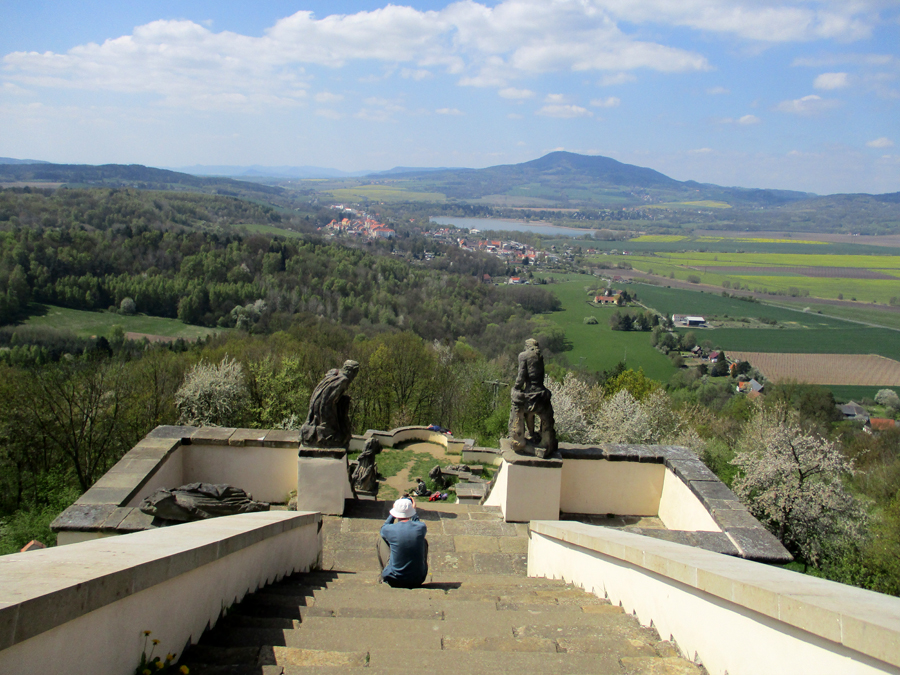
View of Úštěk and Sedlo Mountain from the Baroque Calvary
Úštěk, Kalvárie, Helfenburk, Vlhošť, Holanské ponds, Zahrádky, Novozámecký pond, Provodínské stones, Jestřebí, Dolský mlýn, Martinské stěny, Ronov, Úštěk (a total of 85 km).
May 1-5, 2019
We would like to cordially invite you to the May Máchov hiking and workshop “Listening to the Language of the Earth” – with Luďek Čertík, Jana Kožnarová and Jirka Zemánek – dedicated to the birds, crickets, hills, rocks, forests, trees and ponds of western Kokořínsko and the Máchov region. Inspired by David Abram, poet Mary Oliver and David Haskell. The hiking and workshop will take place from Wednesday, May 1 to Sunday, May 5, 2019.
"Whoever you are, lonely or not, the world is open to you."intensity,
Calls to you like wild geese, hoarse and trembling
and ceaselessly announces your place
in the family of existing things.”
Mary OLIVER (Wild Geese)
This year's May Máchov hiking tour will be a workshop in which we will focus on listening to the poetry of the land of western Kokořínsko and Máchov region and especially the songs of birds. Our hiking workshop will take place in the landscape around the mysterious Vlhošť mountain, in the area of Holanské ponds, in the Jestřebská basin with the Novozámecký pond, which is an important ornithological locality, and in the area of Provodínské stones. This time we will set off from Úštěk and the next day, after walking for about twenty-five kilometers, we will settle in a campsite Aero Holany at the Milčanský pond, from where we will take trips to the surrounding area in the coming days.
Inspired by the ideas of the American eco-philosopher David Abram Through sensory perception and imagination, we will try to become aware of our mutuality with the world of surrounding nature. Using the perception of air and breath, we will evoke that we live more immersed inside the earth than on the earth: that the earth is as present in us as we are in it; that we are part of a speaking, more than human world, in which there is no great difference between when we speak and when the trees speak: just as they do, we use the wind to do so. We will perceive the songs of birds, the concerts of frogs, the rustling of trees and the splashing of a stream as the expressive language of the landscape and we will recall Abram's question whether our human language itself is not originally born of the earth.

"A blooming forest of melodies, cheers and laments, note after note ignites, gushes forth as in the night when lightning strikes, it flashes, catches up, screams, intertwines, welcomes, blows, passes, the bells of the thrush, the flute of the blackbird, it pours into my dreams like dew into lilies."
Jaroslav VRCHLICKÝ (Nightingales)
View of Vlhoště from the Baroque Calvary near Úštěk
In this context, we will recall some animist oral cultures that shared or still share a similar experience of a soulful speaking land and the associated expanded understanding of language; and we will also recall some poets and artists: Gary Snyder, Jaroslav Vrchlický, David Rothenberg, Miloš Šejn. Ludek Certik, filmmaker and poet, introduces us to the poetry and life of the American poet Mary Oliver (1935-2019), with the ideas of American biologist David Haskell, author of the book The Songs of Trees (Songs of the trees), and the British philosopher Timothy Morton. As an amateur ornithologist, he will guide us in bird watching; he will teach us to listen to their voices and recognize them, understand them. It will introduce us to the nature and functions of bird song, as understood by (not only) current scientific research, and to some interesting connections between human speech (possibly music) and bird songs. We recommend that you bring binoculars for bird watching.

David Abram argues that if we want to engage in a more intimate conversation with the living earth around us, we should stop talking only “about” the world and start talking “to” the world: “Shout to the winds, whisper to the rivers and deer...". To open ourselves to a more performative way of speaking that can draw us into a living poetic dialogue with other beings of the earth. Practicing our own voice in Jana Kožnarová's voice workshops should indicate this potential to us.
Your possible participation in the seminar report no later than April 15th for booking accommodation.
Wednesday 1. 5.: Úštěk, Ostré, Kalvarie, Helfenburk, Včelí hrad, Malý Vlhošť (15 km)
We will meet in Prague at the main train station at 6:20, from where we will take the train to Uštěk at 6:51 (see connections), where we will arrive at 8:44. We will walk through the historic center of the city and continue along the road to Ostrý to the hill. Calvary with a baroque pilgrimage area and the Stations of the Cross and the Chapel of the Holy Sepulchre by Ottavo Broggio; from here there is a unique view of Úštěk and Mount Sedlo in the Bohemian Central Mountains and also towards Vlhošť to Kokořínsko. From Kalvarija we will head to Hrádecký důl and the ruins of Mácha's favorite rock castle Helfenburg and from there we will reach the village of Skalka, where we will have lunch. We will continue along the red and blue trails to Silver Hill (400 m above sea level) and further to Vlhošťsky mine and on Little Vlhošť (440 m above sea level), where we spend the night.


"In a sense, we all have to become poets."
David ABRAHAM
Thursday 2.5.: Vlhošť, Holany, Dolanský and Koňský ponds, Babylon, Miličanský pond (15 km)
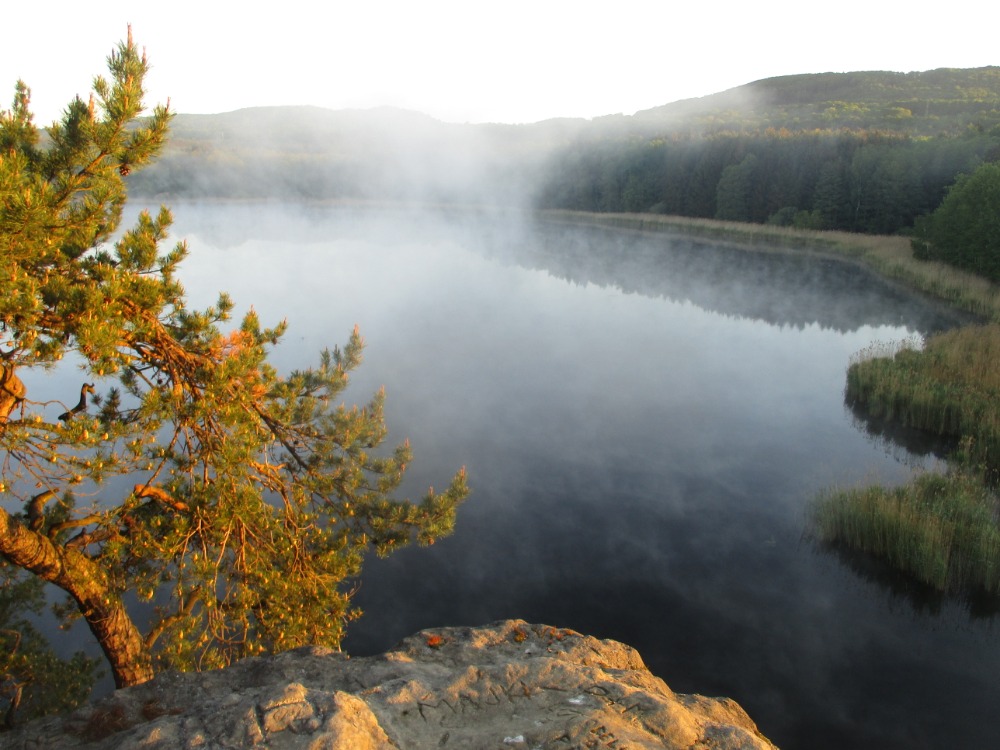
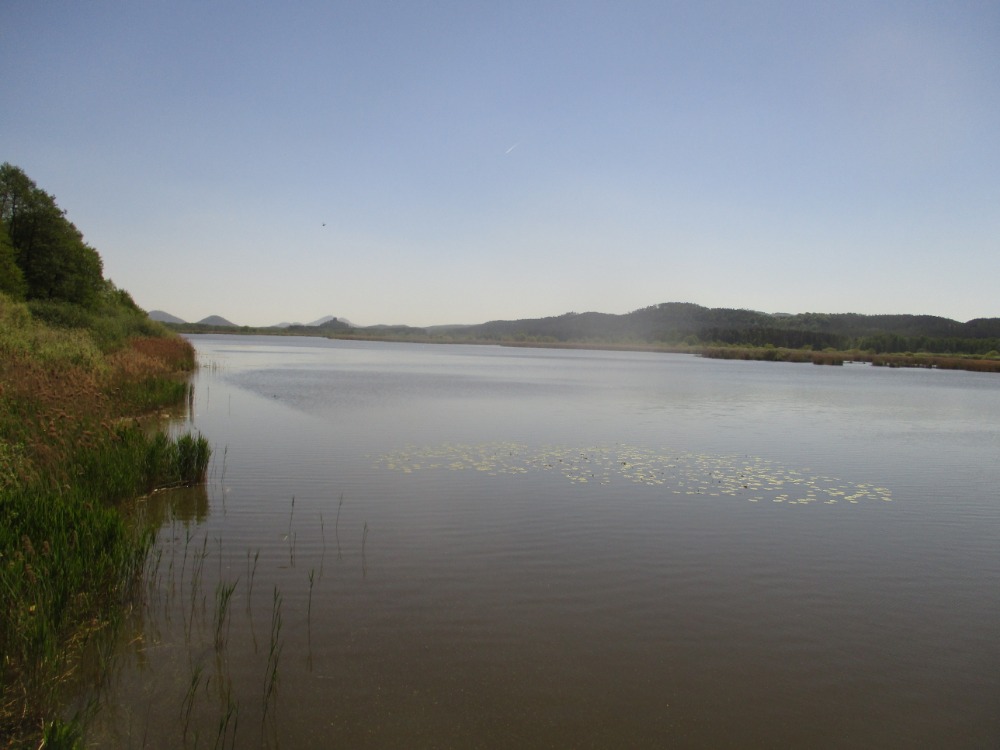
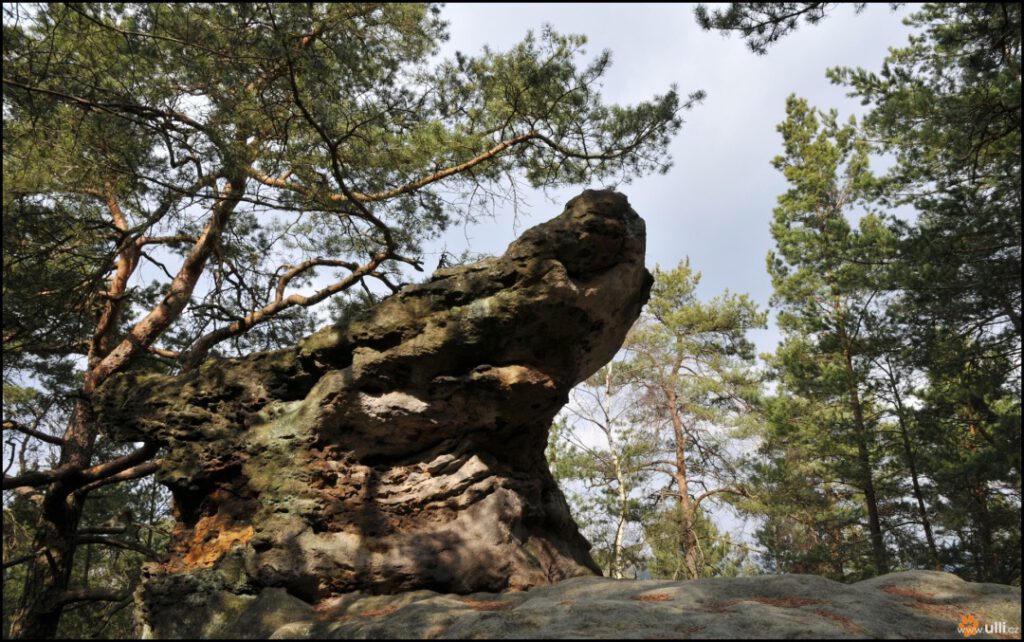
The next morning, we first ritually circumambulate the massive, cumulus-shaped Znělce mountain. Vlhošť (613 m above sea level), the highest mountain in the entire Kokořínsko region. There is a nature reserve with rubble forests (beech forests and relict pines) here, and the wood pigeon and the peregrine falcon nest here; if we are lucky, we may hear its "rehk, rehk, rehk". From Vlhoště we then set off along the blue trail along Court stones until Holany. We will stay at the Aero Holany campsite near Milíčanský pondIn the afternoon we will set off across the system of Holanské ponds (built during the time of Charles IV) around the largest Dolanský pond up to To the Heavenly Pond and Horse Pond with the famous rock Grim Reaper, where we will remember the story of Miloš Urban's novel Hastman; we listen to the frog concert here in the early evening. We will continue through the Kozelská ravine to Babylon and through Hostikovice and along Milčanský pond We will return to the camp where we will spend the night.


"Perception is the basis of everything because it teaches us an almost obsessive relationship with being: it is there in front of us and yet it touches us from within."
Maurice MERLEAU-PONTY
Friday 3.5.: Holany, Zahrádky, Novozámecký pond, Provodínské stones, Jestřebí, Pruský kámen, Holany (20 km)
In the morning we will set off along the blue trail through a beautiful linden forest. Wallenstein Alley to the village Gardens and from there we will continue along the yellow to the national nature reserve Novozámecký pond, a European important ornithological site, which is the center of the Českolipsko bird area. Here, at the bird observatory, Luďek Čertík and I will observe water and wetland birds, listen to their calls and learn to recognize them. For example, the occurrence of the endangered whooping crane and the white-tailed eagle has been recorded here. We will continue along the shore of the Novozámecký pond to Provodín and from there we will ascend to Bald Rock (Sleeping virgin, 419 m above sea level), a dominant Provodín Stones, under which we will take a voice workshop with Jana Kožnarová in the meadow. Then we will go down to Jestrebi and we climb here to the ruins of the local rock castle. We continue along the red trail to Prussian stone (351 m above sea level) in Long ridge and from there along the Novozámecký pond to the Dolský stream to Summer Palace and after the blue we will return to the campsite at Milčanský pondwhere we will sleep.


"As strange as it is, it is true that the acquisition of human language is in many ways similar to the way birds acquire song."
Johan BOLHUIS
Saturday 4.5.: Holany–Dolský mlýn–Dřevčice–Martinské stěny–Malý Vlhošť-Holany (16 km)
In the morning we will set off on the green to Dolsky Valleythrough which it flows Dolsky stream and let's remember this place field of study Vřísek, where the Renaissance castle of the same name is located, which the poet Karel Hynek Mácha visited and drew. We will continue through the Dolské Valley with a number of rock formations to To the Dolský mill, to Devil's Gorge up to Drevčice and at the crossroads Velka Rebcicewhere we turn red on Goose pathwhich will lead us to a natural monument Martin's Walls, which is an exceptional example of relict pine on sandstone rocks and is home to rare communities of invertebrates. We will visit two sandstone rock overhangs Stalactite (47 m long) and Thousand Stone (30 m long) and we will go up to the sandstone plateau and the peak Goose (449 m above sea level) with a unique fragment of sandstone rocks. From Husa we descend again to Little Vlhošť (440 m above sea level) with beautiful relict pine trees and we will continue along the blue and yellow to the village Robbery and Loubský mine to Dolsky Valleywhich will lead us to the campsite at Milčanský pondwhere we spend the night.



…the animistic experience is not only related to the knowledge that everything is alive, but also to the realization that everything speaks, that everything is at least potentially endowed with the ability to express itself.”
David ABRAHAM
Sunday 5.5.: Koňský rybník–Stvolínky–Ronov–Blíževedly–Ostré–Kalvárie–Úštěk (18 km)
In the morning we will follow the red trail across By the Dutch ponds up to Horse Pondwhere we climb the rock Grim Reaper and we say goodbye to the local landscape. We will go around Koňský rybník following the red line and reach the village Stvolínky, which is located on the border of the Ralská pahorkatina and the Bohemian Central Mountains; we will visit the local memorable linden tree and old larch in the former castle park and from there we will continue along the red trail to the top of the beautiful basalt cone Ronov (552 m above sea level) with the ruins of the Gothic castle of the same name. From Ronov we descend to the village Closer to home and we will visit the nearby rock castle Shaft and we will continue through red and yellow to the baroque Calvary at OstryWe stop for lunch in Ostrý and then go down to The barkingfrom where we will return to Prague by train.


"That's why I was born,
Mary OLIVER (Listen)
to look, to listen,
she was losing track of herself
in the heart of this soft world—”

“Mind is not a human quality: it is a quality of the earth. … It is the earth that is truly intelligent, not isolated humanity. Together with other animals, plants, and the drifting clouds, we are bodily immersed in the mind of this living world.”
David Abram
"Earth,... I live with you, in you, on you, I feel with you and in you, as you feel in me."
Karel Hynek MÁCHA
Accommodations
From May 2nd to 5th we will be staying at the campsite Aero Holany by the Milčanský pond in cottages. The price for one night with buffet breakfast is 310 CZK. It is also possible to arrange a vegetarian dinner for 100 CZK, which we recommend (you cannot cook in the cottages and there is no shop in the immediate vicinity). Accommodation and meals must be booked in advance by mid-April. If you are interested, please contact Tomáš Hrůza – tomashruza@gmail.com, mobile: 775 052 607. Please register your participation in the seminar no later than April 15th to reserve accommodation.

Connections
Prague – Úštěk on Wednesday, May 1st (train)
departure from Prague main station: departure from Prague in 6:51 – transfer Lovosice / arrival 7:57, departure 8:01 – arrival in Úštěk in 8:44
departure from Prague in 8:51 – transfer Lovosice / arrival 9:57, departure 10:01 – arrival in Úštěk in 10:44
Úštěk – Prague on Saturday, May 5th (train)
departure from Úštěk in 13:12 – transfer Lovosice / arrival 13:55, departure 13:59 – arrival in Prague hl.n. 15:10
departure from Úštěk in 15:12 – transfer Lovosice / arrival 15:55, departure 15:59 – arrival in Prague Holešovice 16:59
Contact and further information
George Zemanek
sarvanga@centrum.cz
777 117 466
Tomas Hruza
tomashruza@gmail.com
775 052 607
Ludek Certik
certik.ludek@gmail.com
723 037 847
Barbora Kinkalova
B.KINKALOVA@seznam.cz
776 123 969

"I believe that a lot of good would come from a change in attitude if tourists became pilgrims again."
Rupert SHELDRAKE
Actors
Ludek Certik
(born 1989) Graduate of the Department of Film Studies at the Faculty of Arts, Charles University in Prague and the Department of Environmental Studies at the Faculty of Social Sciences, Masaryk University in Brno, program director of the Prague Short Film Festival, an enthusiastic walker and observer, advocate and friend of everything green, wild, and sensitive. He lives and works in České Budějovice. He occasionally writes and lectures about film – mostly about the work of American-born Terrence Malick, but also about (artistic) nature films. He also makes films himself. He translates and writes his own poetry, and sometimes articles dedicated to broader environmental topics and prominent figures from the artistic sphere whose work has an environmental impact. He is currently preparing his first poetry collection and a representative selection of the poetry of the recently deceased American poet Mary Oliver. He collaborates with the Pilgrim association and also with the Karlovy Vary International Film Festival. He has published in magazines Film and Time, Seventh generation, Universe and regularly contributes to the České Budějovice cultural magazine Milk & Honey.
George Zemanek
(born 1953) Art historian and cultural activist. He studied art history and ethnography at Masaryk University in Brno and worked as a professional in several state galleries. Since 2000 he has been a freelance curator: he has organized exhibitions Wilderness – nature, soul, language (Klatovy-Klenová Gallery 2002), From the ground, over the hill to the sky … (SG Litoměřice, 2005) etc. He is interested in the overlaps of art in the field of ecology and spirituality; as a cultural activist he is dedicated to the issue of the evolution of culture and the emergence of a new integral worldview. He is the author of texts with eco-philosophical and holistic themes, translator and editor of publications: Geomancy and Integral Culture (2008); David Abram, Awakening to the living land (2009); David Abram, The magic of the senses (2013) etc. He and his friends founded the association PILGRIM – The Wandering University of Nature, which seeks creative ways to re-establish human culture in nature.
Jana Koznarova
is a voice workshop instructor for teachers, lecturers and the general public. She specializes in exercises to prevent voice disorders, to relax the voice and to strengthen the expression and dynamics of vocal expression. She draws on her own experience in choral and solo singing and on the teaching skills acquired as a lecturer in ecological educational programs at Quiver's YardCurrently, she mainly leads voice workshops for lecturers of Environmental Education Centers. She works in organizations AMPI association, COCONUT, Envira and THERESA on the topics of urban community growing and composting, community supported agriculture (CPA), organic farming and environmental education.
Invitation attachment
David Abram
(born 1957) is an American ecophilosopher, storyteller, and magician, founder and creative director of Alliance for Wild Ethics (AWE). He is the author of two key books on ecological philosophy: The Spell of the Sensuous (1996; in Czech The magic of the senses(DharmaGaia 2013) and Becoming Animal (2010). The ideas of both these revolutionary works, in which he reveals the deep interconnectedness of man with "more than the human world"nature, inspired the creation of a film essay Becoming Animal (Emma Davie, Peter Mettler / 2018). The phenomenology of perception by Maurice Merleau-Ponty and the personal experience and lessons he learned from the indigenous oral cultures of Asia and the Americas were of fundamental importance to Abram's philosophical thinking. Abram explores new possibilities for the ecology of perception and the ethics of language; he understands the current ecological crisis as a crisis of our perception of the world and evokes the forgotten experience of being enchanted within a living, soulful earth: he seeks to resurrect an earthly cosmology. In addition to the book The Magic of the Senses, an anthology of the author's six essays has been published in Czech Awakening to the living land (OPS Nymburk, 2009) and his other texts were published in magazines Seventh Generation, Ekolist, Promény, Prostor magazine, A2 weekly.
“What a mystery is air, what a riddle it is to our senses! On the one hand, air is the most penetrating presence I can ever mention – it surrounds me, embraces and caresses me both inside and outside, it undulates along my skin, flows between my fingers, swirls around my arms and thighs, winds in eddies along the roof of my mouth: it flows continuously through my throat and my windpipe and fills my lungs, nourishes my blood, my heart and myself. Without the participation of this fluid element, I cannot move, speak or even think a single thought. I am immersed in its depths as naturally as a fish in the sea. (…) And it is this invisible enigma that is the real mystery that allows life to be lived. … We could say that air is the soul of the visible landscape, the mysterious realm from which all beings draw their nourishment. As the real mystery of living presence It is the most intimate absence from which the present presence around us emerges, and therefore the lost key to the forgotten presence of the Earth.”
David Abram, The magic of the senses (DharmaGaia, 2013, pp. 271-272 translation: Michaela Melechovská and Jiří Zemánek)
“… more important than the content of what we say is the style of our speech, the form of our speech, the rhythm of our rapping. The music and texture of our speech must somehow carry meaning, must correspond at every point to meaning. Our deepest intention makes itself felt in the cadence, rhythm, and melody of our speech. If we are not in fact disembodied minds floating outside the world, but sentient and feeling animals—corporeal beings tangibly embedded in the breathing body of the world—then language is first and foremost a thing of expression, the structured sounds by which our bodies call to other bodies, whether it be the moon, or the geese cawing overhead, or another human being. It is indeed a kind of singing. Even the most bombastic and abstract speech is still a kind of singing, a way of singing the world. (… )In a sense, we all have to become poets. This does not mean that we should write poems for the sake of poetry. anthology – no. (…) We must notice the music in our speech. (…) we do not speak only as disembodied minds to other abstract minds, but as sentient and feeling creatures we address other sentient creatures, so that our animal bodies are moved and are brought into the conversation so that even other animals are not excluded from this conversation. We feel their presence close to us and so we are careful not to violate our solidarity with them and with the living, soulful earth.”
David Abram in an interview with Derrick Jensen (July 2000 / translation: Jiří Zemánek)
Mary Oliver
(1935-2019) was a leading American poet. In her work, she followed the work of two great classics of American poetry: Robert Frost and Walt Whitman. However, many of her poems also bear the distinct stamp of the mystical poetry of Rumi and the verses of the English romantic poet and visionary William Blake. She is the author of soulful natural lyrics – she wrote her poems with the conviction that the natural world is the fundamental source of poetry. Her poems are characterized by a minimalist expression, moderation in poetic images and a relaxed, almost conversational, civil tone. For Oliver, the model reader was not other poets, but each of us. She did not understand the poem as a puzzle, but as a space for feeling: as breathing green thing. Mary Oliver's poetry is essentially enlightened, sunny. It is the poetry of dawn, the poetry of the solstice (morning is a constant presence in her poems), but also poetry that is essentially pedestrian, unroofed and amorous. However, Oliver's subject of interest is not so much love between a man and a woman (or other sexes), but love for the world as such – the ultimate goal of poetic expression. As Oliver herself says in one of her famous poems: My job is to love the world.. With his seductively simple verses, he teaches us how to become attentive children again – how to give thanks, how to hope, how to find joy and pleasure in the simple and non-violent, how to discover (a reflection of) ourselves in the world around us.
You don't have to be a paragon of virtue.
You don't have to travel hundreds of miles, your knees all sore,
to trudge through the desert like a penitent.
But let loose the soft beast of your body,
Let him love what he desires.
Confess your troubles to me, and I will reveal mine to you.
Meanwhile, the world will go on its way.
The sun and the clear pebbles of rain
Meanwhile they will travel across the lands,
through prairies and deep forests,
mountains and rivers.
And the wild geese, high up in the clear blue sky,
Meanwhile, they head home again.
Whoever you are, lonely or not,
The world offers itself to your imagination,
calls to you like wild geese, hoarse and trembling —
and ceaselessly announces your place
in the family of existing things.
Mary Oliver, Wild geese (translation: Luděk Čertík)
