
Your whole life, whales have been racing around somewhere every second. Are you still afraid?

Ondrej Tucek,
The waterfowl were chirping very loudly all night long.
At the end of 2022, I came across a book recommended by American writer Rebecca Solnit, who shared it on her Facebook account. The Nutmeg's Curse (The Curse of Nutmeg, 2021) by Bengali writer Amitav Ghosh. This brilliant historical treatise with elements of a suspense novel shows that the ideas and beliefs that led to the crimes of European colonialism in past centuries (the murder and enslavement of indigenous peoples, the slaughter of wildlife, the cutting down of forests) are also behind the deepening of today's planetary environmental crisis - most of all, the idea, so many times already subjected to thorough philosophical criticism, that the Earth is a soulless lump destined for uncontrolled exploitation and that non-human life lacks any value beyond market value and, with it, a place in the human heart, in human history.
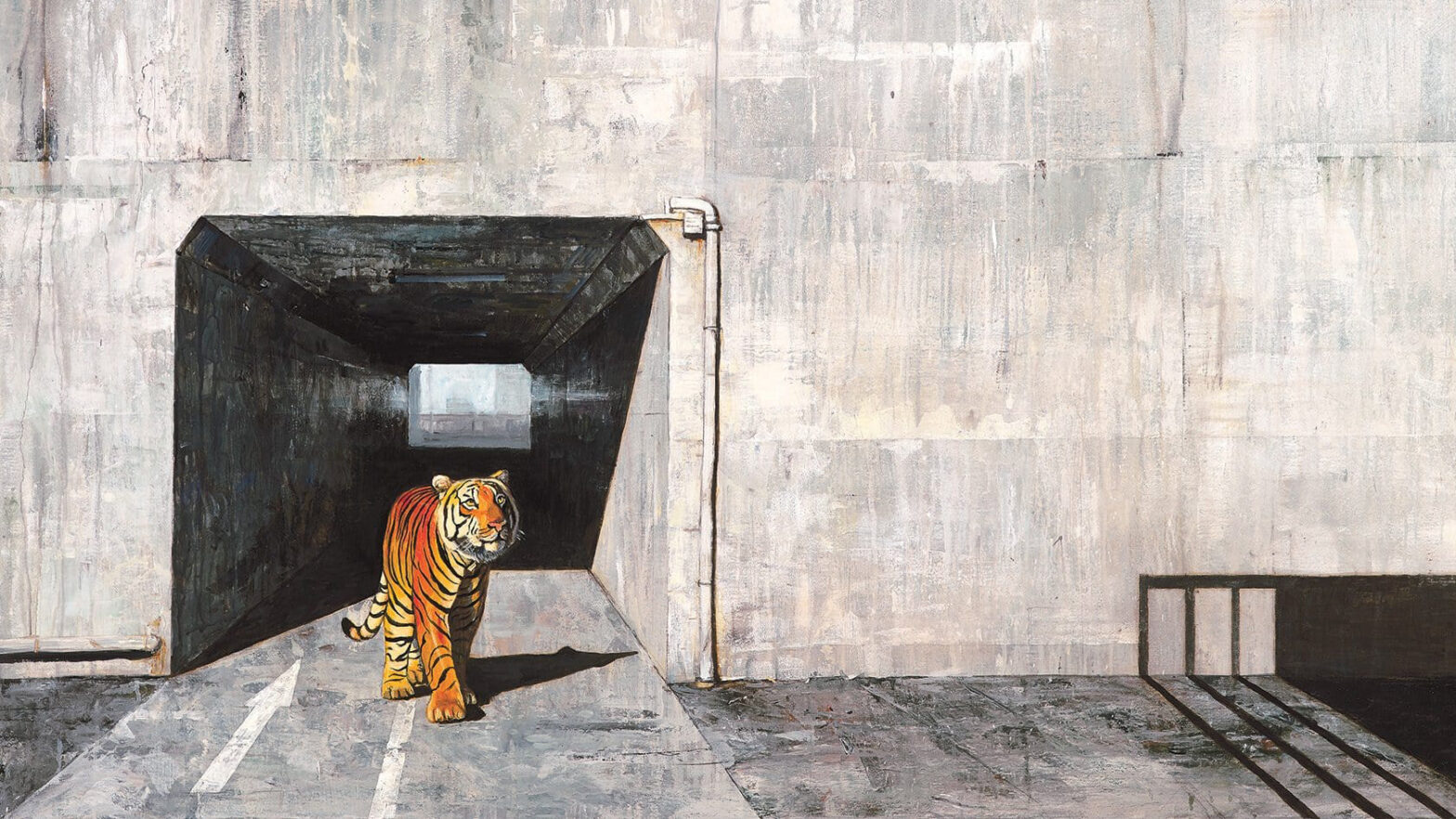
One of the memorable chapters of this extraordinary book concerns an elegiac poem In Memoriam (1849) by the Victorian poet Alfred, Lord Tennyson. Tennyson wrote this poem in response to the death of a close friend, but he also conceived it as a meditation on human evolution, a hymn to progress. Ghosh pauses at a particular stanza in which Tennyson states that man, on his journey “upward” to fulfill his lofty historical role, must “work out the beast” and “let the ape and tiger die,” that is, sever his connection with the animal, the animal community. The quoted verse does not simply say that we must get rid of our bestiality (meaning the baseness within us), which is not an unusual idea in the Western world, let alone surprising: it was precisely the supposed link between bestiality and baseness, inherited from antiquity, that served as a pretext and justification for the mass murder of the indigenous peoples of the Americas, Australia, Africa and Asia. Tennyson goes a step further and claims that we must even let die specific animals so that we can fulfill our destiny. In other words, his words are an open call for violence against non-human creatures.
Tennyson was among the poets whose work was strongly influenced by the scientific discoveries of the time. He enthusiastically read Darwin, Lyell, Wallace and reflected their findings in his work. Poem In Memoriam was largely based on (from the perspective of Western science) revolutionary ideas about the evolution and transformations of the living and non-living world, the interconnectedness and kinship of earthly life. We should be all the more surprised by what Tennyson urges us to do. Despite the fact that the theory of evolution confirmed the kinship ties between the most distant shoots of the Tree of Life, for many, including the island bard, this was not a reason to celebrate interspecies solidarity and blood, but on the contrary, a confirmation of the belief in human (and therefore white) exceptionalism - and the right to decide on the existence and non-existence of other (so-called less developed, inferior) forms of life. Tennyson does not deny biological kinship with other creatures, but he sees them as a clear obstacle, a historical burden that needs to be shaken off in order to achieve the desired progress. What is particularly chilling is that Tennyson does not celebrate the death of non-human fellows. He merely states matter-of-factly that such is the price of Man's rise: he takes the violence his words foreshadow as inevitable, collateral damage.
But to be fair to Tennyson, such a line of reasoning was not unheard of in his time, and one might even say that it was a somewhat stale intellectual cliché. Similar ideas, that is, the idea of the necessity of exterminating inferior races and animals (which, as has been said, was the same for many), were shared and expressed by countless European thinkers, often in even less selective vocabulary. And the sentiment? It was certainly not out of place. After all, a look into the deep past teaches us that similar events happen again and again. Charles Lyell, for example, coined in epochal Principles of geology (1830-1833) the following thesis: There is no need to succumb to unnecessary remorse that we are destroying plants and animals in our efforts for human development. This is simply how it has always been on Earth: the stronger replaced the weaker, the more developed the more backward and less adaptable.
As such, these beliefs reflect Western culture's obsession with the idea of progress, which has always been realized as a demarcation against the natural (against the preserve of the unfathomable). physique), an attempt to free oneself from it by forcibly humiliating, taming, subjugating it: by bringing it under control. Progress was seen as something unambiguously positive and desirable – even if its achievement meant the extermination of half of humanity, half of the biosphere, it was necessary to embark on this journey. This was a show of mercy to the poor savages and wild animals, already doomed to extinction. Few contradicted the belief that it was necessary to remove, exterminate and wipe out everything that hindered the progress of civilization. This was the generally accepted motto of European civilization, which, in a peculiar variation, also penetrated into Tennyson's verses.
It is probably unnecessary to emphasize how deeply Tennyson is concerned in his appeal to dehumanization He was wrong, although he certainly did not feel that he was doing anything wrong. Today we have a wealth of studies at our disposal that prove to even the most hardened of skeptics that healthy psychological development of the individual (and therefore of the human community as a whole) is not possible without regular contact with non-human life: without the presence of the monkey and the tiger, even if only a glimpse. After all, could it be otherwise, when we have lived side by side for so long, influencing each other for so long, imprinting each other on ourselves, on our minds and bodies?
French documentarian Frédéric Rossif, who became famous for his poetic nature films about the lives of large mammals and birds (see, for example, the breathtaking Wilderness Festival from 1976), already declared years ago that the disappearance of animals is not only an ecological disaster, but also a cultural one. Who will accompany our children in their dreams? Will they still be able to dream? Aren't animals, as the great theorist of dreams Gaston Bachelard wrote, the oldest companions of our dreams (nos plus anciens compagnons du songe)? Biologist and philosopher Andreas Weber even says that it is a psychological, spiritual catastrophe. Our inner being is all the richer (all the more colorful, all the more unfettered) the more non-human inner beings it encounters, recognizes, and takes into itself. By murdering the non-human, we commit spiritual suicide, ecocide of our own inner being. The essential connection between the soul and the non-human is expressed by the very word animal. Animal is that which is soulful, connected with the soul, animated. To desire the eradication of the animalistic (in ourselves and around us) therefore means the same as the desire to eradicate one's own soul - or at least an essential part of it.
If Tennyson had only a faint inkling of such a thing, could he have written his poem at all?

We were never modern.
According to Linda Hogan, a poet and essayist from the Chickasaw Nation, we have allowed our relationship with the natural world to be influenced and determined by people who have no connection to the land themselves, who live off no particular places. It was mostly the Western intellectual elite, for whom the natural world had become more of an abstraction to be studied from the comfort of their study than something tangible and perceptible with which to make physical contact, to enter into a mutually enriching relationship – a passive projection surface for bizarre fantasies and the deepest fears. Such people, with their imprudent (detached from the earth and life) words, set in motion the political, military and economic forces that have brought us to the point where we face mass extinction and the very real threat of the end of civilization as we know it.
Like generations of Westerners, Tennyson lived for so long under the influence of images and stories of human dominance and exclusivity that he completely forgot that the nonhuman is indispensable to man: that only thanks to it can he create, think, exist, be at all. That, strictly speaking, no outsideIt is not even human. The animalistic in his mind became a metaphor for backwardness, for backwardness. Our connection with other creatures, so fundamental to the vast majority of non-Western cultures for the vast majority of human development (that is, for long tens, even hundreds of thousands of years), lost its meaning for him.
Okay, you might say. Tennyson wrote his poem in the mid-19th century. Since then, we have reevaluated many opinions and attitudes and have finally become modern. Or not? The truth is that today, in a quarter of the 21st century, even mainstream biology teaches us about sympoetics (co-creativity) of the living on the cellular and ecosystem level, light years away from the idea of the superfluity and inferiority of the non-human being being completely eradicated, from ceasing to sprout new leaves. How deeply ingrained this cultural prejudice is is indicated, among other things, by the widespread tendency to show a strong and intimate relationship with animals in the sphere of childhood. I remember it every time I see how film distributors present nature films as family (and therefore children's) entertainment, while in this regard they do not hesitate to even edit the original accompanying commentaries (a model example is Perrin and Cluzaud The story of the forest, 2015). On the one hand, this is a correct intuition, because children really have a relationship with extrahuman life that is somehow closer and not affected by a number of later cultural ailments (after all, due to their height, they are physically closer to the earth and also have sharper senses), on the other hand, this susceptibility indicates that we still consider everything that reflects extrahuman life with undisguised warmth to be somewhat immature.
At the same time, it is not that “adult” culture has turned its back on non-human beings. Of course, animals have not disappeared, unless we count those that, unfortunately, seem to have been irretrievably exterminated (such as the great spotted woodpecker, the Tasmanian tiger or the Molokai moho). If we look around carefully, we will encounter them practically at every turn. And not only the real ones (from woodpeckers and squirrels in the park to quails in the pantry), but also their countless visual representations on billboards, trams, in shop windows, on clothes. Even so-called modern man still believes in the magical power of powerful totem animals and uses their names to protect everything from sports teams to cars, trains, fighter jets. It is a sad paradox that these names often bear technologies that also take the lives of non-human creatures, which is especially true for heavy construction or military equipment. James Cameron captures this paradox well in the second part of Avatar (Avatar: The Way of Water, 2022), where people hunt Pandoran humpback whales tulkun they use amphibious machines in the form of land crabs (real crabs probably only exist as stuffed specimens in museum collections by then).
Our relationship with nonhuman beings is never unambiguous, simple, or easily defined. It is strange to observe with this awareness how we are constantly surrounded by their presence, however shadowy, and at the same time to see so few expressions of truly deep compassion and love that would testify to a sincere interest and an effort to understand. Or at least those that are not directed only at privileged pets. If an extraterrestrial visitor were to base his idea of how we relate to nonhuman creatures on the overproduction of images and objects with animal and plant motifs, he would undoubtedly conclude that our relationship with them is extremely admiring and kind. He would even think that we are obsessed with them. But it would not take long for the person in question to discover that alongside all this there are also industrial farms, behind whose walls living beings have no value in themselves, are reduced to quantity, weight, a numerical figure without any intrinsic dimension. Oceans filled with toxic waste and shipping noise, where dolphins literally have to scream to hear each other. Wolves and cetaceans hunted with landmines and explosives. Army projects that use genetically modified bees as disposable detectors of hazardous substances. Or nesting holes sealed with mounting foam. And he would also see that many of the things we would not allow ourselves to do to other people, we do to animals without the slightest scruple. Starting with stealing their likenesses and voices for all sorts of commercial purposes (from films to advertisements for banking services), and ending with keeping them in zoos or aquariums. And if he had looked into the law books, he would have discovered that from the point of view of many legislative systems, animals are still considered things, property.
Where to turn for inspiration for a more loving, less conflictual coexistence?
Everything alive
The first logical direction is indigenous cultures. When we look in this direction, we immediately see the privileged role that animals and plants play in tribal mentality and stories. There is nothing overly mystical about it, however. It is a simple consequence of close everyday coexistence, sometimes so close that it can cost you a limb or even your life. Mutual interdependence with the non-human is essential for indigenous peoples (their existence depends on the health of the non-human), which was soon recognized by European conquerors: the deliberate extermination of wild animals, on which the natives depended existentially and spiritually, in order to fundamentally accelerate the disintegration of their cultures, was a common practice. Today we even have a special term for it: biowarfare. The indigenous people do not perceive life hierarchically, but as a unity: all living things have a common root, a common Creator, and all creatures have the ability to relate to any other living being. The feeling of kinship is very strong. Stories in which people are transformed into animals and vice versa form a large part of the mythical repertoire. And so do stories in which animals figure in the creation of the world. It is no coincidence that they often speak of other creatures as distinct nations.
Indigenous people actively strengthen their connection with the nonhuman by drawing it into the web of their stories and songs within religious ceremonies. The ethical considerations of tribal cultures transcend the domain of the human, operating with a concept of humanity (human community) that is much broader and fuller than that coined, for example, by Christianity as a religion of man; the human is constantly taking place in the context of the nonhuman, in the wider community of life, the human is extra-human. We can even speak of a certain merging of consciousness, that is, a form of closeness and connection that goes beyond mere material dependence on other beings. Humans, in a sense, became the creatures they revered and hunted: whale-like, bear-like, raven-like.
Tribal cultures are also well aware that the same thing is happening on the “other side,” that is, that we too become part of the network of stories and minds of other creatures, because direct experience has long since taught them about the intelligences and cultures of their nonhuman counterparts: that not only do we see and hear, but that the ocean also sees and hears, the forest sees and hears, it has dozens, hundreds, thousands of pairs of eyes and ears. Nonhuman creatures are intelligent and perceptive in their own way, and an attentive person sees that they react to our actions, that they watch us, that they listen, that they even try to talk to us. And not only directly (like an injured dolphin or shark that swims up to a diver to help him pull a fish hook out of its fin), but perhaps also by entering our dreams: to warn us, to teach us, opened.
The lesson for us is this: it is absolutely necessary to re-invite into the stories we tell ourselves (and which form our culture and morality) the non-human, which in Western technical civilization has found itself on the very edge of interest, becoming a mere backdrop, a backdrop for the movement of world-forming human history; entire hosts of living creatures that we have excluded from our narratives, deprived of autonomy, individuality, voice, historicity. And not as soulless and lacking their own vitality, but as conscious, feeling and capable of telling and passing on their own stories, as the young author Ceridwen Dovey ( shows in her stories with an unprecedented dose of compassion and understanding)Only animals, 2014) and Talia Lakshmi Kolluri (What We Fed to the Manticore, 2022).

Ultimately, it comes down to what kind of stories we tell ourselves. If we pass on stories in which other living beings, other sentient beings, have no place (and such stories unfortunately still constitute the vast majority), or stories in which living beings appear only as automatons without feelings, the ability to communicate, memory, culture and their own narratives, sooner or later we will forget about them, they will be pushed to the very edge of our attention, until one day they completely disappear, irretrievably. Or, and this is still the better case, they will turn into one-dimensional caricatures that will no longer resemble their breathing prototypes. Here, somewhere, begins the tragedy that lies at the heart of the global decline in biodiversity.
And what exactly are the stories that should balance those in which the nonhuman is placed outside the sphere of human concern or reduced to an exploitable object? Where to look for a whiff of interspecies hope?
A beautiful example is provided by the documentary film All That Breathes (2022, in our country under the name Everything alive) by Indian filmmaker Shaunak Sen. In it, we follow three men from Delhi, India, who run a rescue station where they treat injured birds of prey, mostly the ubiquitous brown kites. The film is as much about universal compassion as it is about the coexistence of people and wild animals in one of the most populous and polluted cities, which, in addition to environmental problems, is also plagued by religious and ethnic unrest. The men themselves do not have much (and due to their demanding profession, their family relationships also suffer), but every day they treat an endless stream of injured birds until they are exhausted. Particularly moving is the scene where the brothers swim across an icy river to save an injured kite on the opposite bank, and in the process almost drown themselves. We witness great personal courage and sacrifice in an effort to remove at least a little suffering from the world, which can be achieved. The brothers, although Muslim, demonstrate an almost Buddhist effort to patiently heal a world that is slowly heading towards destruction: to be a small band-aid for big wounds. Between the lines, the film tells us something about the essential nature of all living things. It says that the suffering of one being is also the suffering of another, and therefore also my own. We should not differentiate "between everything that breathes", we are all ultimately "a community of the wind", reminds one of the brothers.

This is just one of the myriad possible stories that we need to tell and share today. I'm sure you know others, or even do them yourself: by regularly feeding the birds during the winter months, by letting your garden go wild a little (ideally in combination with building a pond for amphibians and aquatic insects), by boycotting products that cause pain to non-human creatures, by turning their pain into profitable business-as-usual, by participating in the development of artistic or educational projects that strive for the general flourishing of life, or even by getting together with close friends after a long day at work to say goodbye to your beloved dog, who is due to be euthanized that same evening. Stories that do not distinguish between the human and the non-human, the cultural and the natural, us and them, that shine through with a love of life in its varied breadth, that, to use the words of multispecies thinker Donna J. Haraway, “becoming-with” in the unified play of living and dying. Such stories allow us to move beyond limited notions of community and cohesion that focus solely on the human (human rights, human dignity).
Natural sciences are also coming to our aid with new insights and stories, often under the direct influence of traditional indigenous wisdom, which is only beginning to be taken seriously after years of ostentatious disregard.
We are at a point where we are able to decode, to some extent, the patterns and messages contained in the songs of humpback whales or the rich vocalizations of dolphins, belugas, and various populations of killer whales (which are literally as different as night and day). This is a major step forward, because for decades, scientific research into animal communication has been conducted in a one-sided manner, where we have treated animals in captivity tried everything to teach according to usSuch experiments, while revealing a great deal about the inner lives of other creatures and their cognitive abilities, have unsurprisingly proved to be a dead end. They sought to demonstrate how animals are similar. us. The animals were presented with purely human problems to solve: we imposed our view of the world, our logic and our concept of intelligence on them. But the inner world of the tested creatures was rarely taken into account, including the fact that it may be so different that it lacks any conceptual framework for the problems presented, and therefore the ability (not to say interest) to decipher them. More and more scientists are now willing to enter their world with humility and meet them for what they are: as bearers of intelligences that are no more remarkable than ours, although often profoundly different (as in cephalopods). We no longer look for what makes them similar to us, but we learn to see them as unique beings with their own path. The result is that there is practically nothing left that we could consider exclusively human, from culture to musicality.
Isn't that a reason to rejoice?
Artificial intelligence, whose various mutations in image and text generation are currently shaking up our everyday lives, is also shedding light on these waters. Algorithms based on deep learning and neural networks are even opening the door to direct communication with a whole range of non-human creatures. We already have tools at our disposal that (with sufficient data) allow us to recognize individuals with perfect accuracy based on their voice (dialect) or some physical feature, such as the shape and color of their tail fins. And according to many, we are not far from being able to communicate indirectly with whales or dolphins. An example is the ambitious non-profit the CETI project (Cetacean Translation Initiative), which aims to translate the vocalizations of sperm whales based on extensive acoustic and visual monitoring of the sperm whale population off the Caribbean island of Dominica. Scientists involved in the project expect a major breakthrough by 2026.
So we are not only living in a time of great extinction and impoverishment, but also in a time of great awakening. Perhaps in a few years we will reach what in one conversation describes ethnobotanist Robin Wall Kimmerer (Potawatomi): that in addition to traditional news channels, we will also have a television channel that will inform us about the latest news in the life of animals in our neighborhood. Fox News, but about foxes. Something like this may sound absurd, but the same thing happened in the past with a number of other, now completely common phenomena. Extrahuman beings in the world are decreasing, and decreasing rapidly, even frighteningly rapidly, but they have not yet completely left our imagination - so there is something to start from, something to develop. Our great task is not to allow them to remain in it as empty vessels without the content of lived coexistence. And this cannot be done without maintaining direct contact with them on a daily basis.
Are you going out yet?

A more beautiful world is possible
It is a great illusion of Western or self-proclaimed modern man to believe that he will become greater, more advanced and more powerful by casting aside his so-called animal self, by letting the monkey and the tiger die in both a symbolic and a factual sense. The effort to get rid of this essential layer of humanity at all costs only leads to mass extinction and suffering, which can hardly be summarized in a few bare sentences.
We are compelled to judge this tragedy from our perspective – how it affects our themselves. That is how this text began, after all. But it is not just about what non-human beings are important to us. If we were to stop there, we would be trapped in the trap of human exclusivity, that is, in the idea that the threads of all meanings converge in man: that it is he who gives meaning to the world, fills it with value. Beauty does not enter the world the moment we label something beautiful: it was here long before us and will be here long after us. On the contrary, we should be concerned with the non-human in itself: its own right to life, self-expression, voice. As has been clear to indigenous peoples from various corners of the world for millennia, we are far from the only bearers of culture. Every natural being is also a cultural being. Every extinction is a cultural catastrophe also in the sense that with each individual (each population, family, pack) a unique cultural trace is lost from the world: a unique variation on a well-known song, a unique hunting technique, a unique bundle of experiences, knowledge and expertise. Extinction is a cultural and spiritual loss, above all, for each and every species it affects. Behind every extinct, disappeared species, there are countless individual tragedies that together contribute to a radical impoverishment of the world.
We are losing ourselves, the world. We are losing each other.
Personally, I cannot imagine life without the presence of rhinos, otters, honeyeaters, trout, mandrills, toddlers and other sentient creatures, both distant and near. They are a large part of who I am. They inhabit my poems, fill my field recordings and musical compositions with their voices and sounds, occupy my imagination daily and visit me, if I am lucky, even in my dreams. They are my extended family: my friends, mentors and, in the case of some, even saviors. In a world where non-human beings were absent for some reason, I would rather not even want to live: I would be as barren and arid as the Sahel. Who would I turn to for advice if my own people could not help me find the right direction? Who would I listen to when I felt tired of human words? What would happen to my inner self, my soul, if no thrush greeted the morning Sun? How else would I cultivate compassion in its broadest form? How else could I truly be broad-hearted?
Although we often despise and fear our animal side because we have long been taught that it is dark and dangerous, unconscious, remains with us. All efforts, however fierce, to eradicate it are doomed to fatal failure: even if we do not believe in our spiritual connection, it is an integral part of our DNA. Let us call this essential inclination towards life, for example biophilia, a deep need for the inhuman, imprinted on us by hundreds of thousands of years of coexistence.
Isn't it precisely that shared path, that long history of mutual flow, an indelible trace, the recognition of which should lead every person to a unanimous rejection of Tennyson's anthropocentric vision? Whatever happens in the coming decades, we must not let the monkey and the tiger die. We must do everything to ensure their survival: they have passed through the eye of the storm with us. A sign of spiritual and moral (social as well as individual) maturity is precisely the ability to take into account our relatives from among non-human creatures, which tribal peoples could teach us, where ethics (and humanity as such) is defined by the ability to see one's own life in relation to the lives of other beings and to adjust one's actions so that they are not in conflict with them, so that they do not cause unnecessary suffering, cracks in the web of life. Because if they do, it seriously threatens our own existence: so intimately are our lives intertwined. The effort to leave animals in the dust behind, to exclude them from the program of human progress, is not a sign of maturity, but of narrow-mindedness and barbarism, which must be resisted with effort, even at the cost of general misunderstanding. As in his wonderful book Whale Music (2023) writes American philosopher and musician David Rothenberg: "Our species has no future on this planet unless we consider the flourishing of all other forms of life to be an integral part of human progress."
Many animal species, persecuted and hated for centuries on the basis of religious and cultural prejudices, hunted for their fur, feathers, antlers or tusks, have a thousand and one reasons to hate us as a species and take revenge on us. Yet we do not observe any such thing in them. Does this mean that there are no cases when an animal has killed a person with an intention other than obtaining food? Of course not. Just think of Tilikum the killer whale, who drowned his trainers from Sea World out of long-term frustration, or of a certain Siberian tiger, who for years took revenge on poachers for past insults. However, these are isolated cases, not manifestations of systematic or hereditary resentment. On the contrary, what we observe repeatedly are new and new attempts to communicate with us, to establish friendly relationships, some of which have been and continue to be fulfilled. Finally, the enduring goodwill is also evidenced by numerous cases where wild animals, such as elephants or dolphins, have protected a person from imminent harm.

While as a society we do everything we can to distance ourselves from non-human creatures, to drive them away from us, animals again and again show an effort to establish with us, as the American religious thinker Vine Deloria Jr. (Lakota) wrote, “an intimate relationship”. We should not miss these rare opportunities and refuse the offered fins, tentacles, wings, paws. The day may come when there are no whales, monkeys or octopuses in the world who would desire to communicate with us and share their innermost feelings, when it will be too late for reconciliation or mutual dialogue, a mutual friendly exchange between two different (and yet so similar) earthly pilgrims.
But for now, they are here with us. For now, Earth is still incredibly alive. And a world where humans and nonhuman life thrive in harmony is still possible.