
Caspar David Friedrich and the landscape near Teplice: hiking to the twin mountains of Milešovka and Kletečná

Teplice Spa (reprophoto)
From Teplice to Doubravská hora, Lbín, Ohníč, Kostomlaty, Černčice, Milešovka, Kletečná, Chotiměř, Opárno, Lovoš, Malé Žernoseky, Kalvária, Kamýk, Litoměřice (67 km).
Saturday, May 7 – Monday, May 9, 2022
“The landscape around Teplice is beautiful … and uplifting.”
Caspar David Friedrich (in a letter to his synon, 1835)
This year we will celebrate the arrival of spring and love on a May journey that we will set out on from Teplice in northern Bohemia. We will commemorate the creative legacy of the leading figure of European Romantic painting, the German painter Caspar David Friedrich (1774-1840), whose work is significantly connected with the landscape of the Bohemian Central Mountains around Teplice (but also with the landscapes of Saxon and Bohemian-Saxon Switzerland, the Lusatian Mountains and the Giant Mountains). It can be said that CD Friedrich in a revealing way expressed something of the specific character of the poetry of the Bohemian Central Mountains, this landscape of isolated conical volcanic mountains, and uniquely celebrated this landscape. The key works in this regard are primarily two of the artist's paintings from 1808, "Bohemian Landscape with Milešovka" and "Bohemian Landscape", which testify to his fascination with this landscape. Both depict the dominant motif of the Bohemian Central Mountains, the Milešovka mountain, or rather the Milešovka and Kletečná mountains, and belong to the significant works of their author and to the top examples of world romantic painting. In the painting "Czech Landscape with Milešovka", CD Friedrich depicted the typical romantic theme of the awakening morning landscape, on which rested the "reflection of paradise beauty and bliss" (Eva Reitharová). The landscape, dominated by sky, air and light, is an expression of the romantic artist's effort to capture the immeasurable and infinite (cosmic) in the finite; the central motif of the two mountains of Milešovka and Kletečná, which rise on the horizon and dissolve in the light, is here sacralized by the author in the form of a double mountain, which probably refers to the symbolism of the double-peaked God's Mountain, which may have been close to the religiously inclined Friedrich.
Saturday 7. 5.: Prague – Teplice, Doubravská hora, Lbín, Bílina meanders, Ohníč, Kostomlaty (24 km)
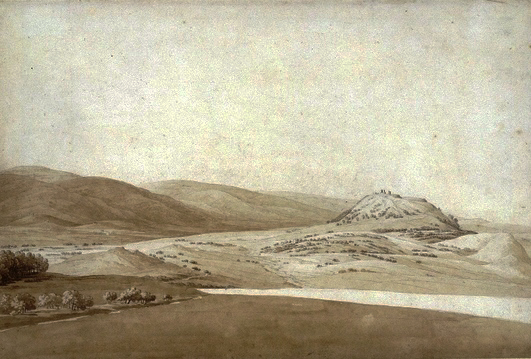
We will meet in Prague at the main train station at 7 am and at 7:25 we will leave Prague by train to Teplice v Čechách, where we will be at 9:06. From the train station in Teplice we will walk along Vrchlického Street to Zeyerovo náměstí and further to Doubravská hora (Castle Hill, 393 m). The ruins of the local castle from the 15th to 17th centuries were a destination for visitors to the Teplice spa in the 19th century. A fragment of the bastion of the castle fortifications has survived to this day, which CD Friedrich captured in two color drawings; he depicted the view of Castle Hill (Doubravská hora) above Teplice from the southwest in a charming ink drawing. From Doubravská hora we will continue to Sandy hill (251 m), where the observatory is located, and then further through Janáček and Humboldt gardens to Lázně Teplice. We will walk through the Spa Square, the Castle Garden and remember the rich history of the local spa, called Little Paris, which was one of the most important in Europe at the turn of the 18th and 19th centuries.
"I must be alone and know that I am alone in order to fully contemplate and feel nature; I must surrender to what surrounds me, I must merge with my clouds and rocks in order to be what I am. Solitude is indispensable for my dialogue with nature."
CD Friedrich


In its heyday, Teplice Spa was an important Central European cultural center, visited by important poets, writers, scientists, philosophers and artists (Goethe, Humboldt, Novalis, Leibnitz, Fichte, Tieck, Seume, Sienkiewicz), musicians (Chopin, Schubert, Wagner, van Beethoven, etc.), as well as statesmen from all over Europe. CDFriedrich visited Teplice as a resident in 1828 and 1835. From Teplice we will continue along the red trail to the village Lbin below Supí vrch; from here we will continue along the meanders of the Bílina River to the village FiremanFrom Ogníč we follow the yellow path to Pohradice Mountain (419 m) with a lookout tower and from there we will continue to Kostomlat pod Milešovkou; The village has a Gothic church and a Baroque chateau, and above it the ruins of a medieval bergfrit-type castle, which CD Friedrich captured in his drawing from 1828. We spend the night in the castle grounds.


Sunday 8.5.: Kostomlaty, Milešovka, Kletečná, ruins of Opárno castle, Lovoš, Malé Žernoseky, Velké Žernoseky, Kalvárie (30 km)
In the morning we will set off from Kostomlaty following the green trail under Silver Hill to Černčic and from there we ascend the blue to Milesovka (837 m), the highest peak of the Bohemian Central Mountains. From Milešovka we descend along the blue and yellow paths below Fox Hill until the crossroads on Paška field and from there we climb to the top Caged (706 m). From Kletečná we go down the yellow path through Hrušovka, Chotiměř to Opárenský mill and the ruins of the castle Oparno and from there we will climb to the top Lovoše (570 m). From Lovoš we descend along the yellow trail to Opárenské Valley except for ferry across the Elbe in Malý ŽernosekyWe will cross the Elbe River to Velky Žernoseky and on the other bank we will follow the green path in the direction of the Elbe River Calvary (245 m). We spend the night in the Kalvaria nature reserve or in the area Hrádek hillfort, whose origins date back to the Bronze Age.

“The only true source of art is the pure and sincere feelings that we cherish in our hearts. A painting that does not draw inspiration from the heart is nothing more than a vain juggling act. All authentic art is born in a sacred moment and is nourished in a blessed hour; it is created by an inner impulse, often without the artist being aware of it.”
CD Friedrich
"You should keep sacred every movement of your mind; you should keep sacred every pious feeling; for that is the art within us. In the inspired hour it will appear in clear form, and that form will be your image."
CD Friedrich

Caspar David Friedrich and Bohemia: CD Friedrich's first visit to Bohemia probably took place in 1807. The first significant works of art connected with the Czech landscape are his paintings "Cross in the Mountains" (Děčín Altar) and the aforementioned paintings "Czech Landscape with Milešovka" and "Czech Landscape", which were created in the years 1807 to 1808. All three were acquired from Friedrich by Count Franz Anton von Thun and Hochenstein of Děčín with his bride Theresa, Countess von Brühl, in 1808. However, one of Friedrich's drawings suggests that he may have been active in Bohemia as early as 1803. Friedrich's painting "Morning Mist in the Mountains" was probably also created in 1808, for which the Tolštejn Mountain in the Lusatian Mountains was probably the model; and in 1810 the famous painting "Night Landscape with a Rainbow", in which he depicted the motif of the Růžovský Hill in Bohemian-Saxon Switzerland. In 1810, CD Friedrich, together with his friend the painter GF Kersting, undertook a famous journey to the Giant Mountains, which resulted in, in addition to a number of drawings, the painting "Morning in the Giant Mountains" (1810-11) and later other paintings. CD Friedrich also worked in Bohemia in the 1820s and 1830s. His spa stay in Teplice in 1828 was particularly fruitful, during which the artist created a number of drawings and watercolors.


“In the landscape it was above all Friedrich, whose deep and energetic mind with complete originality seized this tangle of banality, rigidity and boredom and cut through it with sharp melancholy – and raised from its midst a distinctly new and radiant poetic tendency.”
Carl Gustav Carus
Caspar David Friedrich (1774-1840) was born in Greifswald and studied at the Copenhagen Academy. Together with Philipp O. Runge, he is considered the most important painter of his generation and one of the main representatives of Romanticism in world painting. After his studies, Friedrich moved to Dresden in 1798, which was at that time the center of the early Romantic movement. The exchange of views on new forms of artistic expression between artists and poets such as Friedrich Schlegel, Kleist, Novalis and Tieck was particularly intense and fruitful in this time of upheaval and break with old social structures. In his paintings, Friedrich expressed an emotional response to the world of nature and tried to capture its mysterious metaphysical dimension. The new painting that he strove for in his sacralized landscapes expressed a new pantheistic understanding of spirituality; his theme became the infinity of the universe and divine creation, but also the uncertainty of man in the contemporary world. The melancholy and uncertainty expressed in many of Friedrich's paintings not only reflect the artist's feelings around 1800, but also lend artistic form to an entire era whose worldview was shaken. –– Friedrich's work quickly gained fame and significant public recognition. However, from the mid-1820s, as society shifted and the taste of the time faded, his art met with increasing misunderstanding, and soon after his death, Friedrich was almost unknown. He was rediscovered in the early 20th century, especially by the Expressionists and Surrealists, and then again in the 1970s. In the 20th century, artists such as Max Ernst, René Margritte, Mark Rothko, Samuel Beckett, Anselm Kiefer, and many others claimed to be his.
Monday 9.5.: Kalvarie, Kamýk, Malíš, Michalovice, Radobýl, Litoměřice (14 km)
In the morning we will set off from Kalvária below Strážiště hill to Pebble to the castle ruins. From there we will continue through Malic to Michalovic and further to Radobýl (399 m), from where there is a beautiful view of the Elbe valley and the western part of the Bohemian Central Mountains. From Radobýl we will continue to Litoměřice to the bus station, from where we will return to Prague.

Connections
Litoměřice – Prague / Monday 9 May: BUS
- Litoměřice, bus station: departure 11:00 – Prague-Holešovice / arrival. 12:15
- Litoměřice, bus station: departure 12:00 – Prague-Holešovice / income 13:15
- Litoměřice, bus station: departure 1:15 p.m. – Prague-Holešovice / income 15:45
Contacts
Jiří Zemanek, email: sarvanga@centrum.cz, mobile: 777 117 466
Tomas Hruza, email: tomashruza@gmail.com, mobile: 775 052 607
Karel Čtveracek, email: ctv@seznam.cz, mobile: 603 355 072
Brbora Kinkalova, email: b.kinkalova@seznam.cz, 776 123 969
"I believe that a lot of good would come from a change in attitude if tourists became pilgrims again."
Rupert Sheldrake