
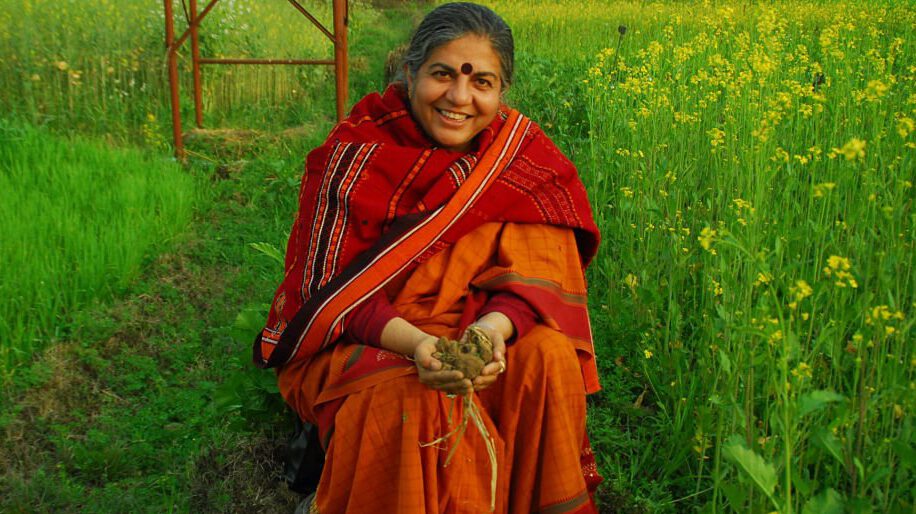
"Soil, not oil, is the future of humanity."
Vandana Shiva
Vandana Shiva is an Indian philosopher, environmental activist, and one of the most prominent figures in the global justice movement. She is particularly interested in issues of biodiversity and organic farming. She is the Director of the Foundation for Scientific Research, Technology and Natural Resources in Delhi and one of the leaders and board members of the International Forum on Globalization. She is also a member of the International Organization for Participatory Society. In 1993, she received the Right Livelihood Award, which is considered the "alternative Nobel Prize". She is often referred to as "Gandhi's Grain" for her activism associated with the anti-GMO movement. She is the author of a number of books: Biodiversity: Social and Ecological Perspectives (1992); Earth Democracy: Justice, Sustainability and Peace (2005) / in Czech: Democracy Earth: Justice, Sustainability and Peace (2016); Soil Not Oil: Environmental Justice in an Age of Climate Crisis (2008); Staying Alive: Women, Ecology, and Development (2010) etc.
This article originally appeared under the title "We Are the Soil" in the magazine The Asian Age (2014) – see also hereThis Czech translation by Alena Malíková was published in the collection Soil – healthy, alive, fertile (edited by Radomil Hradil). Fabula and Bioinstitut, Olomouc 2015, pp.252-254.
We are all made of the same five elements – earth, water, fire, air and space – that make up the universe. We ourselves are the soil. We ourselves are the earth. What we do to the soil, we do to ourselves. And it is no coincidence that the words “humus” and “people” [humans] have the same roots.
The current paradigm forgets this ecological truth because it is based on eco-apartheid, the false idea that we are separate from and independent of the land; and also because it defines soil as dead matter. If the soil were dead, human activity could not destroy it. It could only “improve” the soil with chemical fertilizers. And if we are the masters and conquerors of the soil, we determine its fate. The soil cannot then determine our fate.
However, history shows that the fate of society and civilization is closely linked to how we treat land – our relationship to land can be expressed through the law of restitution.1Albert Howard's term, which refers to the return of organic matter to the soil. (Editor's note), or through the law of exploitation and conquest. The law of restitution – giving back – showed that societies that create and maintain fertile soil can be sustained by the living soil for thousands of years. The law of exploitation – taking without giving back – led to the collapse of civilizations.
Societies around the world today are on the verge of collapse, as are soils that are eroded, degraded, poisoned, buried under concrete, and devoid of life. Industrial agriculture, based on a mechanistic paradigm and the use of fossil fuels, results in ignorance and blindness to the life processes that create living soil. Instead of focusing on the soil-food connection, it is obsessed with external inputs of chemical fertilizers—what Sir Albert Howard called the NPK mentality. Biology and life are being replaced by chemistry.
External inputs and mechanization are essential for monocultures. Exposing the soil to wind, sun and rain means exposing the soil to wind and water erosion in monocultures. Soils with low organic matter content are more susceptible to erosion because organic matter helps to aggregate and strengthen the soil. Soil is lost ten to forty times faster than it is naturally renewed. This means thirty percent less food in the next 20 to 50 years. Soils are stripped of nutrients through erosion. A ton of topsoil contains on average 1–6 kg of nitrogen, 1–3 kg of phosphorus, 2–30 kg of potassium, while eroded soil has only 0.1–0.5 percent nitrogen. Nutrient losses amount to $20 billion per year.
Fertile soil contains 100 tons of organic matter per hectare. A reduction in soil organic matter by 1.4–0.9 percent reduces yield potential by 50 percent. Chemically applied monocultures make soils more susceptible to drought, contributing to food shortages. In addition, eroded and organic-poor soils absorb 10–300 mm less precipitation per hectare per year. This represents a reduction in water availability for food production of 7–44 %, contributing to a decrease in biological productivity of 10–25 %.
No technology can claim to feed the world while destroying life in the soil and disregarding the principle of the law of reversion. This confirms the fallacy of the claim that the Green Revolution or genetic engineering will feed the world. The basis of these technologies is monocultures based on chemical inputs, on principles that destroy soil life and accelerate its erosion and degradation. Destroyed and dead soils, soils without organic matter, soils without soil organisms, soils without the ability to retain water cause famines and food crises and do not ensure food security. This is especially true in times of climate change. Industrial agriculture is not only responsible for forty percent of the greenhouse gases that contribute to climate change, but it is also more sensitive to these changes.
Soils containing organic matter are more resilient to drought and climate extremes. Increasing organic matter production through species-rich, photosynthetically intensive systems is the most efficient way to sequester atmospheric carbon dioxide in plants and then in the soil – as dictated by the law of return.
Land, not oil [Soil, not Oil] is the future of humanity. Intensive industrial agriculture based on oil, fossil fuels and chemicals represents three principles that are killing the soil and thus affecting our future. First, industrial agriculture destroys living soils through monocultures and the use of chemicals. Second, the oil-based paradigm increases the consumption of fossil fuels and creates a false level of productivity that presents an unproductive system as productive.
The trick is to degrade creative productive work to mere merchandise [commodity] and in counting human labor as an input [input], while fossil fuels are not considered an input. The intensive use of fossil fuels on industrial farms is presented to us as if more than 300 “energy slaves” work invisibly for each worker2Energy slave [energy slave, ES], a term first used by R. Buckminster Fuller, is used to compare human productivity to the energy that would do the same work in a modern oil-dependent economy. However, this does not include the incidental costs of damage to the environment or social structures. Formally, one [energy slave] produces one unit of human labor using non-human tools and energy supplied by the industrial economy.. To consider people as an input is to believe that the fewer people working the land, the more “productive” agriculture is. It destroys farmers, it destroys rural economies, the land is devoid of people and full of poisons. The creative work of farmers – the custodians and restorers of the soil – and biodiversity is replaced by deadly chemicals. The creative work of the farmer and co-creator of living soil is not to be an “input” in the food production system, but to become the most important “output” of good farming. It cannot be reduced to a mere commodity. Nor is land a commodity. The creation of fertile living soil, its care and its restoration are the most important challenges of civilization. They are a regenerative output.
Third, abandoned farms are being swallowed up by cities. This is not a natural or inevitable phenomenon. It is part of the pattern of industrial agriculture. Sprawling cities are burying fertile soil under concrete. Every minute, an area the size of thirty football fields is covered in cement and concrete. The Save Our Soil Movement [Save our Soils – SOS], of which I am the patron, was founded by a number of organizations including FAO, IFOAM, Nature and More to wake up humanity in relation to the soil; because humans are also in need.
We should not measure human progress by how much cement has buried the land, but by how much land has been cultivated and liberated.”"Saugandh mujhe je mitti ki" – this soil is my commitment and promise. Living seeds and living soils are the foundation of life and a sustainable society.
.
Deep. True.