
Hiking to the sources of the Elbe and the Polish part of the Giant Mountains
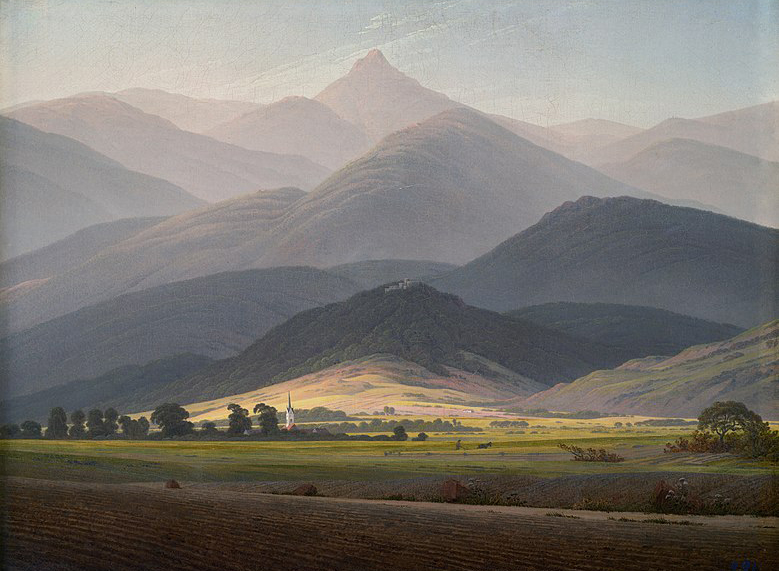
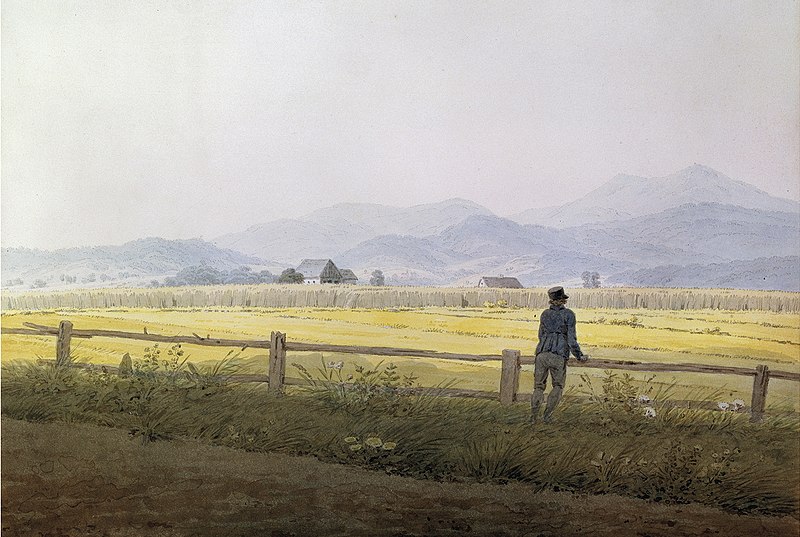
CD Friedrich, Krkonoše / Giant Mountains (view from the Polish side), 1810
following the footsteps of the Krkonoše pilgrimage undertaken in July 1810 by German painters Caspar David Friedrich and Georg Friedrich Kersting
Vysoka Lípa – Studenec – Tolštejn – Luž – Oybín – Hrádek nad Nisou – Oldřichovský Špičák – Hejnice – Paličník – Jizerka – Elbe spring – Sněžné jama – Mužské kameny – Wielki and Maly Staw lakes – Karpacz – Kowary and around Sněžka to Horní Maršov (198 km).
August 21-28, 2022
"If we imagine the artist in his feelings that moved him as a man from the plain and the coast, as he approached the mountains, we will understand how the increasing movement of the earth must have taken hold of him."
Günther Grundmann about CD Friedrich during his trip to the Giant Mountains
In the first half of July 1810, two German painters, friends Caspar David Friedrich and Georg Friedrich Kersting, undertook a more than two-week journey to the Giant Mountains, which lasted approximately from July 2 or 3 to July 18. They set off from Vansdorf, but the actual starting point of their journey was Oybín, a famous cult place for German romantic artists. We will travel to Oybín from the center of Bohemian-Saxon Switzerland from Vysoka Lípa via Studenec and Luž, and from there we will follow the route of the two artists' journey to Hrádek nad Nisou and further across the entire Jizera Mountains and through the western Giant Mountains to the sources of the Elbe; which was one of the main goals of their journey. We will then travel along the ridges of the Giant Mountains through Sněžné jámy and Mužské kameny and around the glacial lakes Wielki and Maly Staw to the Polish part of the Giant Mountains. We will visit Karpacz, where we will see a unique monument of Norwegian medieval architecture, the Wang Church, and the town of Kowary, where both painters arrived on July 13, 1810, and then returned via Poland to Dresden.
During his journey through the Krkonoše Mountains, Caspar David Friedrich created several drawings and watercolors directly in the field, including the watercolor "The Source of the Elbe", and then, under the impression of his experiences from the journey in the same year 1810, he painted three oil paintings: "Morning in the Krkonoše Mountains", "Krkonoše Mountains" and "Moon over the Krkonoše Mountains". He then retrospectively depicted his experiences from this journey in other oil paintings, which were created in variations in the years 1819-20, 1830 and 1835. The Krkonoše Mountains journey introduced the theme of mountains into Friedrich's work - "encounter with the gigantic mountain waves of the Krkonoše Mountains"Günther Grundmann describes in his book Das Riesengenbirge in der Malerei der Romantik (1931), as Friedrich and Kersting marveled on their journey at the rising and undulating mountain massifs, whose movement and power Friedrich tried to capture in his paintings.
First day / Sunday, August 21 (25 km) / Pavlinino údolí, Studenec, Jedlovský pond
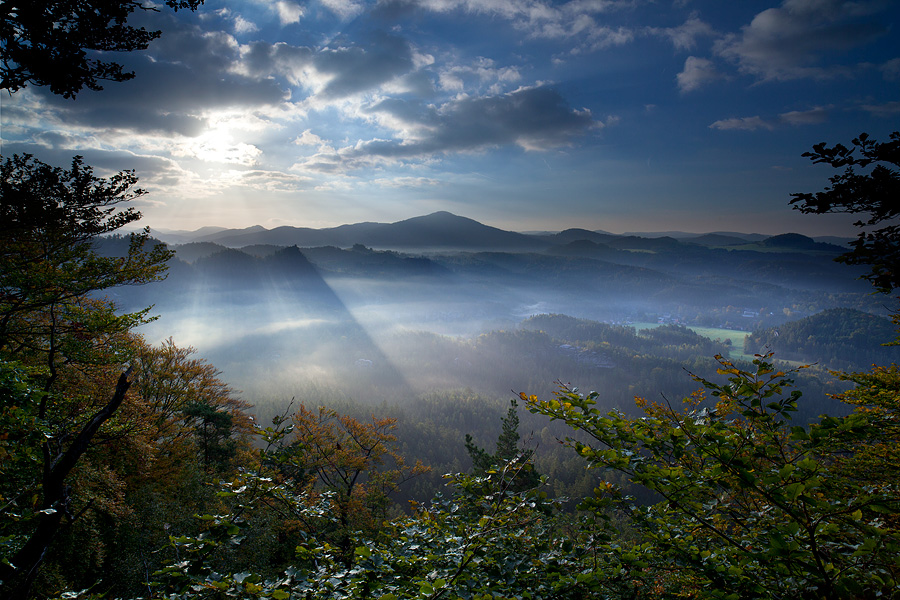
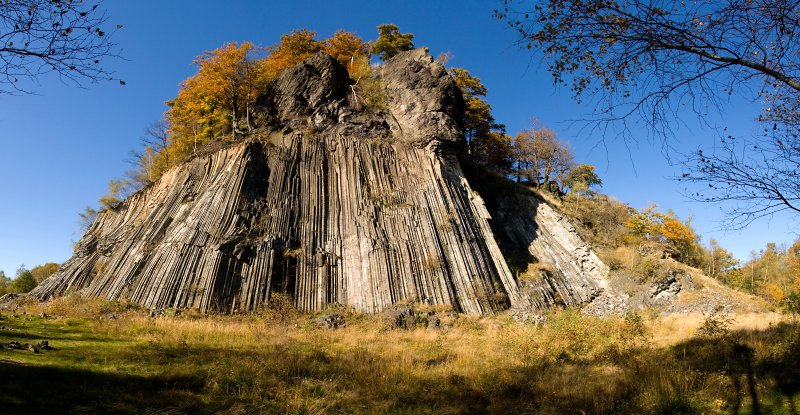
After the end "Praise of the Back Country" seminars We will set off at 10 am from Vysoka Lípa for a hike to the Krkonoše Mountains. We will take the road and then follow the yellow trail to Jetřichovice; from there we will continue along the red trail to Griesel's Pond and The Mermaid's Cave and then on according to the Chřibská Kamenice stream Through the Pavlina Valley to the village of Studený. The entire Pavlina Valley is home to rare fauna and flora, including the river otter, river kingfisher and black stork. We continue our ascent along the red trail to Studenec (737 m), the second highest peak of the Lusatian Mountains and we will also visit the neighboring Zlatý vrch nature reserve (657 m), where in the former basalt quarry we can observe the perfect structure and massiveness of the igneous basalt columns. From Studenec we will continue along the red trail past Malý Javorník (690 m) and Široký hill to the Křížový buk crossroads and further past Malá and Velká Tisová to The Great Jedlovské Pondwhere we spend the night.

Second day / Monday, August 22 (20 km) / Tolštejn, Luž, Carolafelsen, Jánské kameny
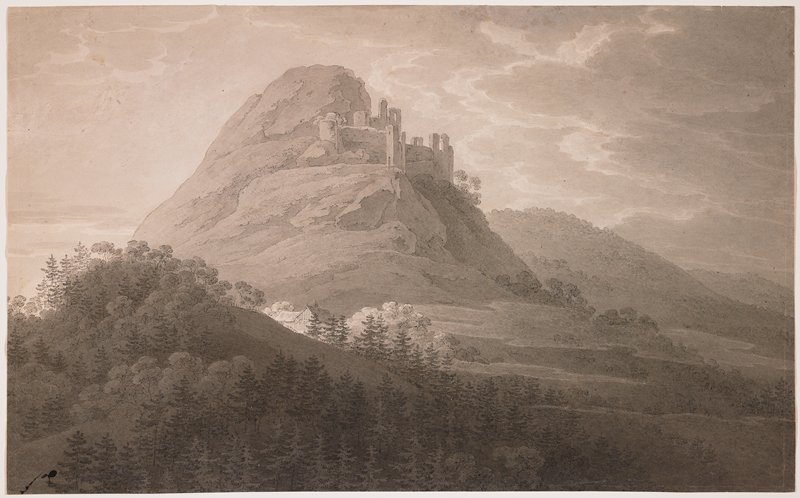
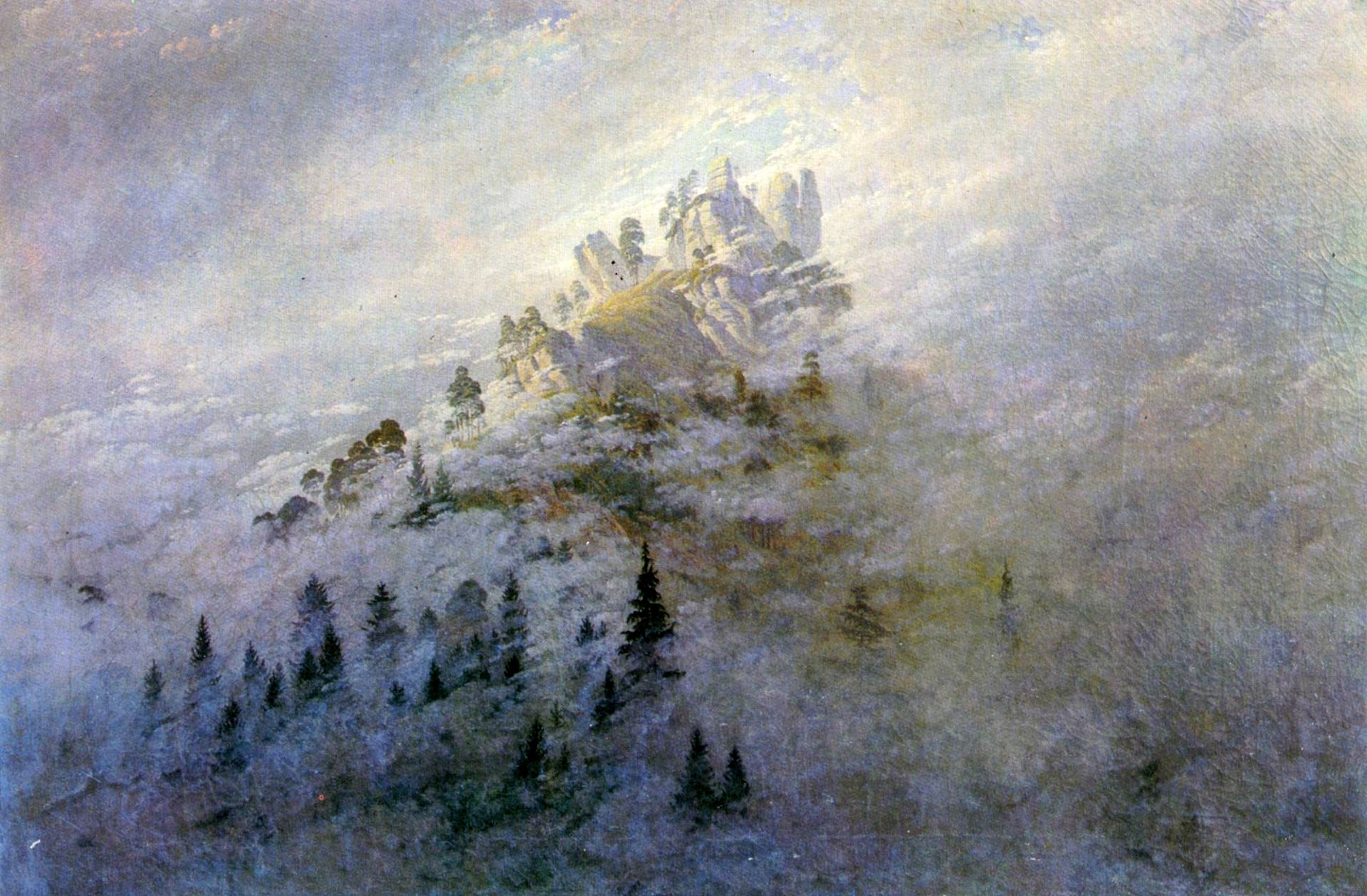
From the Great Fir Pond we will head in the morning to the ruins of the Gothic castle Tolstein (674 m), which surrounds two bell-shaped craters. This distinctive volcanic hill with the ruins of a castle has attracted the attention of many artists, including the outstanding Swiss graphic artist Adrian Zingg, who captured it in an impressive graphic, and probably also CD Friedrich, whose painting "Morning Mist in the Mountains" (1807) is often associated with the Tolštejn motif.

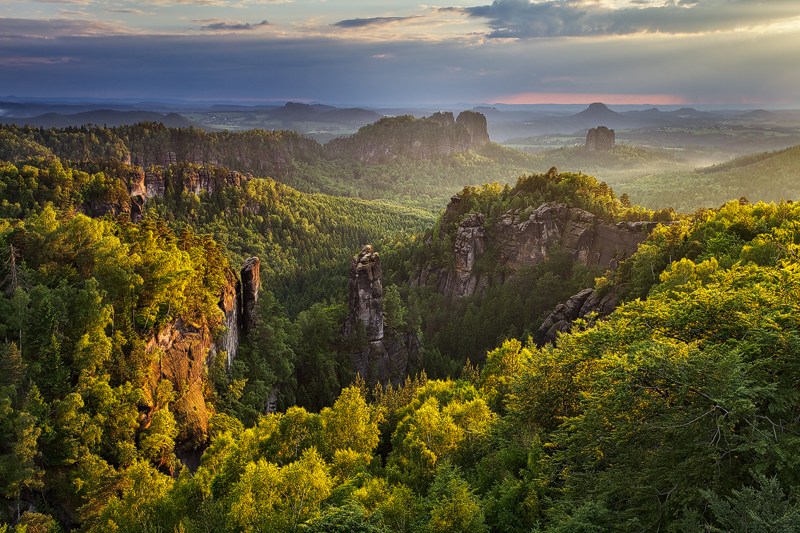
We will continue to Lesná and through Goat's back at the crossroads Pod Ptačinec and then along the ridge to Puddle (793), the highest mountain in the Lusatian Mountains. From Luž we will take the green path to the German side on Holstein (551 m) and on a rock formation Nunnery Rock (537 m) and further to Raven stonesThen we will continue through Johnsdorfer Felsenstadt to a beautiful view of the Carolafelsen above Johnsdorf and further along the green to the Krompach valy border crossing and from there to Jan's stoneswhere we spend the night.
Third day / Tuesday, August 23 (24 km) / Oybín, Töpfer, Hrádek nad Nisou, Grabštejn
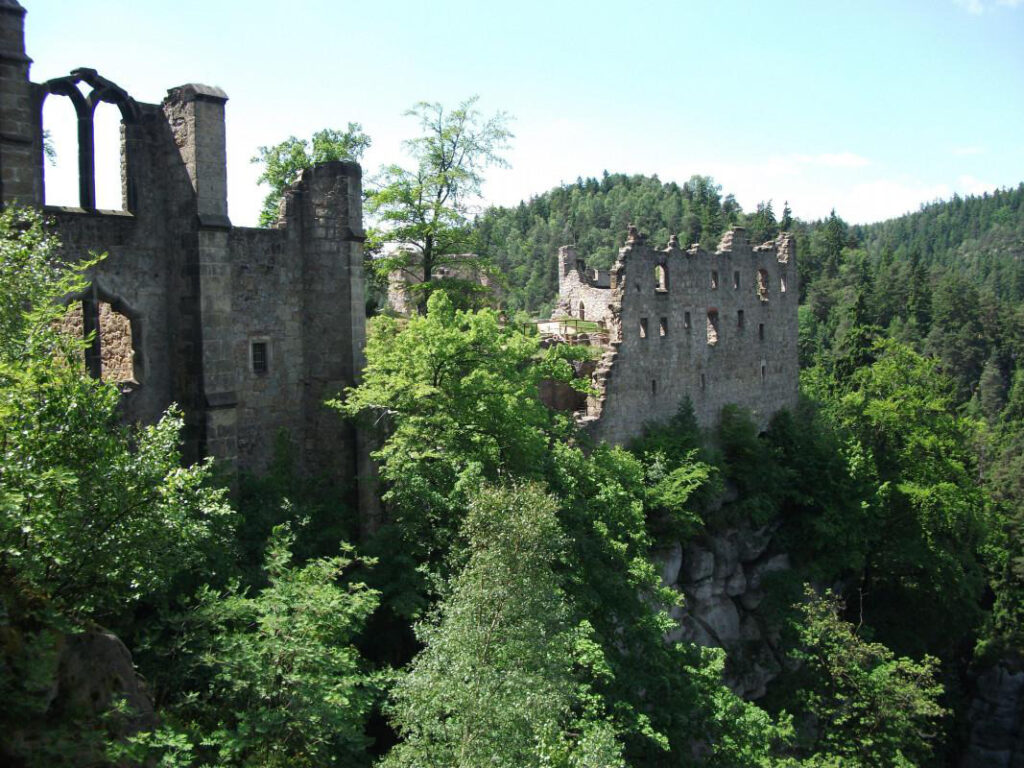
From Jánské kameny we will head to the viewpoint in the morning. Johannstein (602 m) and from there via Johanndorfer strasse on the yellow Thomasweg, after which we arrive at Thomas Rock and along the Ritterweg to the ruins of the castle and monastery in the spa OybinWe will visit the castle chapel, the monastery church and the famous Gothic window, motifs that CD Friedrich drew on his trip to the Krkonoše Mountains and later transformed into paintings such as "Ruin of Oybín" (1812), "Hutten's Grave" (1823), "The Dreamer" (1818), etc. We will walk through this entire unique artistic area, integrated into the rocky landscape, which became a place of pilgrimage for German romantic artists (Zingg, Friedrich, Carus, Oehme, Blechen).
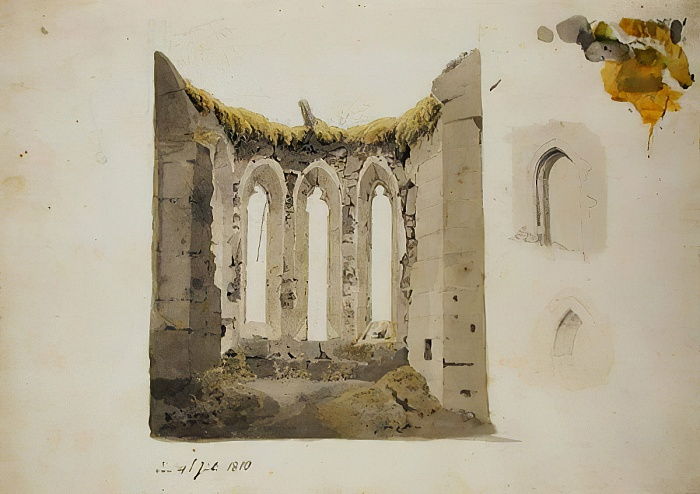
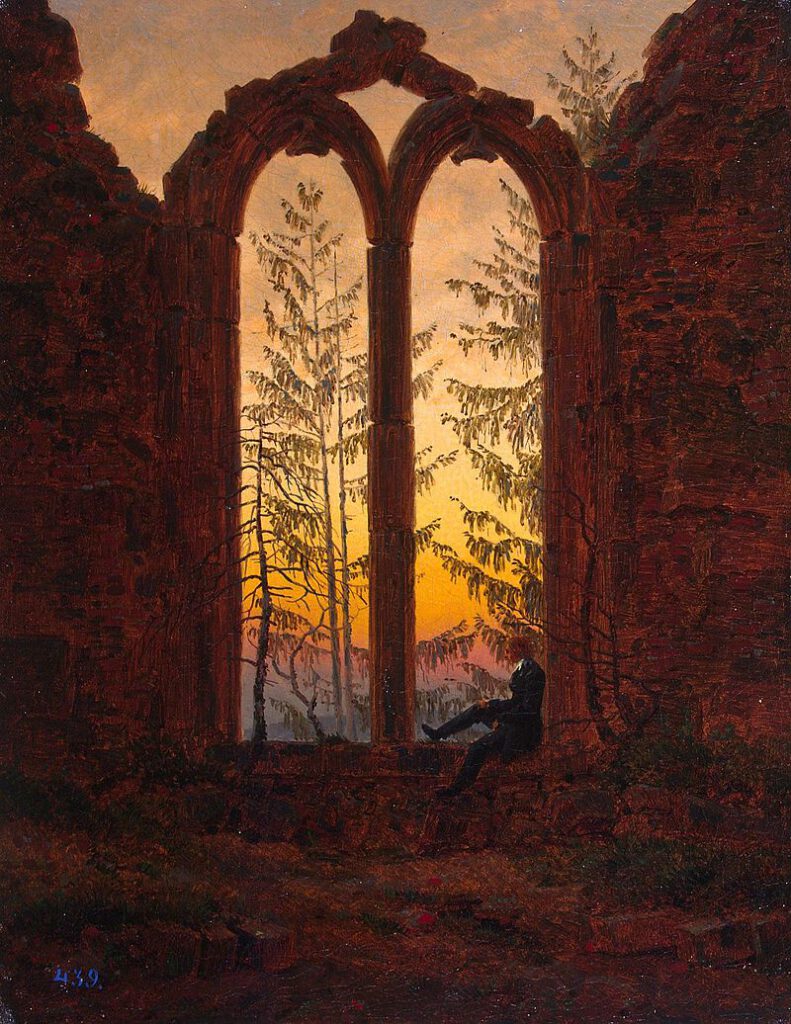
From Oybín we will take the red trail to the Zittau Mountains to the rock town Potter (582 m) with a rock gate and further along the yellow path to the rock needle Scharfenstein (569 m). From here we will follow the green path to the Lví buk border crossing, then to Popova skala (Pop's Rock) (565 m) and from there follow the blue line to Hradek nad NisouFrom the center of Hrádek we will take the green path along the Lusatian Nisa River to the castle. GrabsteinWe spend the night at Grabštejnský pond or a little further at Wenceslas Dam.
Fourth day / Wednesday, August 24 (27 km) / Grabštejn, Jizera Mountains beech forests, Oldřichovský Špičák
In the morning, from Grabštejn or from Wenceslas Dam, we will set off along the green trail via the ridgeline through Václavice to the hill. Views, from where there is a beautiful view of Poland to Jasná Góra (where the geopark is located) and also to the open-pit brown coal mine in Turów and the thermal power plant in Bogatynia, which are constantly destroying the local landscape. We will then go through Horní Vítkov to Albrechtice near Frýdlant, after which we enter the westernmost and least known part of the Jizera Mountains Protected Landscape Area.
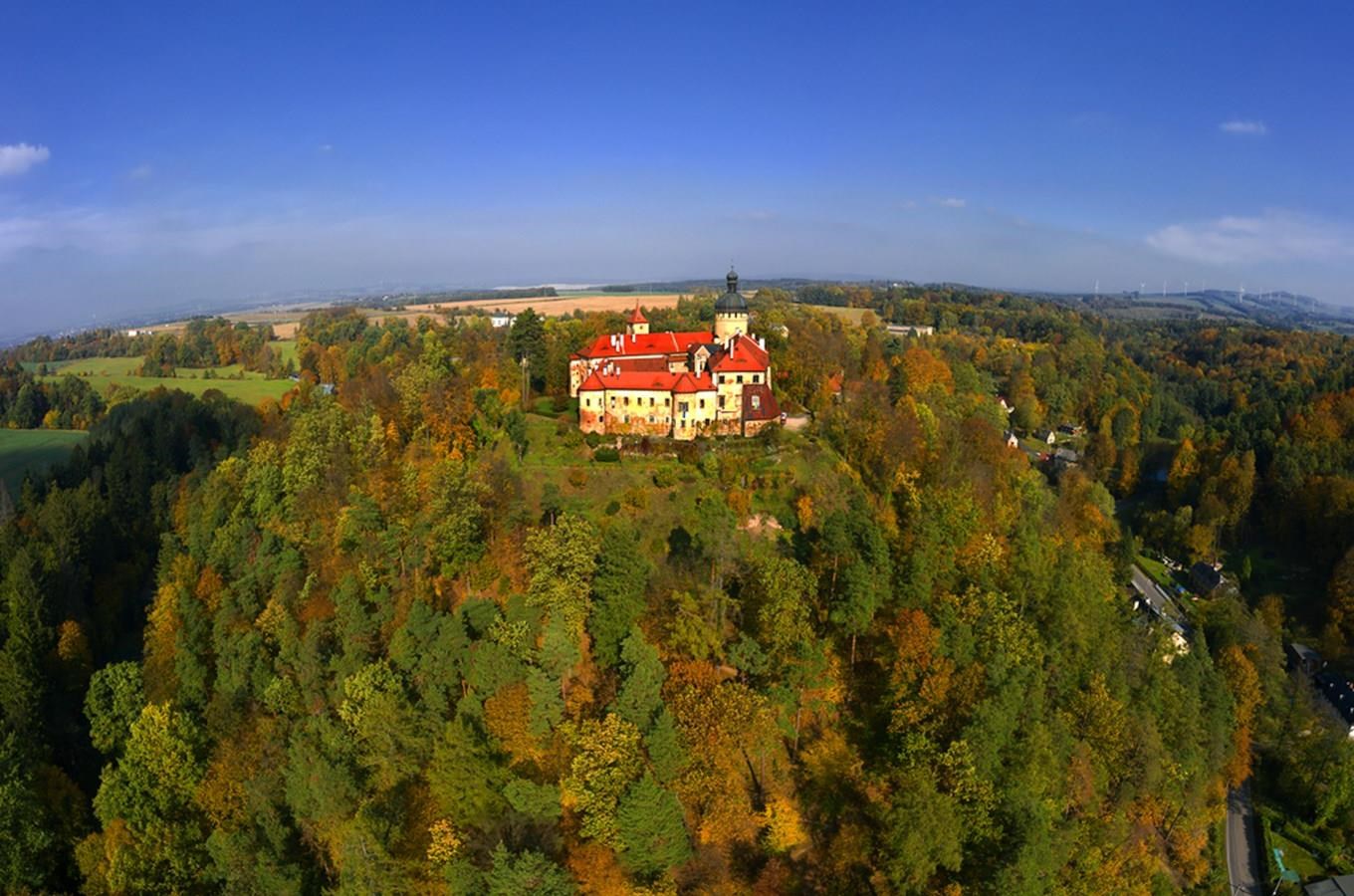
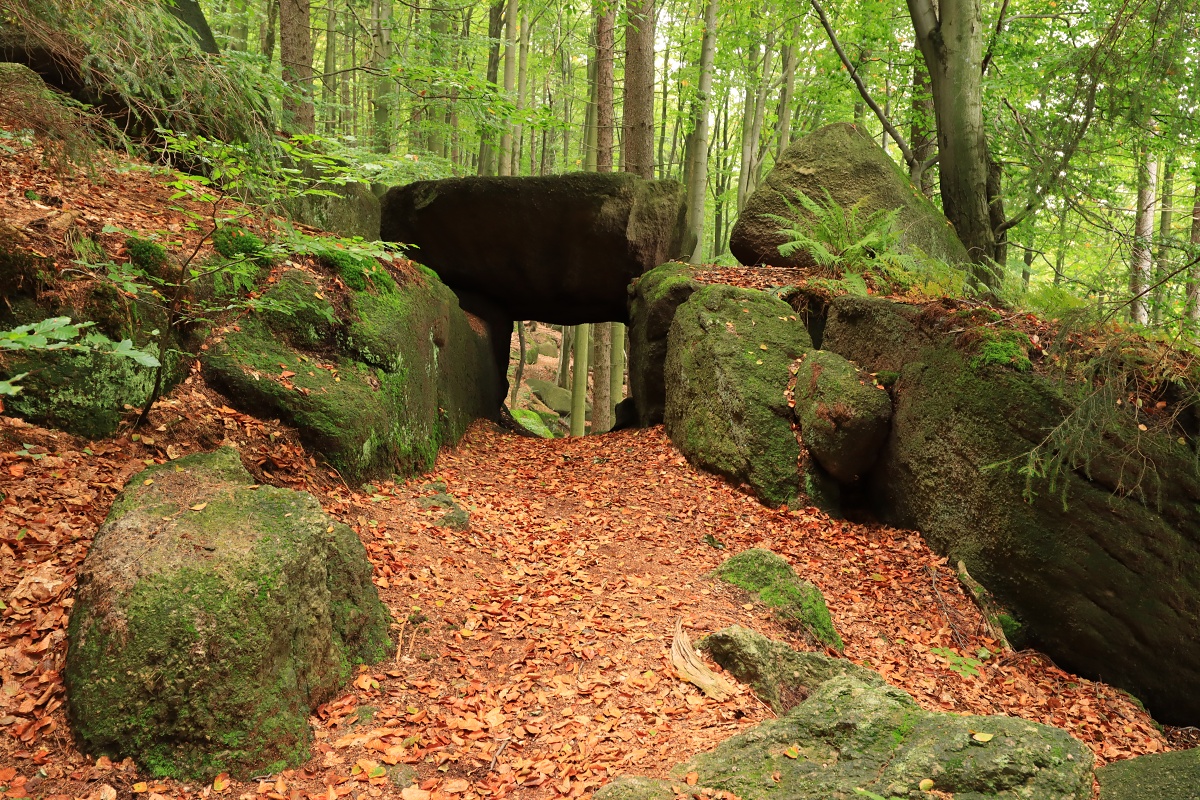

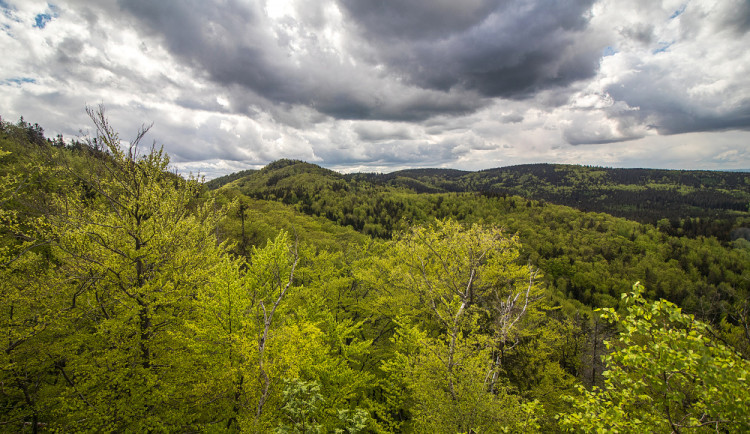
We will continue through the forest, following the green path, until we reach the Oldrichovsky Spicak (724 m), where we enter the area Jizera Mountains beech forests. It is a site of world importance, which is part of the UNESCO natural and cultural heritage; it is the largest natural forest in terms of area and one of the largest nature reserves in our country (950 ha). In addition to beautiful beech forests, there are various groups of granite rocks and boulders. We climb to Oldrichovsky Spicak or we will pass Through the Rock Gate and we will continue on the green to To the rock castle except for Hives (598 m) and to the Oldřichovské saddle. From here we follow the blue trail along the Old Pilgrimage Road to Hejnice, where in the meadows near King's Grove We are staying overnight.
Fifth day / Thursday, August 25 (23 km) / Hejnice, Paličník, Jizerka
In the morning we will set off via Hejnice past the Baroque Franciscan monastery with the Church of the Visitation of the Virgin Mary, which its author, architect Antonín Haffenecker, uniquely placed in the landscape of the Jizera Mountains. From Hejnice we will continue along the yellow trail via White Creek and then further through the Jizera Mountains beech forests to The scythe (944 m), from where there is a unique view of the entire Frýdlant region and the opposite peak of the Jizera. From Paličník we will take the ridge trail along the blue and then the red trail along the peat bogs of the Jizera River to Poacher's stones (975 m) and on Deer Hill (1018 m), from where we descend to the settlement Jizera under the mountain top Beech (1005 m).

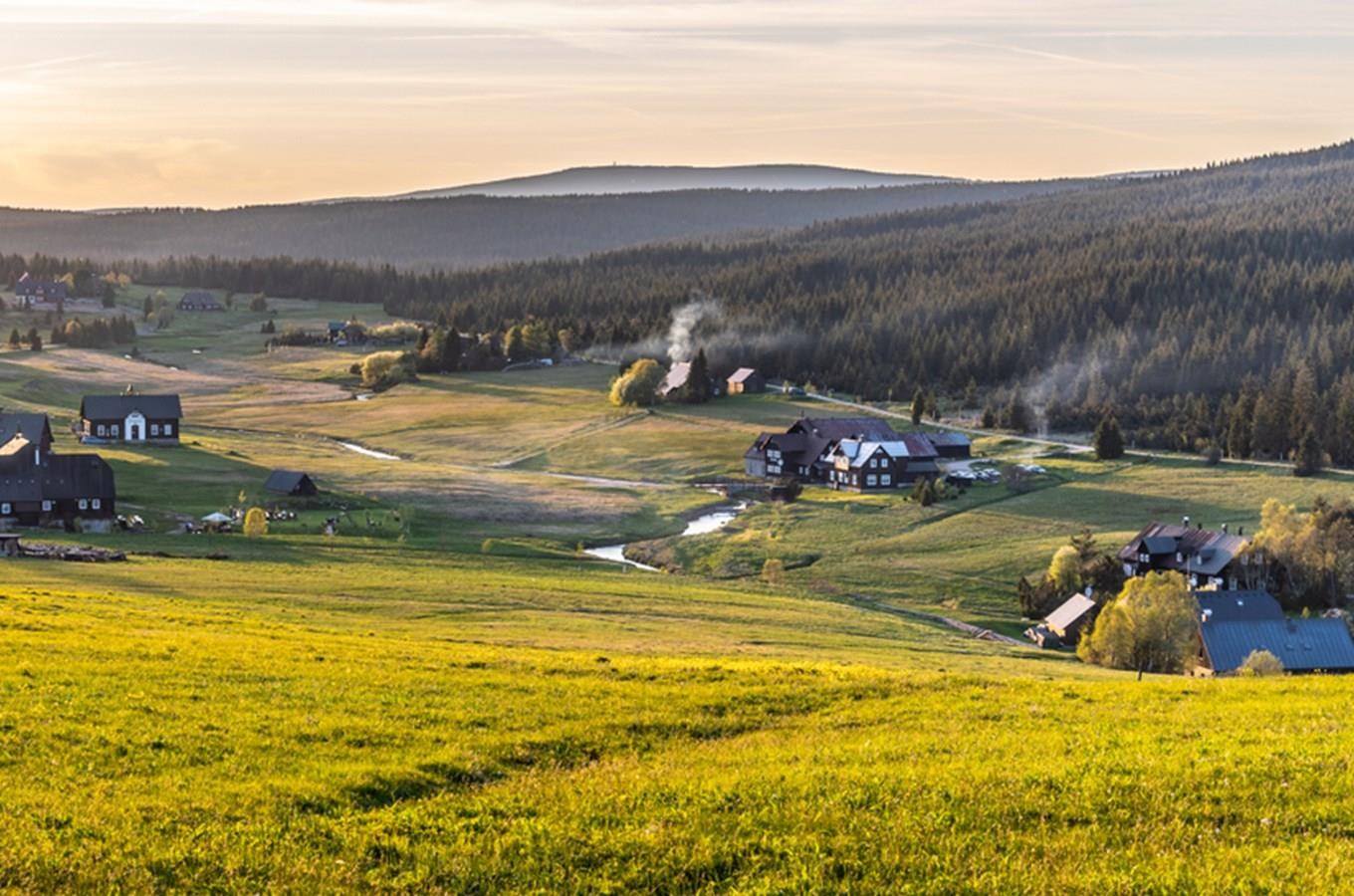
Settlement Jizera is the highest village in the Czech Republic (850 m); it was named after the Jizera mountain. In the 16th century it was the seat of hunters, hunters who usually hunted songbirds; later it was settled by loggers and collectors of precious stones. In the 19th century, two glassworks were founded here, one of which is still in use today. The dominant feature of the Jizera Mountains, Bukovec Hill, is one of the highest basalt igneous rocks in Central Europe. Right in the village there is a strictly protected upolin meadow and peat bog of the Jizera River. We will sleep under the peak of Bukovec.
Sixth day / Friday, August 26 (25 km) / Owce Skaly, Szrenica, Czech hut, Elbe spring
From Bukovec, we can set off in the morning to the sources of the Elbe River in the Krkonoše Mountains via two alternative routes. Either we can take the shorter route through Poland, from where CD Friedrich undoubtedly headed to the Krkonoše Mountains; it leads through Owce Rocks up to the border crossing Szrenica and then through Česká budka and to the source of the Elbe; length 17 km. Or we can go on the Czech side along the Jizera River to Martin Valley, cross the Jizera here and continue through Harrachov and beyond through the Mumlava valley up to sources of the Elbe; this route is 23 km long. We will spend the night in Vosecké bouda, 2.5 km from Labská louka, where accommodation is the cheapest (450 CZK per night in your own sleeping bag).
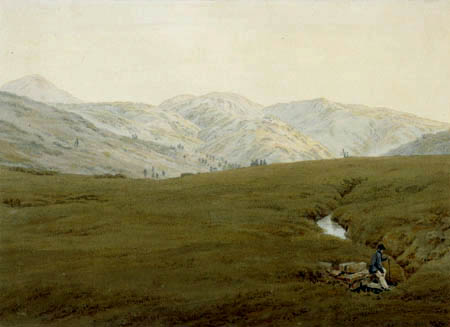
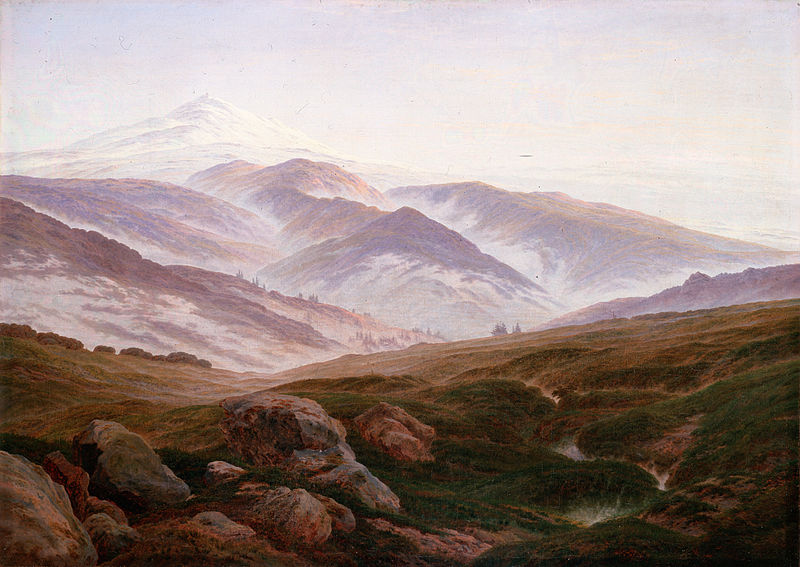
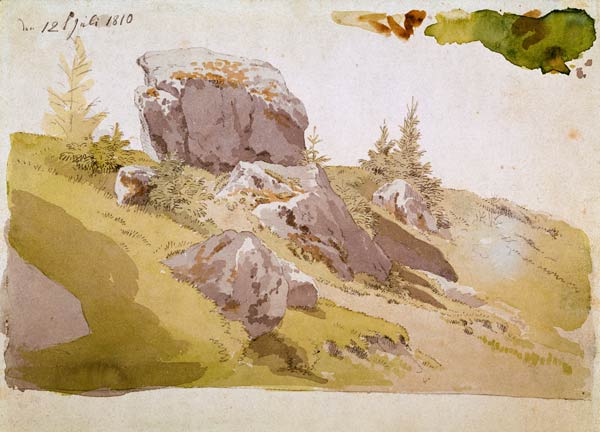
Caspar David Friedrich arrived with his friend Georg Kersting at to the sources of the Elbe July 10, 1810, as evidenced by Friedrich's pencil drawing (now in the Essen Museum), on the basis of which he created a watercolor of the same motif in the same year (see reproduction). The first plan of this painting is occupied by a vast green Elbe meadow, in the lower right corner of which is the source of the Elbe, over which leans the figure of a meditating, half-seated pilgrim in city clothes and with a hat leaning on a stick. Behind the meadow in the background rises the wavy gray wall of the Giant Mountains (from which the peak of Sněžka rises to the left behind). The mountains are slightly frosted with a whitish veil of rising morning fog. It is the time before sunrise, the first rays of which timidly touch some parts of the mountain slopes in the background. The artist later varied this motif in two paintings "The fog is rising in the Krkonoše Mountains" (1820) and "Remembering the Giant Mountains" (1835), in which the dominant motif was the misty mountains in the background, which the artist dramatically dramatized in shape and, above all, color. In the first painting, Friedrich narrowed the foreground of the meadow with the Elbe spring, omitted the figure of the pilgrim, and piled several boulders in its left part, which he had noted in one of his watercolors during his travels.
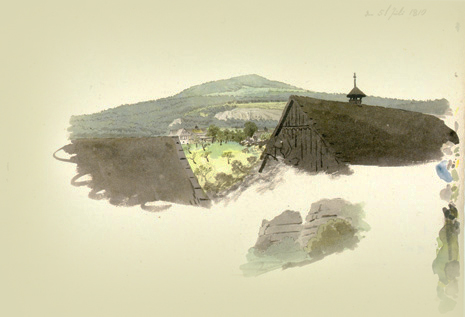
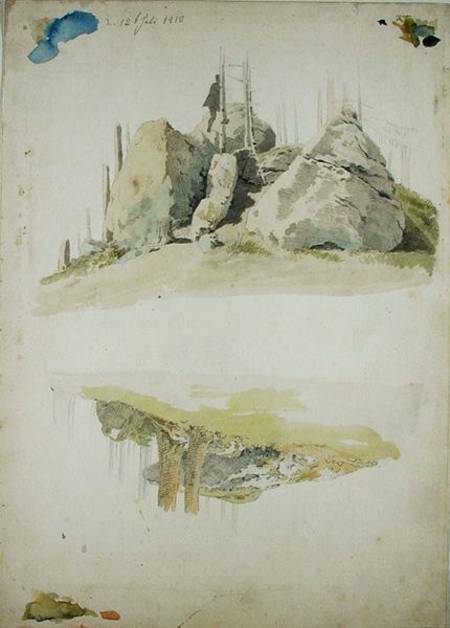
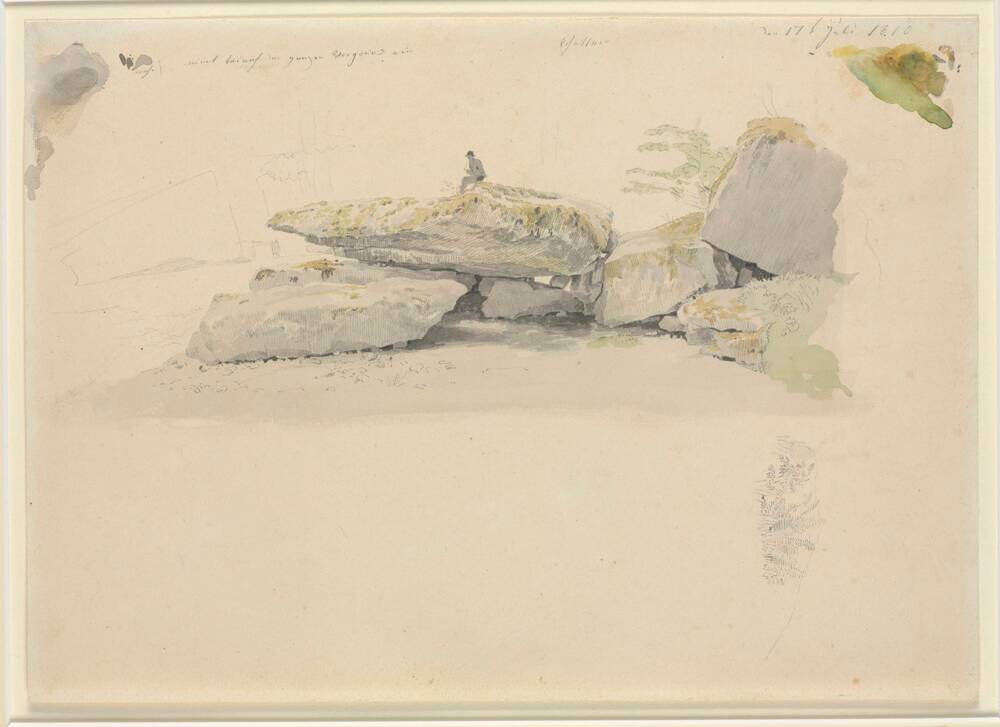
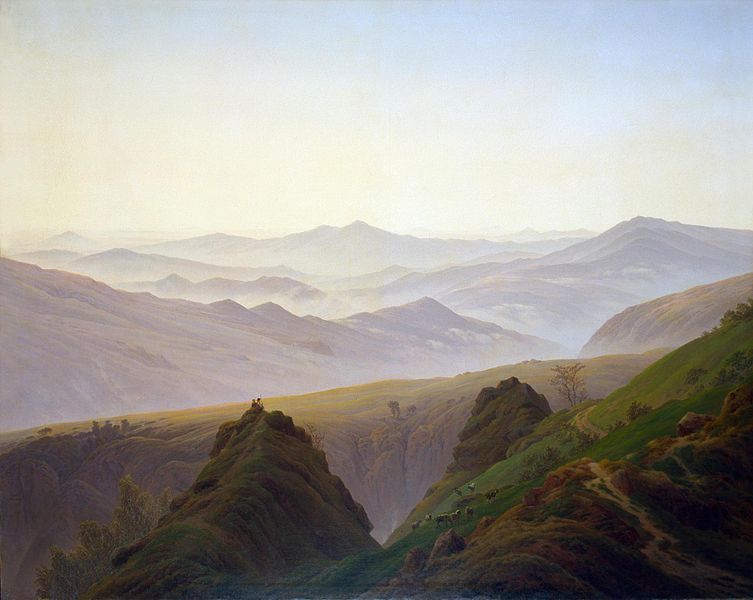
Drawings from the journey: Friedrich and Kersting set off on their journey from Vansdorf through the Lusatian Mountains. On July 2 or 3, they crossed the Czech-Saxon border at Waltersdorf and via Jonsdorf reached Oybín on July 4, where they spent two days. From Oybín to the Krkonoše Mountains, their pilgrimage is documented by several drawings and watercolors by Friedrich, as well as one drawing by Kersting. They show that they left Oybín on July 5; on July 6, Friedrich drew a view of the Jizera Mountains from Hrádek nad Nisou; on July 8, two of his drawings of the ascent along the forested slopes of the Krkonoše Mountains are dated; and on July 10, as we already know, both pilgrims reached the sources of the Elbe. On July 11, Friedrich's pencil drawing of a view of the Krkonoše ridges is dated, a motif that the artist depicted in his painting "Morning in the Krkonoše Mountains" (1810). On July 12, he sketched two, or rather three, watercolor drawings of the Krkonoše boulders (see below). And on 13 July there is a dated pencil drawing of a view of the Giant Mountains from the Polish side from the town of Kowary with the figure of a pilgrim (which he converted into a coloured watercolour). On 17 July he created a drawing of a pilgrim sitting on a group of boulders by the forest (see below), a scene that probably no longer originates from the Giant Mountains. Kersting's beautiful coloured watercolour from 18 July, depicting the wandering CD Friedrich (see below), seems to sum up and conclude the entire joint journey of the two friends through the Giant Mountains.

Seventh day / Saturday, August 27 (26 km) / Snow Pits, Big and Small Ponds, Karpacz
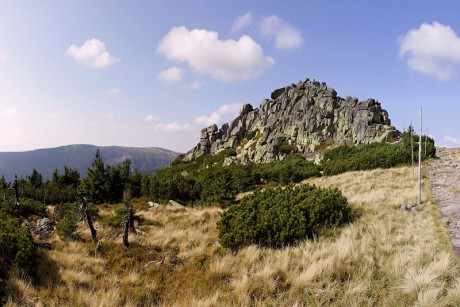
From Vosecká bouda we head towards Elbe Waterfall above the Labský důl and then along the yellow line over High plain (1497 m) to Snow pitsWe will continue along the red trail below the Vysoký kolo (1509) to Velký Šišák (1410) and across Male stones (1417) and the Maiden's Stones (1414) up to Petrovka.
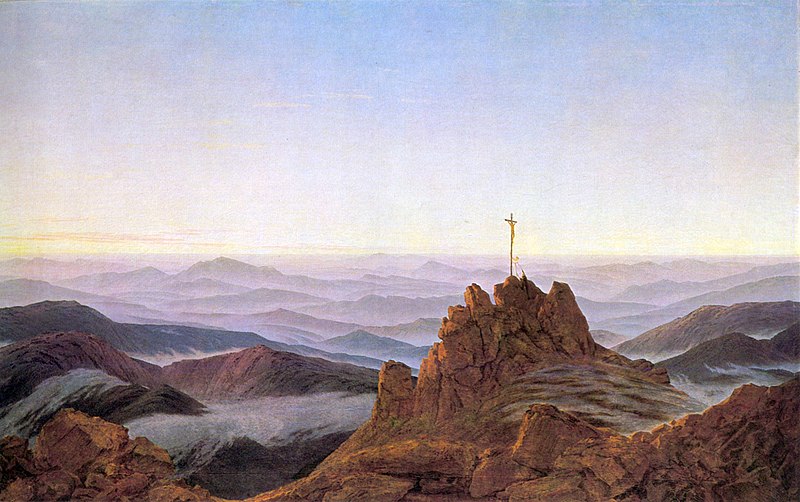
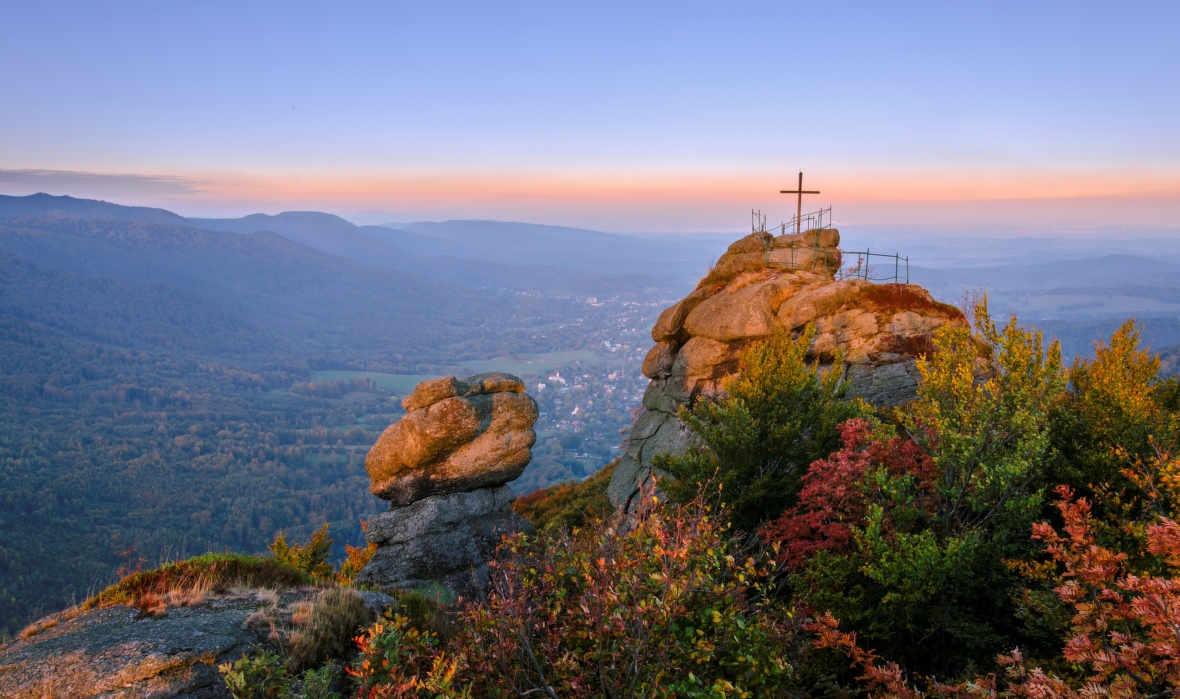
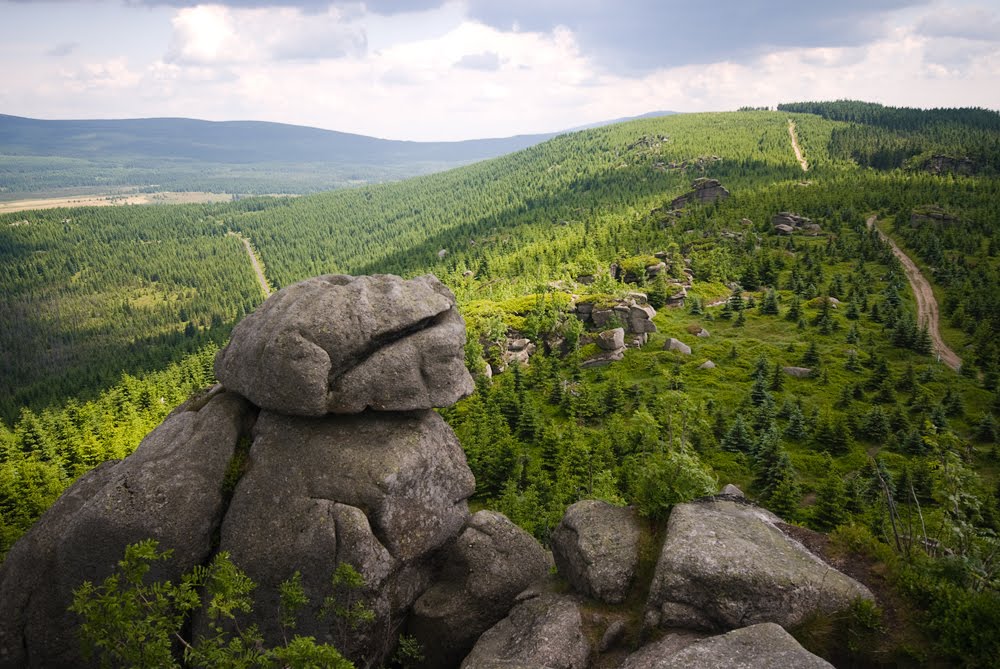
The distinctive granite boulder formations on the ridges of the Krkonoše Mountains, especially the Men's Stones, as well as the deep glacial crater of the Snow Pits, greatly impressed Friedrich, and he incorporated their motifs into two of his symbolic paintings with which he celebrated the Krkonoše Mountains. In the painting "Morning in the Giant Mountains" (1810) placed before a scene of misty, widely graduated mountain ridges in the rising morning sun – which CG Carus compared to “the gently raised ridges of calmly flowing sea waves” – the motif of a high jagged rock with a crucifix and a pair of a man and a woman climbing up to it. The painting expresses a spiritual transcendence, carried by the entire awakening landscape. A similar tension is observed in the painting "Morning in the Mountains" (1823), in the first plan of which a view opens into a deep abyss between two sharp rocky outcrops, which introduces a moment of typically romantic contradiction, uncertainty of existence, into the idyllic scene with two shepherdesses, which the author placed on the top of one of the rocks. Friedrich fully developed this motif in the painting "Chalk Cliffs on Rügen" (1818).
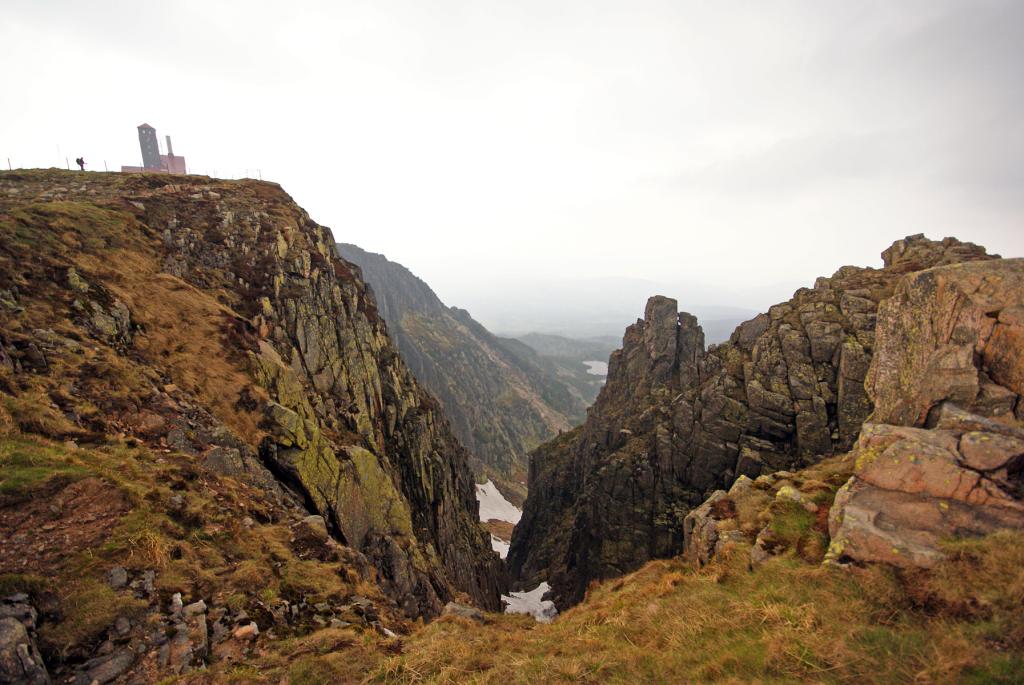
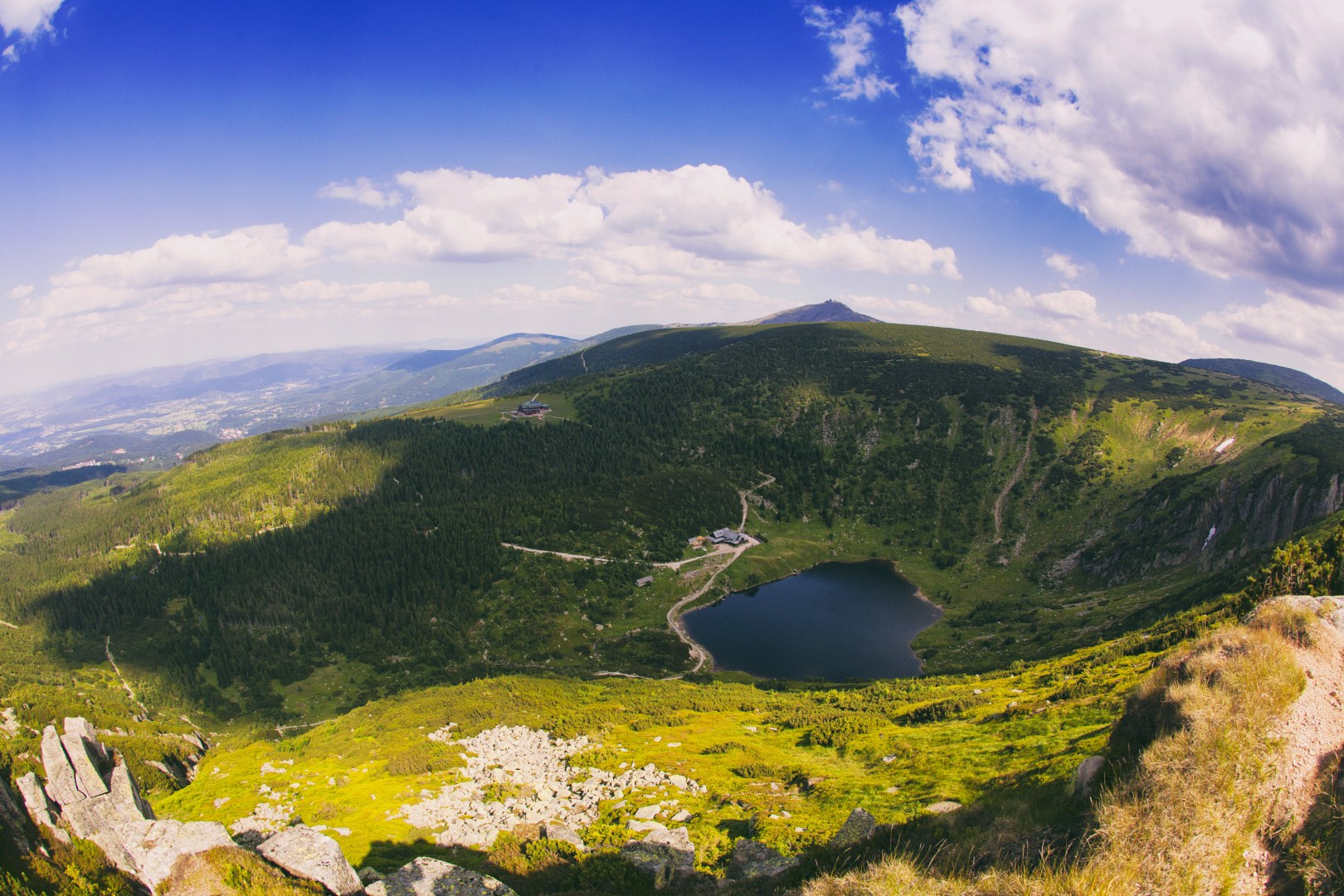
From Petrovka we continue along the red path through Silesian saddle up to To the noon stones under Silver-backed (1489 m) and to glacial lakes Big pond and Small pond (Wielki and Maly stav). The Large Pond is the largest glacial lake in the Krkonoše Mountains with an area of 8.3 hectares and a depth of up to 24 meters. We will go around both ponds from above and go down to the Small Pond, from where we will continue down the blue and yellow to the Polish spa town and tourist center Karpaczwhere we spend the night in a tourist hostel or in a meadow in the forest.
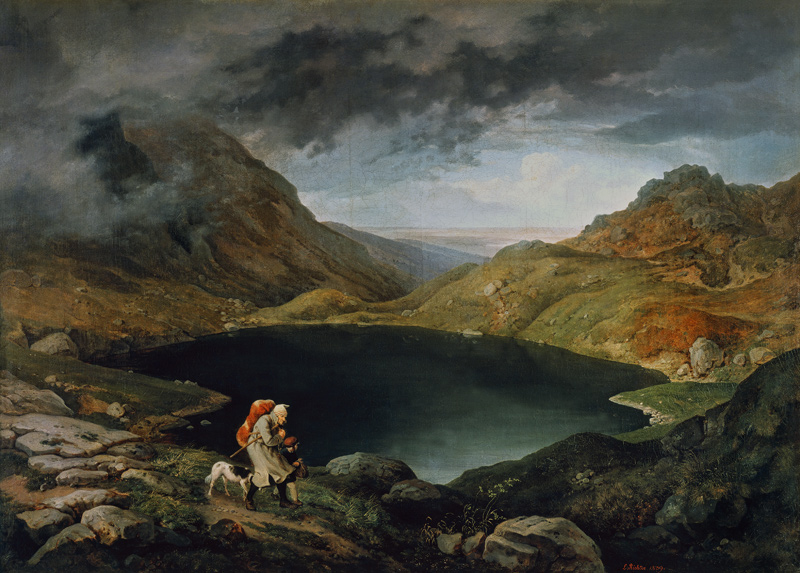
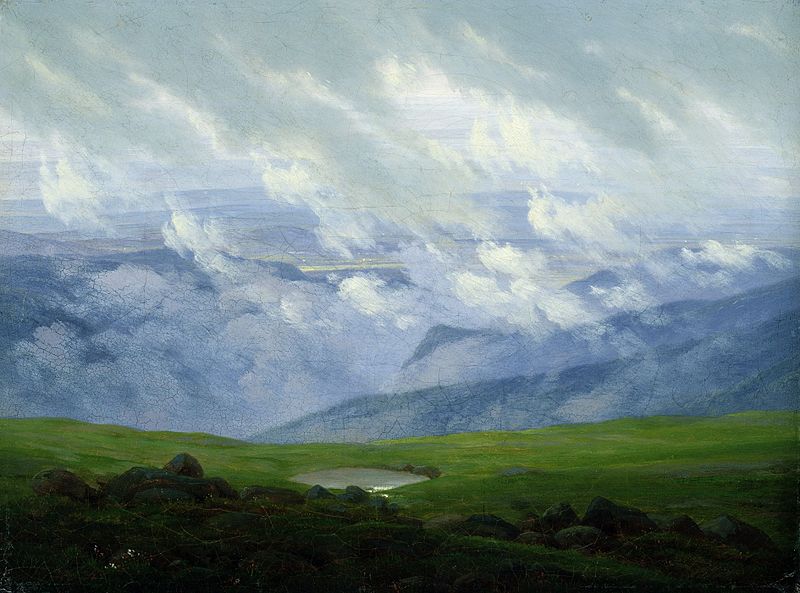
Small pond (They had a low status) was depicted in 1839 in the charming romantic painting “Lake in the Giant Mountains” by Friedrich’s Dresden colleague and friend, the painter Adrian Ludwig Richter (1803-1884). Later, it was also depicted in their paintings and prints by the Czech painters of the late 19th century Julius Mařák and Otakar Lebeda. Friedrich’s painting from 1821 “Stretching Clouds” with the motif of a mountain eye evokes the impression of the Giant Mountains landscape, in which it is also often situated by most art historians. The character of the depicted mountain landscape, whose terrain drops significantly, is reminiscent of the Giant Mountains; however, the location of the lake in an open green meadow does not directly refer to the situation of the Small Pond. Nevertheless, it could be an evocative painting that, as is typical for Friedrich, combines motifs from two landscapes.
"When a scene is shrouded in fog, it seems larger, more sublime, heightening the viewer's imagination and anticipation - like a veiled girl. In general, the eye and imagination are more easily attracted by a hazy distance than by what is perfectly visible to all."
Caspar David Friedrich
"Despite what many artists think, art is not and should not be a mere skill. In fact, it should be completely and utterly the language of our feelings, our moods, even our piety and our prayers."
Caspar David Friedrich
Eighth day / Sunday, August 28 (28 km) / Karpacz, Kowary, Horní Maršov
In Karpacz we will see a unique monument of Scandinavian sacral architecture from the 12th century, which was moved to Karpacz from Norway in 1842. It is a so-called stavkirke, an all-wooden column church of Viking origin, which was located in the fishing village of Vang in southern Norway; hence its current name. WangIn 1841, it was saved from destruction by a prominent Norwegian painter. Johan Christian Dahl, professor at the Dresden Academy and friend and pupil of Caspar David Friedrich. Dahl, with the support of the Prussian King Friedrich Wilhelm IV., secured the purchase, dismantling and careful documentation of all parts of the building and sought to have it moved to Oslo; when this plan failed, he secured the transport of the building to Berlin. At the request of Countess Friederika Karolina von Reden of Bukowce, the king finally donated the church to the Krkonoše village of Karpacz, where the newly built and reconstructed building was consecrated in 1844; since then it has served Evangelicals to this day.
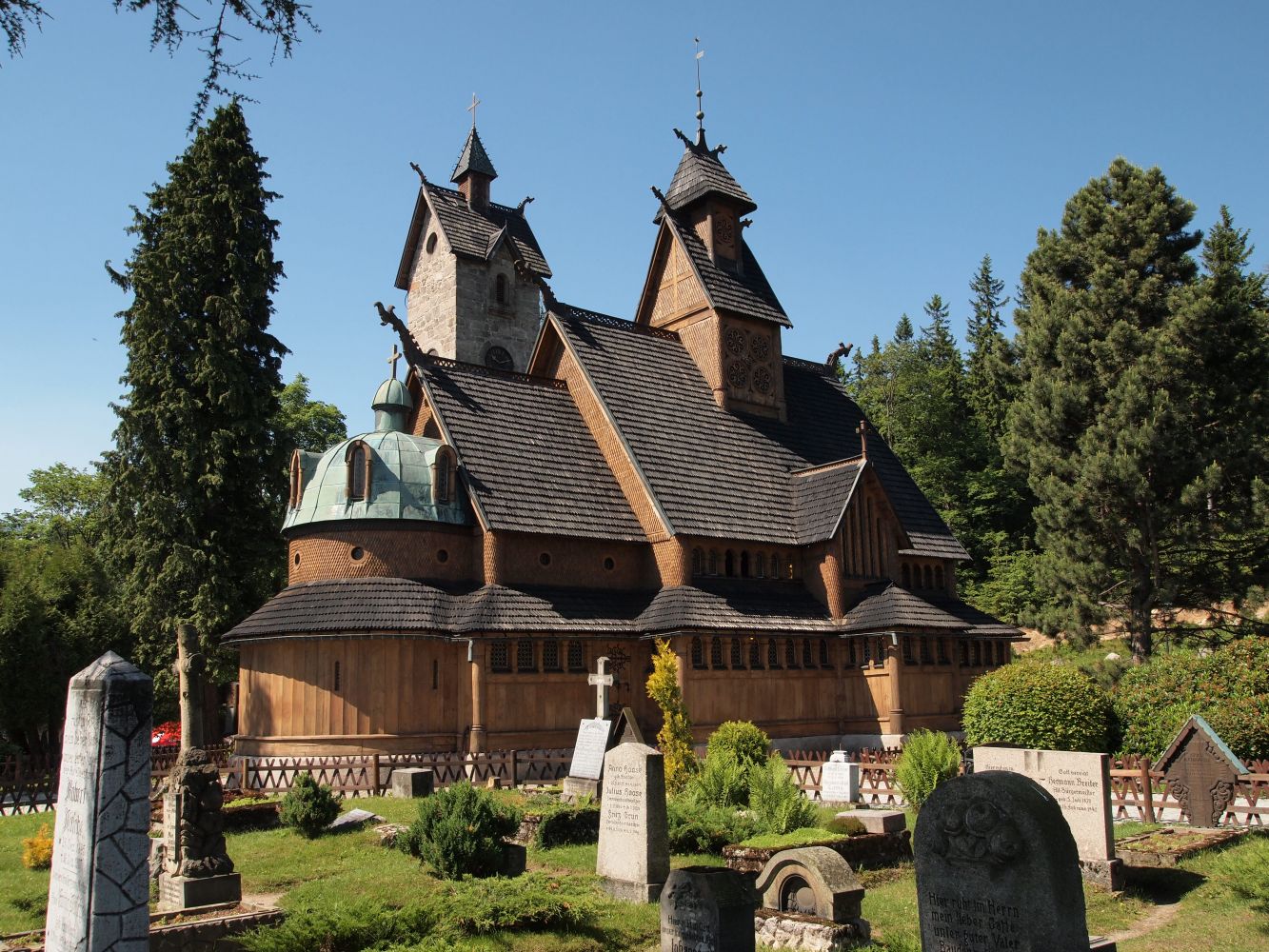
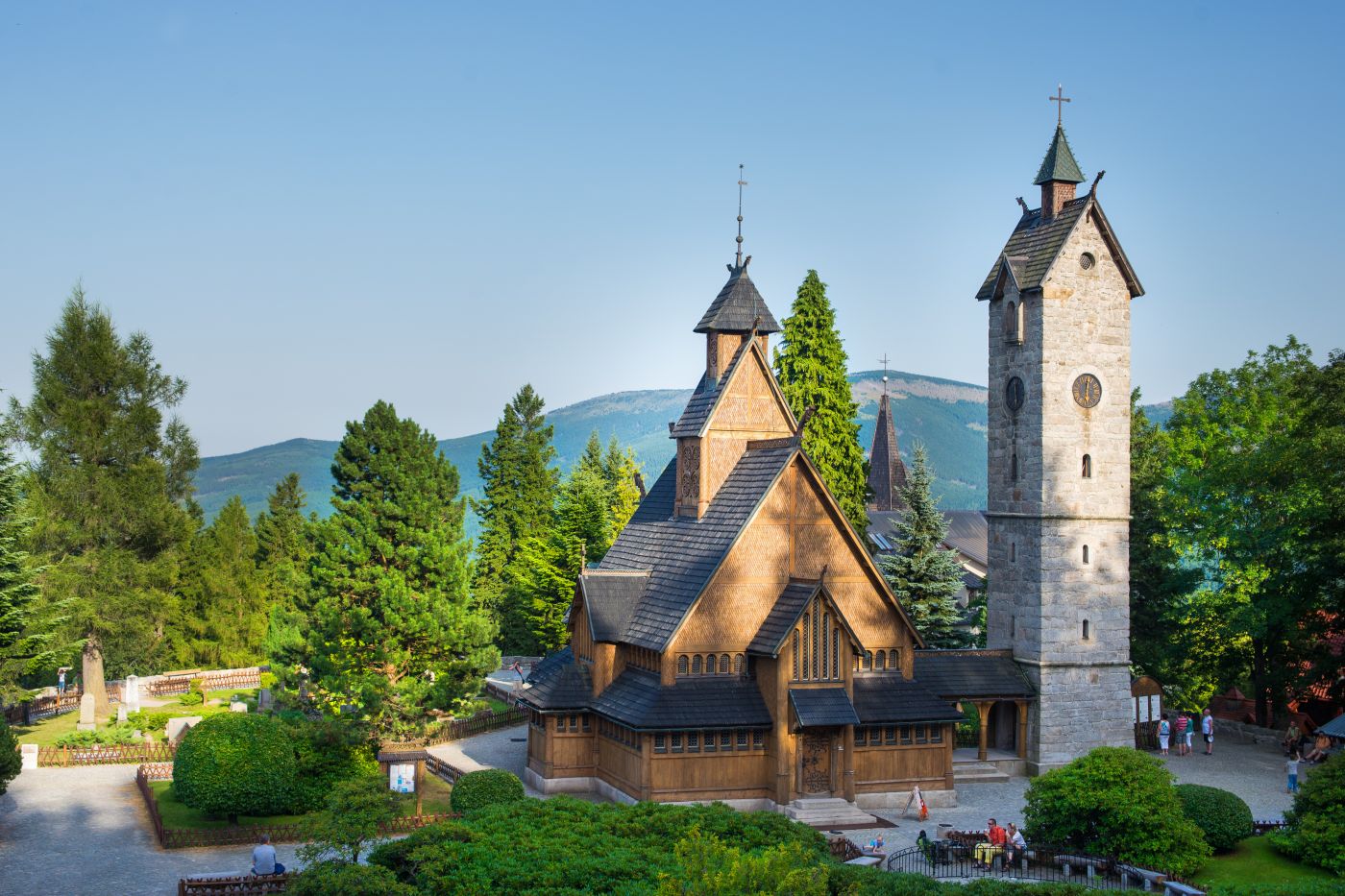
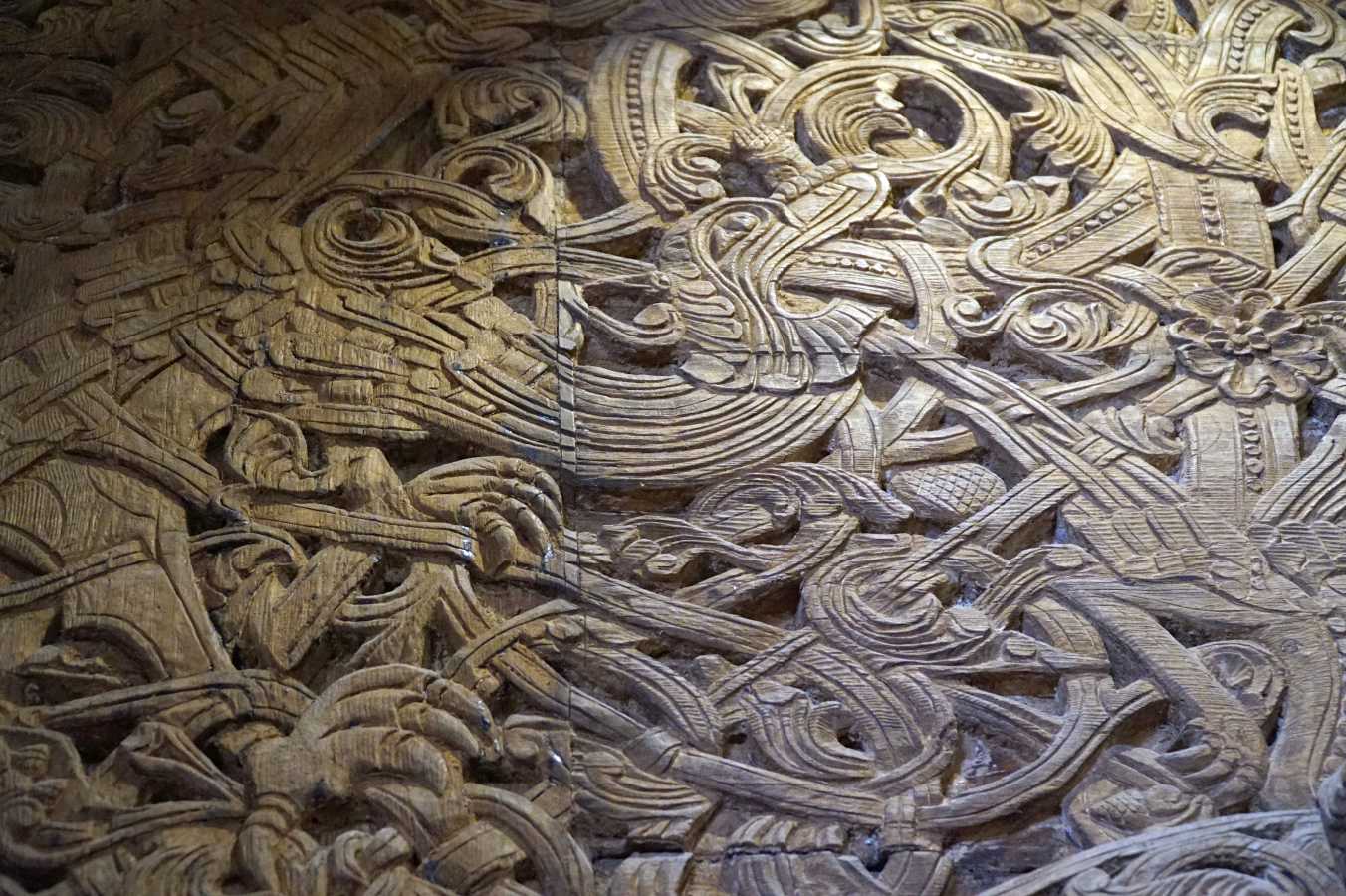
The so-called stavkirke, or pillar church, is a type of building whose roof is not supported by external walls, but by tall columns. There were once thousands of such buildings in Norway, but only thirty of them have survived to this day. For Norway, these are monuments of paramount importance. The church building is built of Norwegian pine and no nails were used in it. Several original wooden elements have been preserved inside: 4 corner columns, 4 interior columns, 2 columns at the entrance to the choir and portals, which are richly decorated with floral and animal motifs and runic writing. Next to the church is a granite tower that protects the wooden building from gusts of mountain wind. Wang Church is also known as the Church of Happy Marriages.
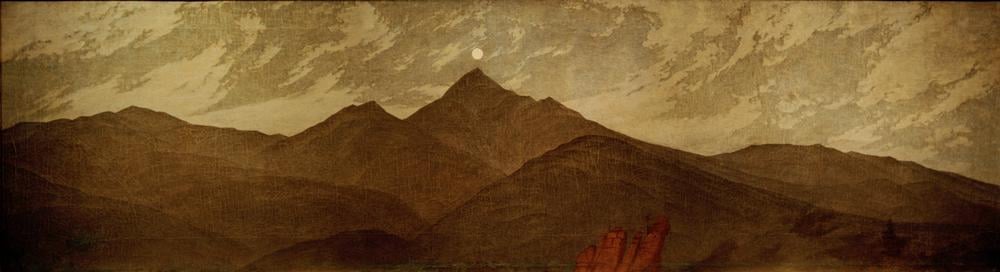
After visiting the Wang Church, we will follow the green and yellow signs to the neighboring village. Kowary, where the painters Caspar David Friedrich and Georg Friedrich Kersting reached during their journey through the Giant Mountains. From these places we will be able to see the Giant Mountains from a more distant perspective, from which Friedrich depicted them in some of his last drawings and paintings from this journey. That is, as a wall of swelling massive mountains with the dominant peak of Sněžka.
From the Kowars we will follow the green and yellow to Border huts and from there on to Malá Úpa and through Horní and Dolní Lysečiny to Horní Maršovfrom where we will return to Prague by bus. (Alternative route: follow the yellow route to the Krkonoše National Park and then the blue ridge route to Svorowa MountainFrom there we will go over the Giant Ridge to Snow White and then follow the yellow path across the Růžová hora to Růžovohorky and then follow the green path to Furnaces under Sněžkou. And from there return to Prague by bus.
Connections from Horní Maršov to Prague on 28. 8.
- Horní Maršov, bridge: 16:21 – Prague, Černý Most: 18:50
- Horní Maršov, bridge: 17:11 – Prague, Černý Most: 19:35
- Horní Maršov, bridge: 18:23 – Prague, Černý Most: 21:18
Contacts
- George Zemanek, sarvanga@centrum.cz, 777 117 466
- Karel Ctveracek, ctv@seznam.cz, 603 355 072
- Tomas Hruza, tomashruza@gmail.com, 775 052 607
"I believe that a lot of good would come from a change in attitude if tourists became pilgrims again."
Rupert Sheldrake