

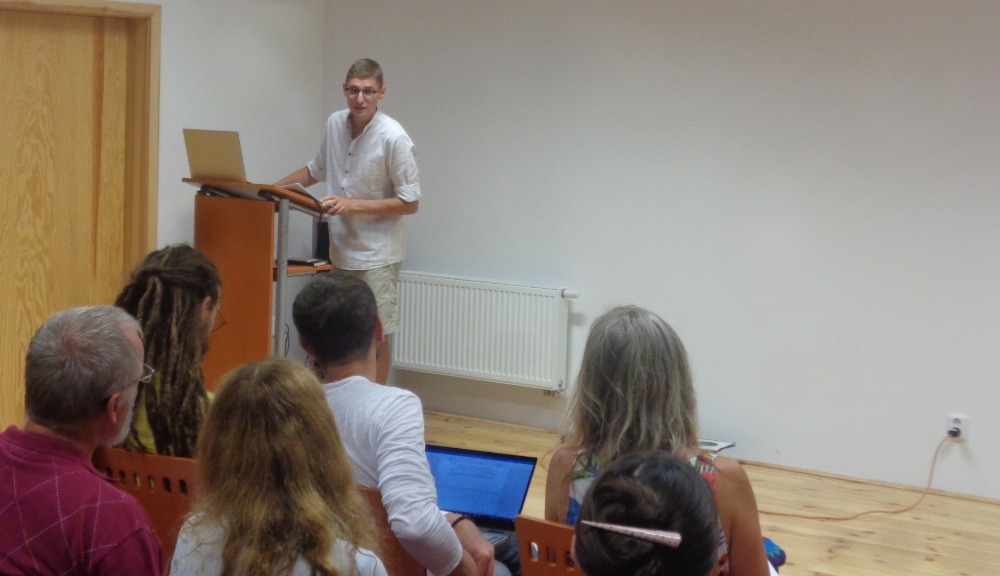
Here we present the text of the lecture by Luďek ČERTÍK, which he delivered at the fifth seminar of the Traveling University of Nature "Everything around me lives and feels as I do - paths to a regenerative culture" at the Rychleby Ecocenter on August 12, 2020. In it, he presents the ideas of the leading contemporary German biologist and philosopher Andreas Weber, his concept of revival, or rather erotic ecology, which he places in the broader context of the development of biological thinking and at the same time in the context of poetics as a new regenerative life practice.
The entire following narrative will unfold with an emphasis on the personal experiential dimension of earthly existence. It is the bodily experience – a point of view medium perspectives, as Aldous Huxley would say – sandwiched between the dehumanizing macrocosmic and microcosmic perspectives, is central to erotic ecology. We are all feeling and perceiving bodies, and only as feeling and perceiving bodies can we experience the world and thus internalize it, make it part of our changing, fluid interiority. This is the fundamental axiom of erotic ecology.
Following the example of Andreas Weber's books, I will intersperse my narrative with a number of my own personal experiences and observations. And I will expand Weber's range of "erotic relations"" those that are more relevant to this seminar and the journey that will immediately follow it.
The experiential dimension of reality and a few words of introduction
According to Andreas Weber, ecology is any view that understands the world as a network or (eco)system flourishing with relationships. From this perspective, poetry itself and all known forms of artistic self-expression are ecology. Therefore, Weber's thinking is inspiring not only for biologists, but also for conservationists, for psychologists, therapists and sociologists, for writers, poets, painters, musicians, etc.
Weber's basic premise is: All processes, all events in the biosphere, can be understood as relationships. Weber attempts to understand this network that we call the world (or the old cosmos), understand through the "science of the heart"; that is, through a method that does not rely on a mere anatomical description of bodies and sensory perceptions, but seeks to understand the world from the very center of the lived experience of reality.
Erotic ecology is therefore not quite ecology in the sense that most of us understand it from school or from everyday journalistic language, i.e., essentially a positivist doctrine of the relationships between living beings and their environment (enlighten). Traditionally, ecology talks about ecosystems, biomes, ecotones, niches and population curves, patterns and climaxes, etc. We find nothing of the sort in Weber. He would say of academic ecology: if we think about the natural world exclusively from this perspective, we neglect an important aspect of reality – its inner dimension, that is, how the natural world affects us as living beings.
Traditional ecology will tell you nothing about why we find the colors and patterns of reef fish or the Indian tiger fascinating. Or why the song of a nightingale affects us the way it does; why it uplifts us and makes us think of love, or why it may be unpleasant, offensive, or repulsive to some (see R. Murray Schafer's studies of the acoustic preferences of people in big cities and in the countryside). In traditional ecology you will learn a lot about population dynamics, about the reproductive strategies of a given species - that some are so-called r-strategists and some are c-strategists - but is that enough? Can statistics and bare positivist facts (collected from a distance, as if out of this world, out of this burning mass; Bruno Latour would say "from Syria") awaken a deeper concern for the well-being and future of living nature in the sense of shared and living earthiness? Can we protect the living and life-giving without taking into account our emotional and spiritual bond with the world, and not just the material benefits it undoubtedly brings us? Can we say anything relevant about the natural world without taking into account our internal experience of it? And when we do, can we continue to think of the natural world as something external – a kind of off-the-beaten-path green haven where we go only to recreate and regenerate?
Weber seeks to show that the natural world is not only a material exterior, but always also and inevitably an interior; that every living being exists as a sentient "multiple selves", which looks around and encounters trembling, wildly blooming meanings in the things around it; that is, that every living being recognizes the world as an inner being and internalizes it through its own ongoing experience, through its own experience.
This leads to a joyful discovery for us. The answer to the question of what life is is accessible not only to biologists. All of you sitting here already have a considerable – indeed, according to a new, deeply ethical and empathetic orientation towards all living things – a completely key preliminary understanding of life, since you are living and sentient beings. Because you knowWho else should know anything about life than the one in whom life burns with longing?
Andreas Weber is originally a biologist and his philosophical and poetic thinking grows out of a scientific foundation. We will therefore also talk about biology and the fundamental revitalizing turn it underwent during the 20th century; and there will also be a small excursion into the past of biological thought (Goethe, Portmann, Margulis, Varela, etc.). Erotic ecology is in fact only possible thanks to these remarkable scientific discoveries.
All questions about human relationships to living things, to the principle of life as such, are preceded by the question: What is life? According to Weber, it is precisely the misunderstanding of what life is – which includes above all the Enlightenment view of life through the metaphor of the machine – that has led us into the environmental mess we are in today; and only a reassessment of life as a phenomenon in the light of new scientific findings – but also by returning to the animistic wisdom of natural peoples and the penetrating and all-enlivening vision of poets – can, we hope, lead us out of it.
In order to truly love, to love everything that flows, everything that feels and is alive, we must first understand life, connect with our own liveliness and through it with liveliness other creatures. How can we love this vulnerable and mortal world if we perceive it as a mere machine? Can we feel real love and compassion for beings whom we consider to be something less than we humans are? Something like a mechanism that we can shut down when necessary and conveniently replace with another, better, more efficient one? Let's call the effort to understand this love.
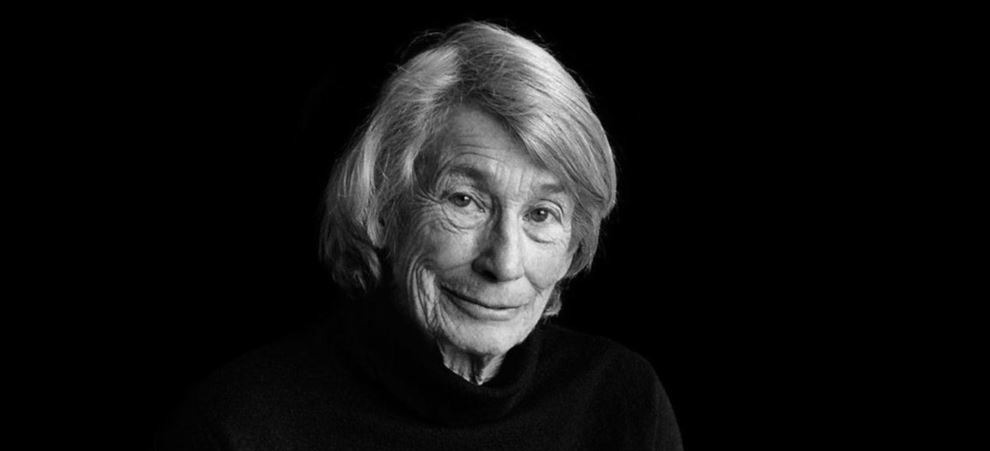
And since this seminar focuses on the poetic experience of the world and poetry as such, and since, as we will see, poetry is a supreme form of erotic-ecological practice, I will allow myself to intersperse this lecture with poems by the famous American poet and beautiful person Mary Oliver. I note that the poems come from the author's famous collection American Primitive, for which she was awarded the Pulitzer Prize in 1983; these are my own translations.
It must also be said that our conversation will, like mushrooms and slime, dissolve boundaries, weaving together all that is alive and inanimate. If our ambition is to truly understand the world and to gain something substantial about it, I do not believe that we can speak of it from the perspective of only one discipline or one exclusive way of perceiving reality. We will only understand the world if we open our hearts to all forms of knowledge, to use the immortal words of the Sufi thinker Ibn al-Arabi.
So I hope we can somehow put it together.
Existence in the world as a process of erotic encounter
According to Henry David Thoreau, summer is a time to be outside, to take in the scents, to feast on shapes and colors, on plums and blackberries, on pears and apples. Summer is a time of openness, a time of nourishment. There is time for reflection and inquiry and similar activities in winter. Trees teach us this vividly when they shed their leaves and store water and all their life force in their roots. So right now we should be outside somewhere; to be wild, to give vent to our wildness, our liveliness. So let's set the summer mood at least with a fitting summer poem by Mary Oliver.
ROSES One summer day, when there was more than enough of everything, wild flower beds along the seaside berm began to bloom explosively; day after day, honey accumulates in red calyxes and bees roll like drops of amber among the petals: there is no end, believe me! to the ingenuity of summer, to the happiness that your body will be tempted to bear willingly.
As I have already indicated above, Andreas Weber's thinking is connected to immediate bodily sensory experience; to how, phenomenologically speaking, the world appears and gives (gives, gives in, opens) to our senses here and now. So let me begin my narrative with Weber's own, as he himself would probably say love, the story that begins his seminal book Matter and Desire.
In it, Weber tells how one day a good friend of his from the northern Italian town where he lived at the time called him to his house to check on a suspicious rustling in the chimney. Weber, like a man of action, climbed onto an old rickety chair and fearlessly put his hand into the chimney, from where he pulled out two exhausted swifts. He immediately released both unfortunate birds out through an open window and watched them, together with the other swifts, circle over the sunlit square, around the church tower, over the roofs and streets. And in that unusually powerful shared moment, he suddenly realized that swifts are not only the element of the wind, its materialization, expression or awakening, but that they are also created by desire! In their sharp flight, in their piercing voices, circling, curving, whistling, he recognized a perfect, crystal-clear liveliness that was nothing other than love with sickle wings, love in flight. And so this initiatory experience led him to reflect on love (Eros) as the fundamental principle of living reality.
According to Andreas Weber, to exist in the world, to inhabit it, is primarily a process of erotic encounter. It is a process of contact, touching, mutual influence, clashing, blending, merging, taking over. Every living creature from birth experiences this shared, freely given reality as various, more or less noticeable, gentle or violent, forms of touch and closeness; now the touch of a mother's palm or a tense breast, now the touch of the morning February sun, the song of a wren, the sea breeze, the cold muzzle of a dog or gravity. We are never completely isolated from the world. On the contrary, through these countless erotic (loving, desiring) relations we are constantly connected to it; like clasped palms or like a flower and its pollinator, we are contained in each other.
The drama of life – seen from within, from its fervent, radiant interiority – plays out between the desire for connection and the effort to maintain the appearance of autonomy; that is, the appearance of the distinctness and unity of our unmistakable self, whose existence is possible only through contact, intersection with the embodied selves of other creatures. For example, in the form of taking food, that is, the consumption of other Heraclitean, dynamic, disintegrating bodies. There is therefore an apparent continuity, a connection (whether given by necessity or simple curiosity) between our body and the bodies of other beings, which sometimes manifests itself as rivalry and at other times as amorous outbursts or as cooperation, symbiosis. As in the following poem by Mary Oliver:
SNAKES I once saw two snakes, American slender snakes, crawling in a hurry through the forest, their bodies like two black whips stretching out; in perfect harmony they held their heads high and glided forward on their smooth bellies; under trees, vines, branches, over stones and flowering meadows, they wandered like a harmonious couple, like a dance, like a love affair.
Weber thus conceives of Eros as a desire or impulse that drives living beings towards wholeness, towards fusion, towards blending; towards achieving fullness in connection with others, without however erasing or abolishing our own unmistakable identity. It is essentially an alternative to the simplistic view that understands life as nothing more than a struggle for survival, as a competition of isolated entities against the backdrop of a hostile, cruel, distanced world.
However, it is certainly not a question of replacing the idea of the world as a battlefield with a monolithic idea of the world as a field of selfless cooperation. That would be a similarly naive and misguided idea, because it would deny the presence of violence and aggression in the world. Rather, it is a question of viewing these relations from a higher level of understanding: even the tension between hunter and prey is ultimately a form of mutually transformative and therefore pro-creative relationship.
Love as a cosmic principle
It is worth noting that such desiring types of relationships permeate all of reality. It is not just the world of living bodies trembling before disintegration. In fact, one could say that biological laws imitate physical laws, to the point where life itself becomes a physical and geological force.
After all, we know that the Eros of life itself begins at the center of the Sun, in the furnace of that gigantic thermonuclear reactor that the Sun is. And let's think of gravity, which David Abram speaks of as a kind of ur-type or primordial form of the relationship of the human body - but actually any body - to the Earth (and vice versa).
And let us also think of all the stars orbiting the galactic core, of the planets held together by their parent star, of the Moon that causes the tides. Let us think of all the galaxies that dance around each other or absorb each other, of the protoplanetary nebulae in which new worlds and solar systems are being formed in a big way, and perhaps even new future loves and losses. All cosmic objects are subject to the laws of the desire for connection. And so are all elementary particles and even bacteria and cells, as we will see in a moment when we talk about the endosymbiotic theory of the origin of higher life. The desire for connection, for creating connections, for coupling, is thus woven into the very fabric of reality. There are even those, such as the American theoretical biologist and pioneer of biocomplexity research, Stuart Alan Kauffman, who say: give matter enough time and it will give birth to life itself.
It could well be that individual atoms will just fly around without interest, but for some reason they don't. And that's why we're here today, talking about it, while supernovae explode far away and gas giants form, and an elephant leads her herd to the last available water source. Whatever the intention, there is a drive in the universe for greater complexity, for the creation of more intricate links, chains, forms, patterns, of which life is the most complicated and miraculous.
The love or desire we are talking about is certainly not just something pleasant, something poster-like, something rosy. Love, says Weber right in the introduction to his book, is not just a beautiful and pleasant feeling. It is not “lemonade” in the way that television soap operas or cheap romance novels present it to us in a simplified way. In the original Greek concept, Eros had the epithet bittersweet, first used in this sense by the poet Sappho. It had a bittersweet flavor, or rather an aftertaste. The ancient Greeks knew well that love is not only joy, but also pain, suffering, agonizing desire, the sting of rejection, shipwreck. And above all, love is inscrutable, it is wild and untamed, it blows its own way. “The dice with which Eros is constantly playing are madness and horror,” goes the famous saying of Anacreon.
So when we speak of love as the guiding principle of reality, we mean love in all its aspects, light and darkness, day and night. Let us not forget that life, however happy, ends in death and is, whether we like it or not, full of pain. All life takes place in the shadow of death. It is possible to live only with its imagination, and it is even so that death gives meaning to life, gives it urgency and heat.
In this context, we can ask: If we do not understand life very well, if our pre-understanding of what life is is based on misleading ideas, can we even understand death? And can we even understand it? accept? And isn't it precisely the problematic relationship to death as an integral, even determining and meaningful factor of life, that our efforts to protect wilderness so often encounter?
Imagine a neatly trimmed spruce forest. That typically peaceful Czech commercial forest that has so dominated our collective imagination. After all, when you say forest, this is what most people imagine, we have encountered something like this since our early childhood. Trees planted in neat rows, not a speck or a twig anywhere, only here and there a wigeon calls or a mushroom picker appears. In such a forest, it is as if time has stopped.
Now imagine a genuine rainforest – for example, Olympic National Park in the western US state of Washington, which is also one of the quietest places in all of America (see the activities of acoustic ecologist Gordon Hempton and his project One Square Inch of Silence) – with all its fallen and rotting trees, its branches, mosses and lichens, with the omnipresent moisture and fungi and countless voices.
That is why the environment of the rainforest seems so vivid and rich and is so full of life, as much as death is visibly present in it; the rainforest is actually a manifestation, a gallery, a celebration, a carnival or a revel (Americans would beautifully say bonanza) death. But not death as a sad and definitive end, as most Western people usually understand death, but as a cycle, as continuity, interconnectedness, perhaps one could say kinship. When I walk the earth, I step on death, I walk on pain, a cloud of flies and decay rises at my heels. Or even better: I literally walk death, I walk pain, the whole earth is one big cemetery, one big joyful burial ground.
But for so many people, this obvious truth is difficult to confront. That is why we prefer to close ourselves off in an illusory enclosure, where death seems to not exist, where it is something that can be easily overcome, controlled or displaced. Let us recall in this context the cult of eternal youth in the cosmetics industry, the relegation of aging people to the periphery of society, the removal of aging trees in parks and forests. This ultimately prevents us from understanding life correctly.
So let's summarize it for the sake of order.
- Life is full of cruel paradoxes and is tragic at its core, as it moves towards an inevitable disintegration, which is not an end but a transformation. As Weber says, every ecosystem is possible only through mutual absorption, devouring, however vulgar and perhaps even terrifying that may sound. For this reason, life cannot be understood without a deep, unprejudiced understanding of the role that death plays in it.
- The world is full of visible and invisible touching, full of the desire for connection. As the title of one of the songs by Icelandic musician Ólafur Arnalds says The whole universe yearns to be touched (The Whole Universe Wants to be Touched). And it is precisely this desire from which new worlds grow, but also dreams and all great ideas. Without desire, which we can also understand as a reaction to the shadow of death, everything is austere, without imagination. The Canadian poet Anne Carson says this in her book Bittersweet Eros (Eros the Bittersweet) expresses it as follows: "Imagine a city where there is no desire. Let us assume for a moment that its inhabitants continue to take in food and drink and that they reproduce in some mechanical way; yet their life seems flat. They spin no theories, they play no games, they use no figurative language. They make no attempt to avoid pain; no one gives gifts. They bury their dead and then forget where (…) In short, a city without desire is a city without imagination."
Wherever we turn our attention, we see some form of relationships, relations, reciprocities, dances, conversations and exchanges. Sunlight turns into green plants, plants become food for wildebeests, mouflons, zebras, musk oxen, bison and roe deer, and these can then become food for an animal called man; when a man dies, he becomes soil, mold, larva, beetle, air, smoke, cloud; a cloud becomes a mountain spring, a stream, a river; a river becomes the sea, the sea a fish, a fish preys on other fish, which are subsequently caught and eaten by man; when a man dies, he becomes an ant, a crow, a parasitic fungus, a creeper, a howler monkey… and so on and so forth and so on.
In light of these findings, persistent questions arise:
What if we have been misunderstanding love for centuries? What if we are imagining something that love is not at all? Doesn't all the misunderstanding start with the fact that we usually imagine love as a relationship between two people (regardless of sex or gender) and that we are taught about love in this way from childhood? Isn't this myth of love as an exclusively human affair what has trapped us in the realm of anthropocentrism and led us to all sorts of environmental disasters? Isn't our understanding of love somewhat selfish and narrow-minded? Isn't it true, Weber asks, that the core of the environmental global crisis is a lack of love? Or at least a misunderstanding of what love is and how far it goes? Shouldn't we reconsider our definition of love and extend it to all living creatures, even the whole world, and see it as a biological principle? What exactly changes when we begin to understand love as a suprapersonal, all-pervading premise and not as a mere blissful or, more often, a somewhat less blissful feeling, but as the very core of reality, as its source – the mother of allif I use a picture from my beloved Tao Te Ching? We can each answer in our own way...
FISH The first fish I ever caught did not lie still in the bucket, but thrashed and gasped for the burning astonishment of the air, and died in a widening burst of rainbow. Later I opened its body, separated the flesh from the bones, and ate it. Now the sea is a part of me; I have become the fish, the fish shines through me; we have risen, entwined and doomed to fall back into the sea. From pain and pain and more pain we feed this feverish plot, kept alive by the secret.

The development of biological thinking
We are talking about liveliness and love, about the inner dimension of life, which on the surface might seem like just the wishful thinking of us idealists who supposedly don't see things soberly enough. However, this should not be allowed to happen in the natural sciences - and specifically in thinking about living nature - in recent times, which has led to a relatively fundamental shift.
When you read about Andreas Weber, you usually come across a somewhat grandiose thesis that biology as a science of life has recently undergone a fundamental revolution that completely changed its paradigm, which had prevailed in biology for perhaps two hundred years. Weber compares this event to the revolution that occurred in physics in quantum mechanics at the beginning of the 20th century. What exactly does he mean by that? And what was the view of life in the biological sciences before the advent of biosemiotics and cognitive sciences?
Here are (in simplified form) the four main characteristics of classical or middle-of-the-road thinking about life within the biological sciences:
- For decades, biological thought was dominated by the idea that the natural world was a battlefield. Competition was considered a fundamental principle of biological processes, the driving force of evolution.
- Living creatures were understood as predictable, perfectly legible, unfree and mechanically acting objects in the hands of impersonal physical forces (in modern times, one's own genes).
- The subjective sphere was completely absent from thinking about living nature. An influential religious doctrine claims that animals and other living beings do not have souls. So there is basically nothing to investigate.
- In its quest to understand life, biological thought has – with honorable exceptions – focused on invisible inner dimensions, accessible only through immersive methods; molecular research is an example.
The first significant breakthrough in this not-so-cheerful picture came with German Romanticism and Goethe's biology. One of the fundamental contributions of Romanticism was the rediscovery of the subjective sphere, the world of feeling, of emotional movements. Romanticism was essentially a reaction to the overly rationalistic Enlightenment with its geometric gardens, austere military fortresses, vivisections and other achievements of the soaring rational spirit. In fact, we could say that Romanticism opened up the dimension of liveliness to Western man. And it was, after all, also Romanticism that opened us to the "night side" of the" nature. If there is anything typical of Romantic art, it is the countless images of death, the afterlife, windswept cliffs, storms, dark nights in dark forests, and desolate mountain peaks.
From this newfound interest in the inner life arose Goethe's biology. A biology of the visible, where the perceptible outside is at the same time the most suitable and easiest way to the inside. A biology that understands the body as a kind of revelation. However, the poet and naturalist Goethe also came up with another significant discovery - namely that through the outside we can not only see the inside, but also that the outside affects the inside, our inner being! This is beautifully expressed in his famous theory of colors. Another great German naturalist and traveler, the father of modern ecology and the predecessor of holistic and systems thinking, Alexander von Humboldt, claimed something similar. Humboldt believed that the natural world cannot be understood without taking into account the emotions that are awakened in us, for example, by the sight of a reddening sunset. And he tried to embody this in his famous and groundbreaking descriptions of tropical nature, which mix scientific and poetic precision, and which so influenced the form of painting at the time (see, for example, the work of the Hudson School painters).
This specific stream of thought was continued in the 20th century by the Swiss biologist Adolf Portmann, who held the view that the need for aesthetic self-presentation is as important to any organism as its efforts to reproduce or to maintain the fire of metabolism. Most living creatures invest at least as much energy and effort, if not more, in aesthetic self-presentation. He viewed the external appearance of living beings—their coloring, vocalizations, but also their behavior, what he himself called their own phenomenon—as an expression, as an externalization of their internalities (both genetic equipment and the unconscious wealth of the inner world). In Portmann's presentation, all living nature appears as an externalized, outwardly turned interior. Appearance, the surface is for him an atlas, a relief, a map of otherwise inaccessible and incomprehensible inner landscapes. The depth of life is therefore not something that needs to be penetrated in a complicated way using complex apparatuses. But it is something that freely reveals itself to us through the sensory-perceivable surface, the colors and time-forms of the realm of light: all we have to do is open our eyes and learn to see.
From these and similar insights, the field of biosemiotics could later grow, which claims that if it is perceptible as a way into the interior, if it is an externalization of the interior, then we move in a world of immediately perceptible existential meanings. It ultimately comes to the insight that all living beings (starting with the living cell) orient themselves in the world on the basis of certain values, on the basis of certain ideas about what is good for them and what is not, or, as Andreas Weber says, on the basis of feelingHere Weber directly follows his teacher, the philosophizing biologist Francisco Varela, the originator of the term autopoiesis , or self-creation, with which he fundamentally enriched the debate on the autonomy of living beings.
The study of the inner world of non-human living beings is experiencing a huge shift today thanks to modern technologies that allow us to penetrate places that were previously accessible only through imagination. Today, we can easily measure brain activity, perform various complex intelligence and cognitive tests, or conduct long-term field research using modern photographic technology, which brings new and new groundbreaking findings about the intelligence and sentience of most large and long-underestimated groups of creatures: reptiles, birds, mollusks, fish, fungi and plants. Thus, the long-overlooked inner, subjective dimension is finally returning to thinking about living nature; in a sense, it has become a science graspable. Moreover, the cultural aspects of extra-human life are currently being seriously investigated (see, for example, the latest book by ecologist Carl Safina Becoming Wild, in which Safina treads the path of the concept cultural evolution as one of the fundamental creative forces in the natural world). Yes, that's right, we are far from the only cultural beings on this planet.
From the perspective of erotic ecology, groundbreaking research in the field of microbiology is also crucial for us. When Walt Whitman, in his inimitable Blades of grass wrote "I contain crowds...", apparently had no idea how prophetic his words were. It turns out that all life, at its most basic biological level, is a coexistence, a co-existence. Our bodies could not function properly without the millions of bacteria in our intestines or on our skin, and similarly, most existing plants could not survive without their invisible symbiotic partners.
It was Lynn Margulis, in particular, whose theory of endosymbiotic evolution of higher life moved research in the right direction. Margulis essentially showed that all multicellular organisms and organisms with a cell nucleus, that is, eukaryotic organisms, are the result of mutual absorption and transformation of once independently living actors (bacteria) into partial organs in the cellular body. The story of evolution is therefore in a sense a story of mutual changes, transformations, merging, coupling. However, we do not have to stay only in the microbial kingdom. Let us remember the spider and its web - according to new findings, the spider's web is a direct part of its mind, its extension, its material manifestation; or the sea card, which carries thousands of species of tiny crustaceans and algae on its shell, just like the space turtle A'Tuin in Pratchett's Discus or as her prototype from Indian mythology.
Based on these and similar examples, concepts such as individuality or biological species have been re-evaluated in recent years. How can we define species or individuality in a world where life is not possible without always being multiplicity? Where does my body, my consciousness, my self begin and end; or rather, a flimsy idea of what my self actually is? These are quite serious questions that can even arouse considerable fears in people about the loss of humanity - as expressed in a certain sense by the myths of werewolves and vampires. But we all know very well that as many animals we have in us, so many times we are human. Or as David Abram says: "We are human only in contact and companionship with that which is non-human."
To supplement this, I would like to add that on a theoretical level, the British philosopher Timothy Morton (Dark Ecology, Being Ecological). Morton speaks of a certain porosity between individual living entities, of the permeability (or the appearance of solid, unwavering) boundaries between the so-called human and the so-called non-human, of the interpenetration or mutual seepage of biological bodies, but also of the mutual penetration of the external and internal worlds. Morton gives the example of a chameleon that becomes what it touches; it literally disguises itself by touch. In the artistic sphere, these ideas are brilliantly illustrated by Jeff VanderMeer's sci-fi novel Annihilation, whose plot revolves around a contaminated area in the style of a Stalker Zone, where the influence of an alien entity causes bizarre anomalies, mutations, and the merging of various animal and plant forms.
A very timely contribution to this debate is the book Entangled Life (Intertwined life) by the young British biologist Merlin Sheldrak (son of Rupert Sheldrak, the apostle of the theory of morphic resonance and morphogenetic field), which touches on these questions through modern research on fungi. And it is not just about lichens as a symbiotic association of several different organisms (algae, fungi and, in many species, yeasts), whose research was originally at the very origin of the term symbiosis. A great challenge to our thinking and experience of the world is primarily the findings brought by research on mycelial networks, filigree networks of fungal fibers that grow through the soil and connect everything that finds its home and support in it. Looking at this living, pulsating network, we encounter a form of consciousness that is far removed from what we know from our own experience – decentralized, omnipresent, expansive and similarly alien to that found in cephalopods, which have neurons distributed across their bodies in individual tentacles. It is surely no coincidence that the ingestion of psilocybin or psilocin, the psychoactive substances contained in many hundreds of psychoactive mushrooms around the world, awakens in most people experiences close to the loss or dissolution of the ego; mystical experiences of connection and fusion, the perception of the world from nowhere and everywhere at the same time. Thus, mushrooms seem to grant us a glimpse into the mysterious way in which they experience the world.
He develops a similar idea in his book A new vision of psychology American psychologist James Hillman. According to Hillman, the soul is polyphonic, multiple, polytheistic in nature. Remember how many times you have been surprised that someone can behave in completely contradictory ways in different situations: sometimes kindly, sometimes violently, sometimes openly, sometimes withdrawn. Have you ever been surprised that you behave in a completely unpredictable and previously unsuspected way? The human soul is not monolithic, uniform and easily defined as a category in a questionnaire. People are not simply joyful or rude, but many different influences, many characters are mixed in them. The soul, like the surrounding world, is wild and ambiguous, speaking in many different voices. Actually, Hillman points out, we should rather say that we have souls.
So let's try to summarize it in a reasonable way: Modern research paints a picture of living organisms as interconnected and inseparable, and as autopoietic (self-forming) subjects that navigate the world based on feeling and meaning, and whose multiple bodies are a perceptible expression of their inner being, or perhaps we could say liveliness. And now the key question that will lead us into the final part of this story: Why is this so important today? And how can all of this help us alleviate future suffering?
Cultural revival
Let us recall that, according to Andreas Weber, one of the causes of today's global environmental crisis is a misunderstanding of what life is. There is, of course, a vast difference between thinking about life, or rather living beings, in the spirit of earlier times, or when, on the contrary, we perceive them as Weber and his ilk do. Either we understand them as unthinking machines or, on the contrary, as feeling and dreaming, meaningful and experiencing pain and joy. The metaphors we choose to describe reality profoundly influence how we deal with this reality. And it was precisely the Enlightenment metaphor of the machine, the idea that matter is barren and inert, that allowed the emergence of what I sometimes call the "unculture of death""; that is, a culture that, in the name of quick profit, has declared total war on human and, above all, non-human life. We all know its manifestations and attitudes well, just look at any intensively and therefore purely rationally farmed field.
However, in the light of new findings in biosemiotics, microbiology and cognitive sciences, the idea of an inert dead world of matter, matter without any meaningful inner dimension, is no longer tenable. All modern findings show the correctness of the ancient intuitive assumption – and therefore also the sensory bodily experience of reality, that is, the proof, so to speak prima facie – that the world, or at least a certain layer of it, is essentially alive. In other words, it is no longer possible to ignore the inner subjective, meaningful dimension of life. Otherwise, we risk exacerbating the current problems.
According to Andreas Weber, we should strive in this spirit for cultural revival, about transcending the mechanistic ideology of dead and disjointed matter towards a culture that life – i.e. the needs and feelings of living beings – puts them at the forefront of their interest. This transformation is all the more urgent because in the current ideological context it is difficult to achieve a deep internal transformation. All our projects to save living nature will never be effective unless the overall ideological climate from which they grow changes.
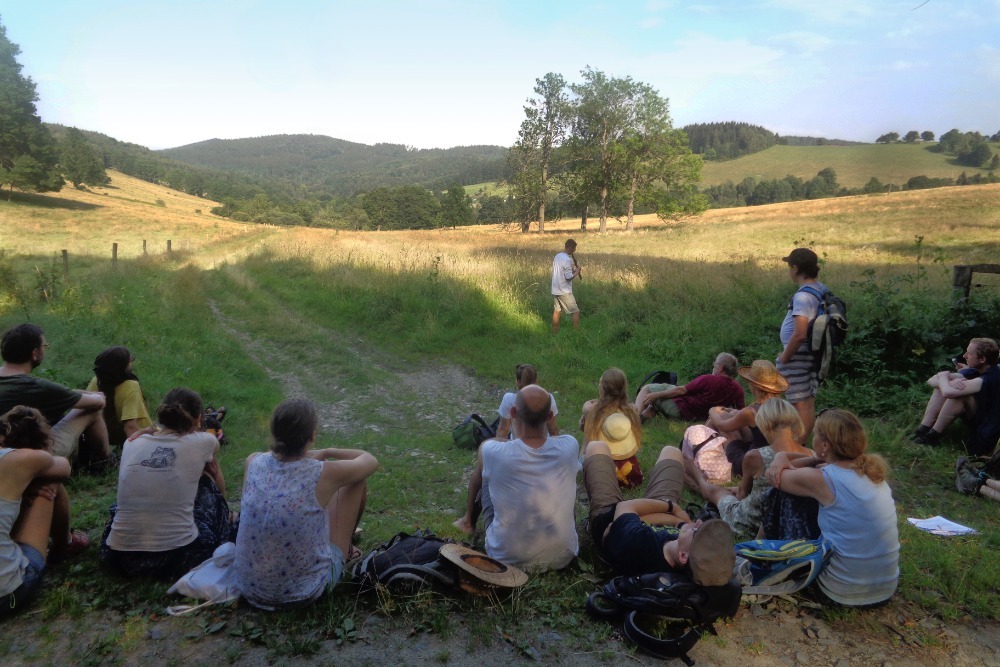
But let Weber himself speak: "Sustainability cannot be achieved with the current operating system of economics, politics, and culture as long as that fundamental “bios” – our unconscious assumption about what reality is – remains tied to the ideology of dead matter. Nature is threatened at a profound level by disregarding the principles of mutual fruitful imaginative interweaving that shapes all life." So how can we achieve this transformation or this turnaround? Of course, there are many paths to it – each of you will surely come up with your own, and most of you are already implementing such a social transformation in some way. There are countless practices that can lead us to a deeper experience of aliveness – our own and the aliveness of the world. Recently, for example, I Seventh generation published a text about listening to the world, in which I talk about how the act of focused listening is a form of stepping outside the narrowly understood self; it is actually a form of animating touch, "undressing" from the self. And of course, wandering is also a type of erotic practice, very popular especially among the local collective.
This erotic aspect of wandering manifests itself physically in every moment my foot kisses the ground I walk on – each step represents a two-way touch, a dance, a conversation. When wandering, we are most aware that the ground is breathing animal; our consciousness expands and becomes the consciousness of the forest, the field, the meadow, the fox. We free ourselves from old habits and walk into a wider, more than human world, into another's body.
Every step on a journey is therefore an act of self-transcendence, of transgression. Like the psychedelic experience, we can understand journeying as a mind-expanding, mind-revealing practice, a form of the deepest self-knowledge. In both cases, we humbly surrender to something greater than our individual lives, we open ourselves to the boundless wildness of the overthe human world with all the joys and risks that can lie in wait for the wanderer. The insightful Australian thinker Freya Mathews, who wrote a stimulating little book about wandering Journey to the Source of the Merri, would say that we are learning to accept given.
It often happens that if we travel long enough, we no longer notice the difference between ourselves and the dirt road, between ourselves and the sky or a pair of swans that are flying overhead with a loud whistling of their wings. Isn't that when true happiness begins? Don't we stop being strangers at such a moment - if only for that rare and fleeting moment - and re-enter the experience of those whose lives truly grow from the soil of their homeland?
To travel means to get to know the world from the inside. From the perspective of fatigue, exhaustion, frustration, ecstasy, excitement, joy and satisfaction. But at the same time also as something close, earthly, irreplaceable. It is a certain form of establishing and deepening ties – with the world, with extra-human life, with one's own soul, with fears, pains, ideas, dreams. However, not by force, coercion, conquest, but soft, by the way.
In Pilgrim, Rupert Sheldrake's words are often quoted in this context, that much good would come from tourists becoming pilgrims again. But perhaps it is not enough to be pilgrims only there outdoors, while wandering through a sun-enlivened landscape, when we clearly know: "Here and now the journey begins, here is the beginning and here is the end, yours!" Perhaps it is about understanding everything in our lives, all our daily activities – from growing vegetables to communicating with our neighbors – as a pilgrimage, as a certain path of knowledge and enrichment, as establishing, forming and strengthening bonds, connections. Finding our home on the journey is perhaps the greatest task of every person.
The practice of poetics
Of all the possible revitalizing practices, poetry will now be of most interest to us. It represents a kind of flagship for this seminar, a source of the highest inspiration. Some may laugh at this, but like Andreas Weber, I believe that one of the ways to revitalize our lives and our culture is through poetry, through the path of poetry. All those Trumps and Bolnosars and all that they represent – their selfish culture of death – we can simply resist through poetry, through this giver and guardian of life-giving waters. And the beautiful thing is that it is a non-violent path, a path without great honors, but still powerful. The earth trembles when you love!
In poetry there is no separation of body from mind, spirit from matter. Poetry reveals and understands that the external always awakens an internal response in us, that it touches us and that it profoundly transforms us. Poetry therefore carries within itself from the very beginning the ethos of revival. The name of Francisco Varela has already been mentioned here, who showed that all life is poetic, more precisely carpoietic, that is, it literally dwells poetically; that is, it is not just a way of experiencing, reserved for a privileged class of poets. On the contrary, poets remind us that we all have a common poetic basis, that reality itself is poetic, pregnant with creative potential.
In this sense, Weber believes, ecology should become more poetic, because it is precisely the sphere of poetry that has traditionally addressed and continues to address this inner sensitive dimension – this inner connection between the external world, the world of living bodies and our inner self – with its ambiguous magical (wild!) language. This does not mean, of course, that ecologists should start writing poetry en masse. It is a matter of principle, of recognizing the importance of the inner subjective dimension of life, of recognizing the importance of this connection for the practical protection of nature.
Mary Oliver, who has guided us through this narrative through her poems, writes in her advice to aspiring writers that it is not enough to simply describe what we see or hear in front of us in order to turn it into a poem. If I look around this room now and, for example, write: people are sitting on chairs, the chairs are made of plastic and metal, light bulbs hang from the ceiling, geraniums are growing in a pot, the air conditioning is not working for some reason, and somehow arrange all this so that it at least seemingly resembles a poem, it will not automatically become a poem. What is needed for this is a spark, an emotional element, a gesture of inspiration, a movement of transformation; what you describe must simply go through a process of emotional enrichment – rather like enriching uranium; the result, after all, can be just as explosive and radiant – a process of internalization, a test of the inner self. A collection of bare facts does not make a poem, any more than a pile of rocks makes a hummingbird or a giraffe.
And of course we are talking here – or rather erotic ecology – about experiences and the inner dimension of life. About something that is fundamentally difficult to grasp, that is elusive, at least in ordinary, unimaginative terms. This means that the attempt to grasp this inner sphere in words must use an indirect, slightly roundabout magical language. In short, you cannot say love means this and this and express it by mixing this and this together, and voila. No. The world is ambiguous, wild, and opens up here to one side, here to the other. It is never the same, but is constantly reshaped and changing. That is why poetry relies on the art of metaphor, on figurative expression, which is actually description from the inside.
Metaphor creates a connection between one thing and another on the basis of external similarity – “his hair is as black as coal” – but also, and much more often, on the basis of a kind of internal resonance. Metaphor is deeply ecological, it is a form of relation, of stitching – literally ghost thread. It is actually a kind of card trick or a disguise, however, we can all agree that a truly well-chosen metaphor (a metaphor in the right place and at the right time) can awaken something very deep in us, which is inaccessible to rational knowledge. We may not fully understand it, but we still know, suspect or feel to the core that it expresses something deeply true about the world or about life; precisely that facet or potentiality that was not yet apparent to us, that escaped us.
What better proof of the significance of an inner experience can we get? What better proof of the truth of a fact can we have than when our own vitality, our own heart, tells us with trembling yes, that's it, this is what I was looking for. And you will feel it like a seismic wave, going through your whole body, your whole being, your whole animal. Because the only way to have any experience, to become a manifesting, self-expressing inner being, an inner being that can feel, experience joy and pain and all the tensions of earthly existence… is only possible if you are matter, if you are a body.
If I have learned anything about poetry in recent years, it is that poetry does nothing less than reveal the invisible web of relationships between people and everything that surrounds and permeates us in the world, that erotic dimension of being. In a world of isolated objects and dead matter, solitude is possible and common, but not so in a world of life and feeling. After all, how can we be lonely in a world where we share with everyone – not just people, but also sperm whales, phlegm, lionfish, cloves, baobabs – the same basic desires, the same basic experience of life; the same awareness of what it means to live? That is, everything good and bad, joy and sadness, rapture and fatigue, pain and pleasure. And this is something every good poet knows intrinsically, experiences intrinsically and tries (ideally) to express in his work; quite possibly even subconsciously, unconsciously, without deliberately striving for such a thing. The poet is the herald of the soul, the herald of the liveliness, the ambiguous nature of the world.
And today – on the threshold of the sixth mass extinction, on the threshold of the great thaw and the great thirst – we turn to poetry for guidance, hoping that it will teach us again to feel and remember our own aliveness, the essence of what makes us living creatures (what defines us as living creatures, what distinguishes us from the inanimate) and what connects us to all other living beings on this Earth – be it the hardy turtle, the thoughtful kahau, or the gentle manatee.
To conclude, let me read a short poetic miniature that I wrote last week on my morning commute. In it, I tried to express in a simple way some of what has been discussed here today. This brings the circle of this speech to a close: “Early in the morning I walk along the river. Fishermen sit silently on the banks – their gazes fixed somewhere beyond the surface – and young shorebirds circle above them; birds related to the martins, the color of the clay banks in which they dig their burrowing nests. Their voices, so similar to the gentle gurgling of the water, echo among the moored cruise ships and boats. Am I here for the shorebirds, or is there something more to it? I continue on, wondering what drives us to come to the river to spend our free time in its company. How is it possible that a seemingly inanimate entity like the river can have such a fundamental influence on our lives, its flow? How does it happen that we become one with the river? I remember the miles and miles that I have walked along the Vltava over the years. I remember every kingfisher I watched hunting on its banks, every shrike and butterfly, every tiring summer day that the river allowed us to survive. I remember the boundless joy that comes from swimming in the river, long meditations in the sunlight, a body agonized by the flow. And I remember the days when the Vltava overflowed its banks and flooded the city streets, scales at every step (TS Eliot wrote: “I think the river is a mighty brown deity.”). And I remember the days when the sight of its moving surface made me cry – as if only flowing water could unlock the accumulated sadness and finally let it go. And one thing I know for sure: when I arrive at work in a few minutes, where I will be staring at the monitor screen for long hours, the river will go with me: like cool air, like freedom, like an uncharted depth. And I will – sooner or later – return to its shores, to once again ignite my wild, meandering heart."
Bibliography
- David Abram, The Magic of the Senses / Perception and Language in a More Than Human World. DharmaGaia, Prague 2013.
- David Abram, Becoming Animal. An Earthly Cosmology. Pantheon Books, New York 2010.
- Anne Carson, Eros the Bittersweet. Dalkey Archive Press 1998.
- Johann Wolfgang Goethe, The sensory-moral effect of colors (with a foreword by Jan Dostál). Fabula 2004.
- Gordon Hempton – John Grossmann, One Square Inch of Silence: One Man's Search for Natural Silence in a Noisy World. Free Press (Simon and Schuster) 2009.
- James Hillman, A new vision of psychology. Malvern 2020.
- Alexander von Humboldt, Travelogues from the New World. Clinamen 2001.
- Stuart Alan Kauffman, The Fourth Law: Paths to General Biology. Paseka, Prague 2004.
- Karel Klesner (ed.), Biology in the Service of Appearance / On the Theoretical-Biological Thoughts of Adolf Portmann. Pavel Mervart 2008.
- Stanislav Komarek, History of biological thought. Published by Vesmír 1997.
- Bruno Latour, Back to Earth: How to Understand the Politics of the New Climate Regime. Unrest 2020.
- Lynn Margulis, Symbiotic Planet / A New Look at EvolutionAcademia, Prague 2004.
- Freya Mathews, Journey to the Source of the Merri. Ginninderra Press 2015.
- HR Maturana – FJ Varela, The Tree of Knowledge / Biological Foundations of Human Reason. Portal, Prague 2016.
- Timothy Morton, Dark Ecology. Columbia University Press 2016.
- Timothy Morton, Being Ecological.Pelican 2018.
- Mary Oliver, American Primitive. Back Bay Books 1983.
- Adolf Portmann, New Paths in Biology. Piper Collection 1960.
- Carl Safina, Becoming Wild: How Animal Cultures Raise Families, Create Beauty, and Achieve Peace. Henry Holt and Co. 2020.
- R. Murray Schafer, The Enchanted Forest (2005), book & CD.
- Merlin Sheldrake, Intertwined Life / How Mushrooms Shape the World, Change Life, and Influence the Future. Every 2020.
- Andreas Weber, The Biology of Wonder: Aliveness, Feeling and the Metamorphosis of Science. New Society Publishers 2016.
- Andreas Weber, Matter and Desire. An Erotic Ecology. Chelsea Green, White River Junction 2017.
- Andreas Weber – Hildegarda Kurt, Manifesto of Revival: Politics and Poetics in the Anthropocene. In: Jiří Zemánek (ed.), Everything around me lives, feels like me... paths to a regenerative culture. Pilgrim 2020.