
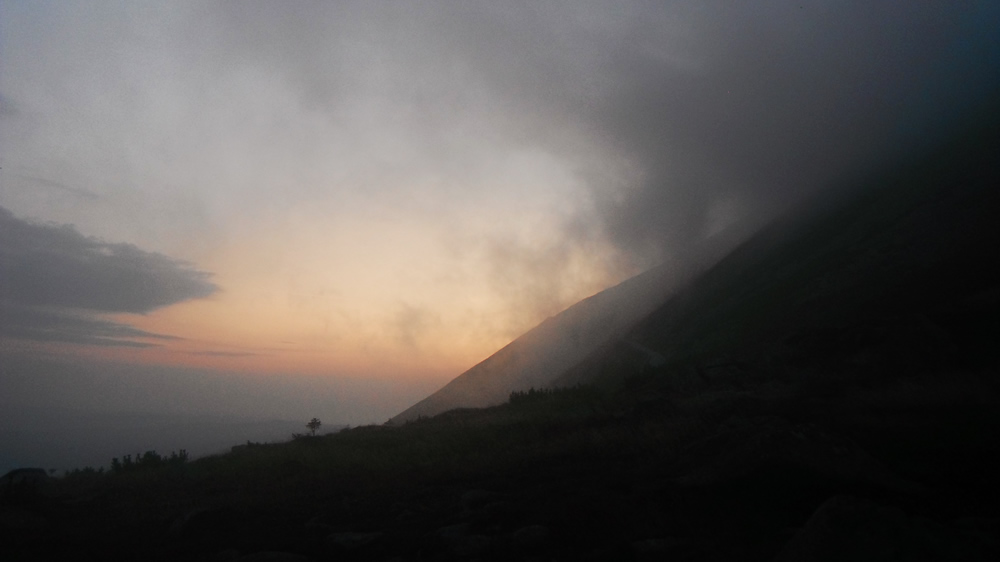
On the art of pilgrimage or knowing how to get lost
Pilgrimage means embracing the land, nature and letting it embrace you – with all your senses! As a pilgrim, I simply cannot avoid it, escape from it to another reality, or intellectually deceive it in any way. On the contrary, I must be extremely attentive and at the same time humble, because I will never see the reality of the land that surrounds and carries me in its entirety; moreover, like a woman, it is incredibly changeable, ambiguous, elusive… In order to meet it, I simply have to “get entangled” with it, get lost in it, get lost in it. Such is the journey into the wilderness. Only in this way can our journey be a path on which we “discover treasures”, on which we will see the world and ourselves differently.
Therefore, Henry David Thoreau's pilgrim maxim was to set out on even the shortest walk with the conviction that we will never return. Before we set out on it, we should be able to surrender everything. In other words, it means being able to free ourselves from intellectual concepts and unnecessary thoughts, because:"There are more things in heaven and earth than we dream of in our philosophy.." Earth artist Robert Smithson characterized the art itself as: "to be able to get lost", which is even more true for pilgrim art. When traveling, we should try to forget what we know intellectually in advance, our usual assessments of reality. This opens up more chances for us to be drawn into sensory reality, to perceive it as a living presence, to truly encounter it, to be surprised by it and to feel its miraculousness...
It means becoming a participant instead of a mere spectator or disinterested observer, establishing a real “bond” (I derive pilgrimage from this term), a partnership with the natural world that surrounds and encompasses me – awakening my dormant sensitivity and breathing, feeling and seeing the land with my whole body. This happens not only through long walks, but also by spending the night in the landscape. From that moment on, we gradually begin to dream its dreams more and more. For me, this is the ethic of pilgrimage, best expressed by David Abram: “We are human only in contact and companionship with that which is non-human."Only in this way can we open up to a sense of the sacred, a feeling for the reciprocity and wholeness of life, or if you like, for its mystery, which we can discover in our hearts in such beautiful moments."
This text was written in April 2005 after the Ecological Days in Olomouc and was published in the collection A Landscape of Doubts / Collection of Reflections from the Ecological Days Olomouc 2005 and 2006 (ed. Michal Bartoš, OPS Nymburk-Olomouc 2007, p. 163) and subsequently in the magazine Ekolist (vol. XVI / issue 06, May 26, 2006, p. 17).
About walking
Walking, or more precisely, a multi-day journey through the countryside, has allowed me to establish an intimate connection with nature and my own self during a time of personal crisis. For me, a spontaneous and unplanned long walk, combined with uncertainty and surprise – when I don’t know what the weather will be like or where I will sleep – represents a means for such “reconnection” and harmonization with a more than human world. Walking allows me to dissolve the conceptual boundary between myself and the land and to participate with my perception in the broader ecology of the landscape surrounding me. Thanks to this experience, it became clear to me that my harmonization with the natural world conditions the degree of my harmonization with my own self. It follows that there is a deep connection between our psyche and the natural world. This fact was once pointed out by the Jungian psychologist James Hillman, who argued that the psyche is essentially unlocalizable; if the boundaries of our subject cannot be precisely defined, then psychology necessarily merges with ecology.
What we are facing today, according to James Hillman, is the repositioning of the subject back into the world, or rather its "reunion" with the world. An analogous experience was expressed almost two hundred years ago by the great poet and walker Karel Hynek Mácha when he wrote: "... earth, I live with you in you on you, I feel with you and in you as you do in me". I believe that it is precisely this recognition of the psyche, of subjectivity to the rest of nature, in other words, the recognition of the primacy of the earth, on which all our material and spiritual life depends, that represents a fundamental turning point for us today. And in my opinion, this is where the possible transformative potential of the simple act of walking lies. If we want to preserve and restore life on Earth and once again begin to perceive ourselves as members of the great earthly family from whose amazing evolutionary creativity we were all born, then we should wander the earth more often, listen to it and have a conversation with it.
This text was written for Veronica magazine, a magazine for nature and landscape conservation, for an issue dedicated to walking: Veronica, XXX. Volume 2016, issue 4, p. 41 (section "What does walking mean to you?"); edited by the author.