
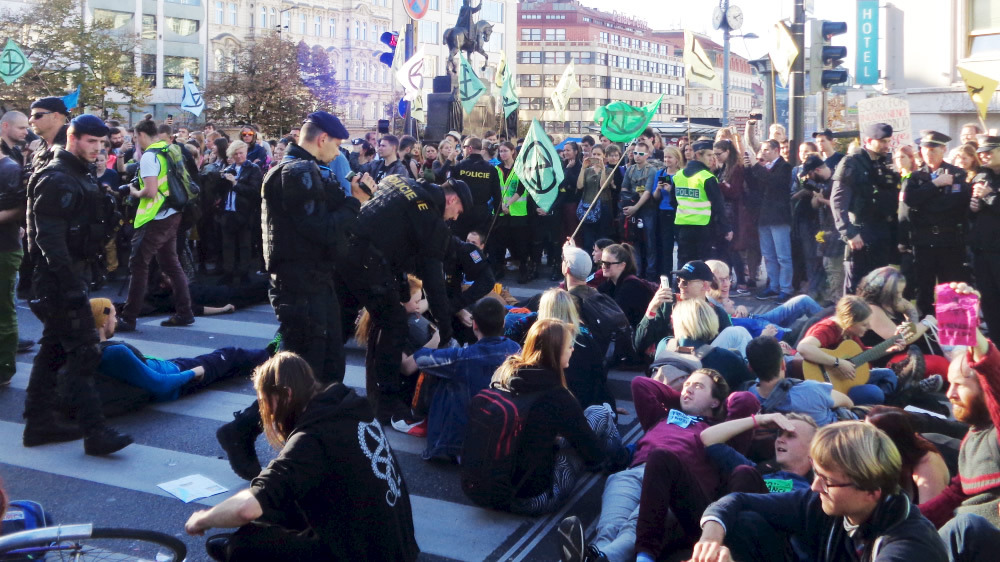
Speech at the Extinction Rebellion event in Prague on October 12th:
"We are not here to rule the world, we are here to become an integral part of the greater earthly community."
Thomas Berry
I am applying for rebellion for lifeThe American philosopher Christopher Bache characterized our current situation in the following words: “There seems to be a certain maturation taking place today; a kind of massive underground awakening. … There is a heat that throws us into collective work and brings us into unrest and convulsions that force us to throw away the past and create a new present. It draws us all together into a mass rearrangement in an accelerated learning process."I think that the reason we are gathered here today is not just about a radical protest, urgently reminding politicians of what scientists say needs to be done today to at least mitigate the worst-case scenarios of the climate crisis. That is certainly important, but from a broader perspective, I believe, it is also about finding a way out of the current impasse in which our civilization has found itself, and together discovering a new meaningful story for our world.
This brings us to the question: “What does it mean to be human in the 21st century, in a time of planetary ecological and climate crisis?” In my opinion, it will be a completely different story of humanity than the one that survives today, which is built on dualistic thinking and our separation from nature; thanks to which we have been able to control nature and improve some human conditions, but at the same time it has led us to today's catastrophic degradation of biodiversity and climate. We are changing the chemical composition of the planet at a dizzying rate, we are changing biological systems, we are changing the geological systems of the Earth over millions of years, and we are ending the evolution of the 65 million-year geological era of the Cenozoic, during which life on Earth incredibly flourished. We have completely permeated the Earth, its biosphere and atmosphere, we have completely taken over it and have become predators of all species. What will come next? How could we stop this process of devastation and move into a new stage of civilization in which we would be able to develop mutually beneficial relationships between us humans and the Earth, which is necessary for the further possible continuation of the evolution of life on this planet?
Some people argue that because we have so technologically penetrated and dominated the Earth today, the dichotomy between our culture and nature, between the human mind and the Earth, has disappeared. They say, “We and the Earth are one.” While these thinkers seek a reconciliation between humans and nature—talking, for example, about bioeconomics and how we should become stewards of this whole new natural-cultural Earth—they do not abandon the old Enlightenment story of our human dominance over the world, based on its control and mastery. They still understand the world as nothing more than a storehouse of material raw materials and as a scientifically understandable and technologically controllable set of inanimate building blocks that we can endlessly organize and improve, including controlling and improving ourselves.
But if we really want to create a new sustainable culture, a culture that truly supports and develops life, we must move further. We must place the benefit and wealth not only of us humans, but of life as a whole at its center, which presupposes a transformation in our self-understanding and our relationship to the earth, which ecophilosopher David Abram has succinctly expressed: “We are human only in contact and companionship with that which is non-human." This statement of Abram implies that we are not separate from the world, but rather shaped by it - our humanity develops only in intimate reciprocity with the "more than human" earth. We do not live on the Earth, but literally in the Earth, we are immersed in the living breathing medium of our biosphere like fish in the sea - it affects our every heartbeat, our every breath, our every thought. It is the Earth that is truly intelligent, not isolated humanity - this statement today poses a fundamental challenge to our entire Western technological civilization.
The cause of most of our current problems lies in the fact that we still inertially view reality as dead, as if it were without any originality. Our natural, social and economic sciences try to understand the world as if it were a mere mechanical process that can only be understood through statistical analysis; our economy, industry, agriculture, forestry, but also medicine, law, etc. operate on the same principle. Therefore, today we urgently need to discover the subjective dimension of nature on a wider scale; to realize that we live in a living world in which human creativity and intelligence are not something unique or isolated. We are part of the inexhaustible stream of life that gave birth to us. The deep creative, poetic and expressive processes that take place in it are now beginning to be revealed, for example, by contemporary biology, philosophy, cosmology, psychology and deep ecology; and artists are also aware of them. Therefore, today we need a real rebellion for life in the deepest sense of the word. It is not enough to just reduce CO2 emissions to zero and base energy on renewable sources! We need to resurrect liveliness, vitality – in us and around us! To realize that we are alive in a world that is itself alive! The Earth is not only a source of material raw materials, but above all, it is the source of Life.
We must bring the theme of life into science, economics, ecology and politics, as biologist Andreas Weber emphasizes. We must force ourselves to become more fully alive. Learn to combine rationality with subjectivity and feeling, seriously consider what life is and what role we play in it. According to cosmologist Thomas Berry, the basic condition for the emergence of a new sustainable era of relations between man and Earth (which he calls the ecozoic era) is the understanding that The universe is not a collection of objects, but a community of subjects.; we need to discover man today at the level of the species and within the community of living systems, within the story of the evolving cosmos. According to Berry, "There is no such thing as a human community that is in any way separate from the Earth community."The fate of human society is totally linked to the fate of the entire earthly community: "There is only one community of Earth, however differentiated in its modes of expression – one economic order, one health system, one moral order, one world of the sacred."According to cosmologist Brian Swimm, our deeper destiny today is to give birth to a new coherence within the planet as a whole - we are the first species to have the ability to care for all other species."
David Abram says that when we objectify the world in an instrumental way, we deny ourselves and at the same time deny the possibility of encountering the world as a meaningful subject. Since everything in our world is endowed with the ability to express itself, to speak, to feel, and to relate to one another, we should talk less about the world and more to speak to the world: “Shout to the winds, whisper to the rivers and the deer!” In this way, we can reconnect with the living land around us, feel its life-giving touch and meaningful connection, and experience a sense of gratitude. In a sense, we should all become poets: the land needs to hear our voices again, our songs, and our admiration. I would therefore like to conclude with a poem by the American poet Gary Snyder, “A Prayer for the Great Family,” inspired by the Mohawk prayer
"Gratitude to Mother Earth, sailing day and night —
and its soil: rich, unique and sweet
May it be in our souls.
Gratitude To the plants, turned towards the sun and the leaves changing with the light
and delicate roots; resistant to wind
and the rain; their dance, which is an airy whirlwind of seeds
let it be in our souls.
Gratitude to the Air, carrying the gliding swift and the silence
The owl at dawn. The breath of our song
a breath of pure spirit
let it be in our souls.
Gratitude to the Wild Creatures, our brothers and sisters who pass on to us
secrets, freedom and customs; who share their milk with us; perfect, brave and knowledgeable
let it be in our souls.
Gratitude to Water: clouds, lakes, rivers, glaciers;
whether they hold it in or release it; spilling through our bodies
salty seas
let it be in our souls.
Gratitude to the Sun: the blinding pulsating glow passing through
tree trunks, mists, warming caves in which
Bears and snakes sleep — to him, for he wakes us —
let it be in our souls.
Gratitude to the Infinite Heaven
that holds billions of stars — and reaches much further
and lies beyond all power and thought
and yet it is within us —
The progenitor of the Universe.
Whose Wife is the Soul
So let them be.
(Gary Snyder, This Poem is for a Bear. ARGO, Prague 1997, pp. 99-100; translation by Luboš Snížek.)