
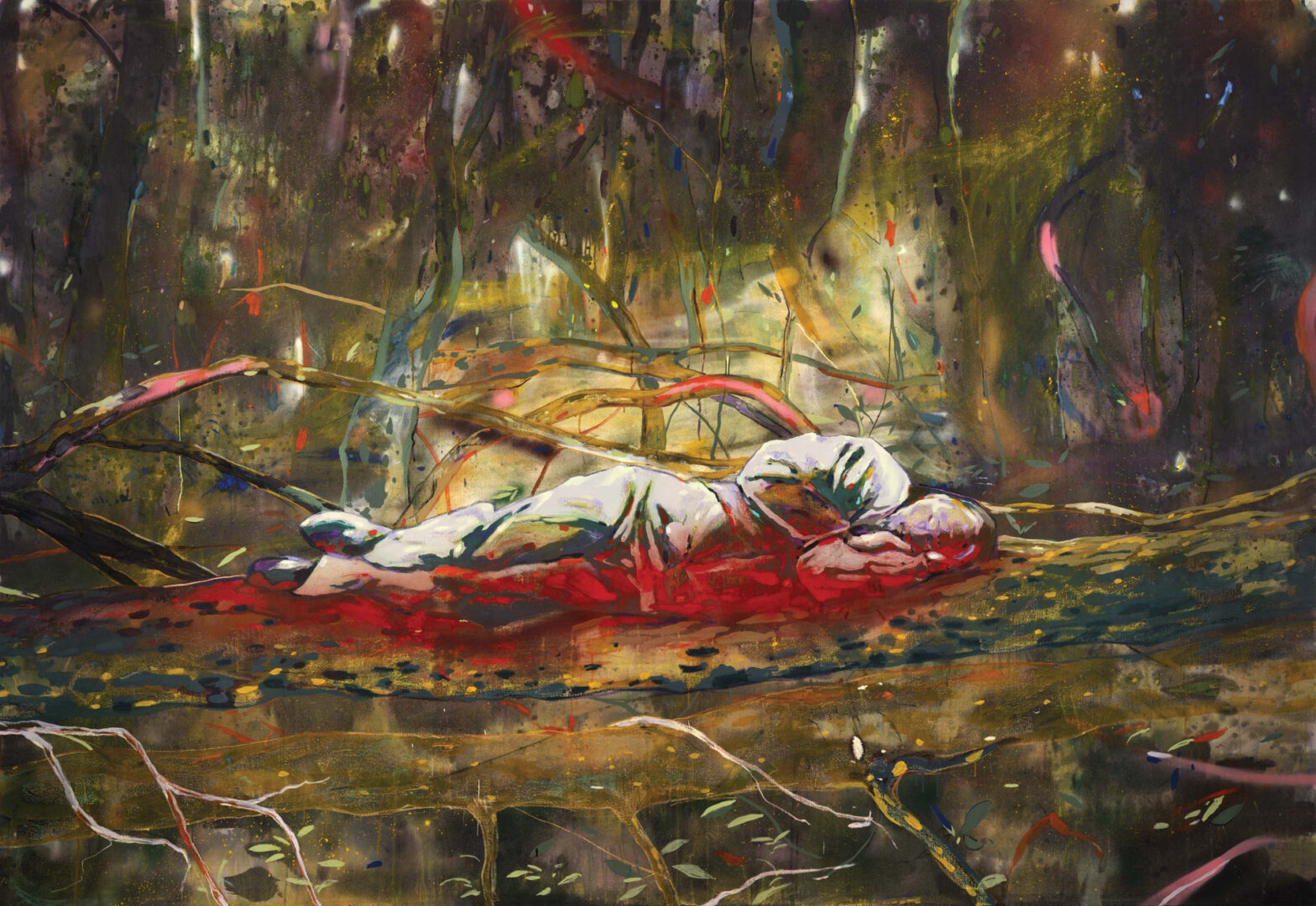
What story should we start from today and what story should we return clients to so that their individual movement is not in deep conflict with the collective one? In this reflection, its author Martin Nawrath is inspired by therapy that is ecocentric.
The text was published in Psychology TODAY 4/2025.
I like stories, myths and fairy tales. This text is a bit of a story, maybe for some it will be more of a fairy tale, but I hope it is not naive and childish. Its title is inspired by David Abram, who is not a psychologist or psychotherapist, but he is definitely a person who is close to stories, especially those that come from the Earth and belong to it. If I were to professionally relate David Abram to the humanities, I would call him a phenomenologist of sensory experience. Most of us who work in therapeutic or helping professions like stories and use them in our practice. In this article I want to highlight the role of our common story on a larger than individual level, as is the ambition of this column.
I especially like stories that are crystal clear. That is, comprehensible in that certain characters and plots can be seen as elements of a crystalline grid, which is fascinating in its complexity and integrity. This does not necessarily mean that they are rectangular or square in terms of story and straightforward and clean; rather, I see the grid as a sphere in which the individual elements are connected by a series of links that relativize the causality of the plot. The fragments are put together only at the end of the story. Only then do we begin to see the whole and its meaning.
What story does therapy live in?
As He shapes us, God speaks to each of us,
then silently walks with us out of the night.
These are the words we hear vaguely:
You, sent for your memories,
Go to the edge of your desire.
Embody me.
Burn like a flame
and cast great shadows in which I may dwell.
Let everything happen to you: beauty and horror.
Just keep moving forward. No feeling is the last.
Don't let me lose you.
Not far away lies the land they call life.
You will know it by its severity.
Give me your hand.
Reiner Maria Rilke
Western-style therapy can be considered a response to the psychological ailments that individuals, couples, and families have experienced and are experiencing, who have not received or are not receiving the saving help of religion, spirituality, or faith. Science has gradually begun to heal not only our physical shell, but also our mental suffering. It has invented and continues to invent hundreds of different methods that are more or less successful. Religions functioned in the same way before, gradually replacing one with another in the hope that the next, more authentic, more current, and more vibrant one will bring the expected salvation or at least a temporary feeling of comprehensive health.
It can be said that it was precisely by defining itself against the dysfunctional, naive or false that the modern era tried to detach itself from religion as the "opiate of humanity" (in the communist story) or as a "collective neurosis" (in the story of psychoanalysis). And this with all the contradictions and tensions with which both stories claimed to be scientific. This tension can perhaps be hidden in a further simplification, in which therapists began to replace the services of clergy to a certain extent and today, psychotherapeutic schools are often inspired by the influences of spiritual teachings. And it is no exception that many clergy have now also added psychotherapeutic education to their skills.
But back to the story. In what broader context did the therapeutic environment develop? I hope you will not object if I summarize it, in a somewhat simplified way, into the story of democratic capitalism brought by the West. The therapist helps the client to return from isolation or exile to the game with knowledge and skills that are adequate for this story. It should be noted that within this framework of the free market world, new methods of “healing the soul” are constantly being born and old methods of “healing the soul” are also functioning – scientific, less scientific and unscientific. However, cracks are increasingly appearing in the story of our democratic capitalism, in which the concept of therapy has developed very viable, which are seriously beginning to disrupt the integrity and functionality of the canvas of the basic plot.
It is not easy to live and admit to ourselves, but if we are honest and informed, we see more and more clearly today that the world was not and is neither democratic nor (in a certain sense) capitalist, i.e. based on the market as an equal and free exchange of services and goods. The only thing that truly unites us globally is the market and the internet, and even that does not apply everywhere, fully and certainly not equally and fairly. Moreover, the much preferred and self-evident story is starting to crumble even in the very cradles of democracy. A wave of leaders still elected democratically, but acting autocratically and even dictatorially is slowly redrawing the map of the world. The impact of social networks and their way of informing and conducting "democratic discussion" plays an increasingly important role in the nature of this democratic election. Within the framework of the capitalist story, it is necessary to recall the role of the owners of these networks, who became (historically speaking) "overnight" the richest people in the world. And we know that in every wealth in fairy tales, there was also hidden power and with it potentially great risk.
The flaws in today's story
To stay true to the framework of this magazine, let's try to honestly summarize where today's story fell apart and how it relates to the story of therapy. The West has behaved and behaves in a superior, powerful and aggressive way in certain respects. And let's transfer it straight to our therapy room. Perhaps there we meet the victims and the originators of this superiority. Those who have and had access to resources and power, as well as those who did not and do not have it. The West and its individuals often, even if indirectly, live from what they have gained at the expense of others. The West has unleashed unimaginable violence, and even if this violence does not currently take the form of a world war, local injustice is everywhere - of course not only because of the West. Abused children and raped women, frustrated subordinates, bankrupt startup founders and emigrants also come to therapy rooms. And recently, more and more, those who have somehow slowly, inconspicuously, but more tangibly lost clean water, air, healthy forests and soil, and someone is offering them a trip to Mars as a cure or at least an endless space of relief in a parallel and really only seemingly democratic police the internet.
Democracy of nature
So if we step out of this story, we may not find ourselves on comfortable ground. Not even as therapists. What story should we start from, what story should we rely on today, what story should we return clients to so that their individual story corresponds to the collective one or at least is not in deep conflict with it?
When I first became acquainted with the psychology of CG Jung, I was professionally fully occupied with ecology. I began to realize how profound a challenge ecology is, and that not everything can be solved in a simple and straightforward way, as was done with freons and the ozone hole in the 1990s. However, even this straightforwardness took about four decades from mapping the problem to the final change! At that time, I also came across an inconspicuous book by director Tomáš Škrdlant Democracy of natureI remember her because back in 1996 she courageously described the challenges our system faces today.
This book, like any good story, does not provide clear instructions, techniques or methods of solution. It is small, thin, grey. It is a hidden or forgotten gem in a pile of more colourful, voluminous and at first glance more understandable titles. It is worth noting that the late Zdeněk Neubauer played an important role in the content and nature of the manuscript. This biologist and also an expert in history, religion, but also Hermeticism, inspired Škrdlant to write a congenial work, which, unlike Neubauer's, is more concise, clear and understandable. What Škrdlant brings is not a guide to solving the world's problems, but as the first chapter already suggests: it is about changing perspective and changing through perspective.
So what is the strength of this book? In short, it describes the nature of the system in the form of key metaphors that are easy to imagine because they are based on images of the natural world. It writes about the nature of fire, flowing water or falling stones, and the book brings these vivid images and events into new contexts, such as the nature of power, the nature of management, decision-making, and therefore the nature of democracy and the free market as the foundations of today's system. Škrdlant and Neubauer then develop the ideas of the book in a somewhat more demanding text that deals with the elemental nature of the world (The Hidden Truth of Earth). But why talk about these books in the context of psychotherapy?
Ecocentric therapy
What Škrdlant and Neubauer offer is not just some narrowly specific and professional ecological treatise. It goes much deeper, namely to the nature of thinking, perception, feeling and intuition, i.e. to the sublime waters of psychology. I deliberately use these four qualities of the psyche according to CG Jung here, because his psychology is in a certain sense elemental. It is based on hermeticism. Jung's understanding of elementality has little to do with how our scientific and technological society physically and unilaterally understands the elements. The language of the elements has the character and form of the language of nature. By immersing ourselves in the elemental nature of language, we are actually nature in the "most elemental" sense. A kind of evidence of matter, its tangible and bodily "reality" is mixed here with a deeper experience of the common, inseparable world of matter and word and also the binding nature of how they belong together. I do not truly become watery just by repeating the word "water". For this to happen, the actual water of my body must rise, including its imaginative part, that is, the water that I see with my inner vision, experience in dreams, and am immersed in in rivers, oceans, and torrential downpours.
But let's try to connect with the world of psychotherapy again. One of the therapeutic directions is Bill Plotkin's path. I mention it because Plotkin himself speaks of his model as something that primarily creates space for discussion. With its careful attention to images, terms and archetypes arising from the natural world, his model is so universal that it is very easy to relate to it. Just as everyone on this planet has a relationship with the Sun or the Moon, light and darkness, we can similarly relate well to the images of the nest, the garden or the spring, to name just three of those that Plotkin uses in his model of eight stages of human development.
And we get to the heart of what a turn to ecological therapy can be important for our common story, for our awakening. Western man has separated himself from nature in his understanding of the world. It is a bit of a hackneyed song, but we still do not fully understand it. If we focus on therapy, then through a series of definitions, terminologies, words and models, our human world has separated itself from natural images, but especially - as David Abram writes deeply about this - with words themselves and especially writing, it has resisted the connection with the natural world, or rather the identification of the natural and human worlds. The world of writing is capable of living without nature, but we as humans cannot.
To be sure, I will immediately dispel the idea that I am presenting models and approaches in which we become savages or animals and somehow abandon humanity, our language, writing and speech, as the title of Abram's latest book might at first seem. Becoming an animal. Neither Plotkin nor other ecotherapeutic or deep ecological trends announce anything like this. The phase of man's separation from the rest of nature is undoubtedly of fundamental importance to his story. It is one of those key events in the crystalline lattice of the story that has not yet ended, and therefore does not yet make complete sense. We give it that meaning, right now and here. Here, somewhere, man recognizes himself, here we are talking about the emergence of consciousness and the moment when evolution offered the universe to see and reflect. However, it seems that the story has shifted today. If we stay with the world of psychotherapy, we return to emotions, the body, the functioning of the brain, the role of hormones, the vegetative system, in short, we discover the world of the body. One could almost say that the body inhabits the world of therapy, and for one simple reason. Without it, there is no way out for the plight of the soul in our time. As Jung says, we do not have a soul, the soul has us. Plotkin's concept of the soul then very strongly rejects the separation of the soul from the body.
Big turn
If we are looking for a relevant story for the West and Western therapy today, it seems that ecocentricity is not some icing on the cake, an interesting complementary technique or some therapeutic novelty. There is a sense of change and awakening in the air. And I would like to point out again: it is not simply a matter of starting to go to the forest with clients from time to time. Ecocentricity shakes the very cornerstone of the existing paradigm, which Plotkin calls egocentric. The answer to a paradigm shift never comes from the fruit, i.e. the cherry, the fruit at the end of the branch, but from the stone, the chestnut, the acorn. The cornerstone. This term also has an ecocentric basis. Everyone understands it with their senses, everyone simply sees it and feels with their own bodies how fundamentally this stone determines the form, quality and strength of the building begun with the stone. It is no coincidence that the New Testament uses it as a symbol of the foundation and stability of the kingdom of God. The apparent enemy of the “true faith”, which is alchemy, also understands it in a similar way. In it, the philosopher's stone is a legendary substance that has the ability to transform base metals into gold and provide the elixir of life, which symbolizes spiritual transformation and enlightenment. It is not for nothing that Jung, at first glance, meaninglessly immersed himself in alchemical images and books. He searched for a language, images and symbols in them that would be more than just a human world and could be supported by something more stable than mere human words. We can understand these and we each understand them in our own way. Is it then possible to formulate a common story using only human language?
Fill in the story
You are certainly missing a lot in this text and story. For example, courageous case studies anchoring the ongoing paradigm shift in the destinies of specific people of this time. More detailed indications of how to participate in this great turnaround. I will not lie to myself or to you that I have such stories behind me. However, there are certainly and will continue to be more and more therapeutic books among us and in literature. I look forward to them, I have confidence in them and I place my hope in them.
I remember one of my clients who was preparing for death due to a serious and incurable form of cancer. We didn't talk much in the last sessions. There were more and more pauses and silences. And although the meetings took place online, from time to time a special power appeared in them. No longer physical in the true sense of the word. It was a kind of power of attitude, the position of the whole body and personality towards death and dying. Even through the monitor, it was clear that these were not phrases, but the deep reality of an almost unreal body. I don't have enough words in the human world for this. Only the memory of my body will never forget this client and her power.
Snow the world
At the seminar I was given an assignment. To find an "unabashedly" wild, authentic, but not human being and have a conversation with it. Unfortunately, I don't have much time, so I take the park as a favor instead of wilder nature. After half an hour I lose patience. To look for spontaneity in the well-trodden paths and arranged tree lines? And suddenly it hits me in the eye. Large areas of the park are filled with snow. It covers the lawns, the trees, and me. I hesitantly ask him what we have in common, where I am him and he is me. I allow myself to become snow more and more. I fill the world with what is mine, I fall wherever my flakes fall. Somewhere I fall, somewhere I stay, somewhere I barely hold on for a second, somewhere I turn into invisible moisture, somewhere I evoke beauty on the branches of sentences, somewhere I am cold and seem intrusive. In the office, my words fall onto the blank white pages of the monitor. The flurry of letters dares to overwhelm you – perhaps to freeze someone, perhaps to get under someone's skin.
Resources
Abram, D. Awakening to the Living Earth. OPS, 2008.
Abram, D. The Magic of the Senses: Perception and Language in a More-than-Human World. DharmaGaia, 2013.
Markos, J. Children, I'm sorry. We also bear some of the blame for the difficult times ahead of us. Respect, online, 02/2025.
Neubauer, Z., Škrdlant, T. The hidden truth of the Earth. Elements as archetypes of ecological thinking. Malvern, 2021.
Plotkin, B. Nature and the human soul. Maitreya, 2014.
Rilke's Book of Hours: Love Poems to God, translated by Anita Barrows and Joana Macy. Riverhead Books, New York 1996.
Skrdlant, T. The Democracy of Nature – an Ecological Game of System Similarities. Original Videojournal, 1996.